Crude oil trading alert: Geopolitical tensions fuel supply-side concerns, driving oil prices higher; awaiting a breakout.
2026-07-22 09:30:15
International crude oil markets continued their rebound on Wednesday, with WTI crude oil prices rising for the second consecutive trading day, briefly approaching $85.50 per barrel during Asian trading hours. This increase was primarily driven by escalating risks to several key global energy transportation routes, with the market refocusing on the risk premium associated with potential disruptions to the crude oil supply chain.  The main supporting factor for the recent crude oil market has not come from improved demand, but from increased uncertainty on the supply side. Market participants believe that as security risks rise along energy transport routes in multiple regions, the fragility of the crude oil supply chain is once again becoming a significant driver of price volatility. The spread of supply risks beyond the Middle East has caused the global crude oil market to re-induce a higher risk premium . In the United States, President Donald Trump stated that the likelihood of negotiations with Iran is currently low and warned that the US would take swift action if the Houthi rebels in Yemen take actions to disrupt commercial shipping in the Red Sea. This statement further exacerbated market concerns about regional shipping security. The Red Sea has long been one of the important alternative routes for global energy transport. For Saudi Arabia, diverting some crude oil to Red Sea ports through domestic pipelines can reduce its dependence on the Strait of Hormuz. However, the security situation in the Red Sea region remains highly uncertain. The recent attack on a Kuwaiti oil tanker carrying petroleum products transiting the Strait of Hormuz serves as a reminder to market participants that major global energy transport nodes still face potential risks. The Strait of Hormuz remains a vital channel for global crude oil transport; the market estimates that approximately one-fifth of global seaborne crude oil supply passes through this region . Any security incident involving this shipping route could quickly impact market sentiment and prompt traders to price in supply disruption risks. Meanwhile, the energy market's focus has expanded beyond the Middle East. Energy export risks in the Black Sea region are being closely watched by investors. The Caspian Pipeline Union (CPC) export terminal on Russia's Black Sea coast, which handles most of Kazakhstan's crude oil exports, was recently attacked by a drone. Continued disruption to related transportation facilities could further restrict the flow of crude oil supply in the international market. Currently, crude oil traders are simultaneously assessing multiple supply risk factors, including shipping security in the Middle East, the stability of Black Sea energy infrastructure, and changes in the export capacity of major oil-producing countries. The combination of multiple supply-side risks has given WTI crude oil renewed upward momentum . However, further price increases still face certain limitations. On the one hand, the global economic growth outlook remains uncertain, with manufacturing activity in major Asian economies and consumer demand in Europe and the US remaining key market focuses; on the other hand, changes in the US dollar index and expectations regarding major central bank monetary policies could also affect demand for dollar-denominated commodities. The market's current focus is on whether supply risks will escalate further in the coming weeks. If Red Sea shipping remains disrupted, or Black Sea export facilities recover slower than expected, crude oil prices may continue to be supported. However, if these risks ease and inventory data show ample supply, the upward momentum in oil prices may gradually weaken. From a daily chart perspective, WTI crude oil recently ended its previous consolidation phase, with prices regaining a foothold above key moving averages, indicating a gradually strengthening short-term trend. Currently, oil prices are trading above $84, with market momentum strengthened by supply risks. Technical indicators suggest that bullish forces are recovering, but the upward momentum may slow as prices approach previous resistance levels. Resistance is seen around $86; a decisive break above this level could lead to a further test of the $87.00 area. Support is initially seen at $82.50, followed by the psychological level of $80.00. Overall, the daily chart still leans towards an upward trend, but the impact of geopolitical risk developments on price fluctuations needs to be monitored. From a 4-hour chart perspective, WTI crude oil has formed a continuous rebound structure, with short-term moving averages gradually trending upwards, and prices maintaining a high-level consolidation range. The MACD indicator shows that bullish momentum has strengthened, but after a short-term surge, there is technical pressure for a pullback. If oil prices can stabilize above $84, the market may continue to attempt to break through the $86 resistance level; if it falls below $82.50, it may retest the support level near $81. Currently, the 4-hour chart shows that the bulls have a certain advantage, but the sustainability of the rise still depends on whether supply risks continue to escalate.
 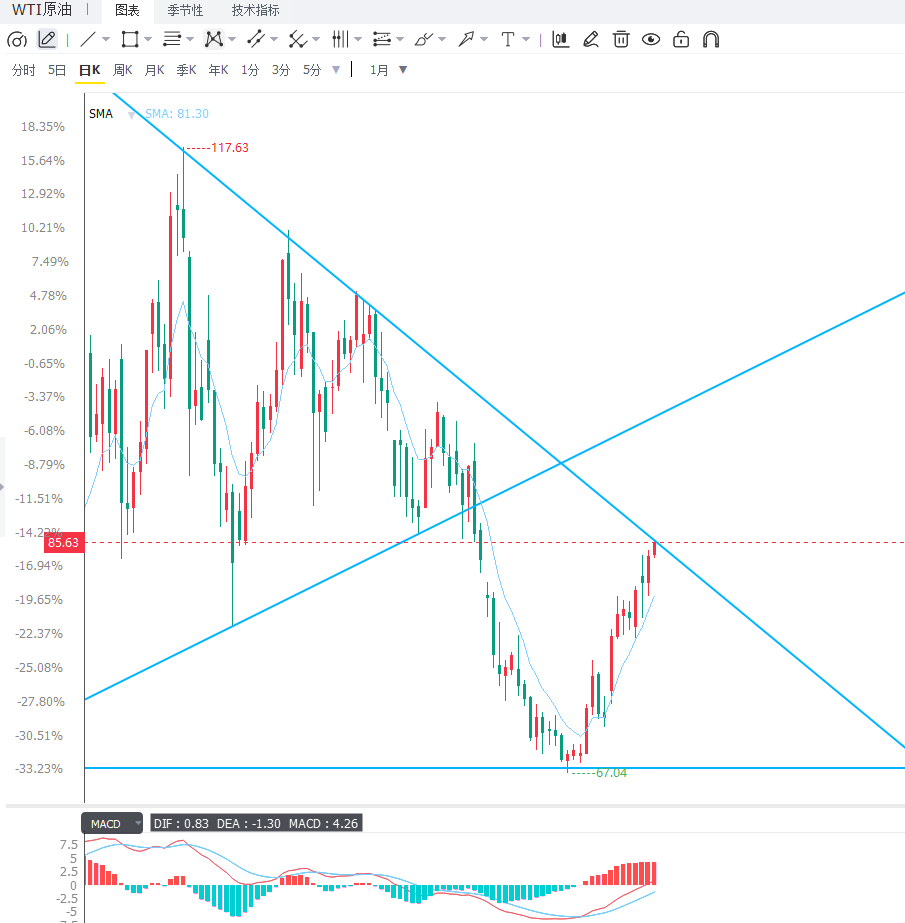 The recent rise in WTI crude oil prices reflects a repricing of supply security concerns in the market. Risks related to energy export facilities in the Red Sea, the Strait of Hormuz, and the Black Sea are simultaneously under scrutiny, maintaining a high risk premium in the crude oil market in the short term. Future oil price movements will depend on whether supply disruption risks escalate and whether global demand can provide further support. In the medium to long term, the energy market is entering a period of high volatility, and investors need to closely monitor the security of major shipping routes, inventory changes, and adjustments to export policies by oil-producing countries. If supply risks continue to escalate, WTI crude oil may continue to challenge higher levels; however, if risks ease, prices may quickly revert to fundamental factors. Therefore, the current market presents both opportunities and risks, and traders need to focus on news-driven price movements.
The main supporting factor for the recent crude oil market has not come from improved demand, but from increased uncertainty on the supply side. Market participants believe that as security risks rise along energy transport routes in multiple regions, the fragility of the crude oil supply chain is once again becoming a significant driver of price volatility. The spread of supply risks beyond the Middle East has caused the global crude oil market to re-induce a higher risk premium . In the United States, President Donald Trump stated that the likelihood of negotiations with Iran is currently low and warned that the US would take swift action if the Houthi rebels in Yemen take actions to disrupt commercial shipping in the Red Sea. This statement further exacerbated market concerns about regional shipping security. The Red Sea has long been one of the important alternative routes for global energy transport. For Saudi Arabia, diverting some crude oil to Red Sea ports through domestic pipelines can reduce its dependence on the Strait of Hormuz. However, the security situation in the Red Sea region remains highly uncertain. The recent attack on a Kuwaiti oil tanker carrying petroleum products transiting the Strait of Hormuz serves as a reminder to market participants that major global energy transport nodes still face potential risks. The Strait of Hormuz remains a vital channel for global crude oil transport; the market estimates that approximately one-fifth of global seaborne crude oil supply passes through this region . Any security incident involving this shipping route could quickly impact market sentiment and prompt traders to price in supply disruption risks. Meanwhile, the energy market's focus has expanded beyond the Middle East. Energy export risks in the Black Sea region are being closely watched by investors. The Caspian Pipeline Union (CPC) export terminal on Russia's Black Sea coast, which handles most of Kazakhstan's crude oil exports, was recently attacked by a drone. Continued disruption to related transportation facilities could further restrict the flow of crude oil supply in the international market. Currently, crude oil traders are simultaneously assessing multiple supply risk factors, including shipping security in the Middle East, the stability of Black Sea energy infrastructure, and changes in the export capacity of major oil-producing countries. The combination of multiple supply-side risks has given WTI crude oil renewed upward momentum . However, further price increases still face certain limitations. On the one hand, the global economic growth outlook remains uncertain, with manufacturing activity in major Asian economies and consumer demand in Europe and the US remaining key market focuses; on the other hand, changes in the US dollar index and expectations regarding major central bank monetary policies could also affect demand for dollar-denominated commodities. The market's current focus is on whether supply risks will escalate further in the coming weeks. If Red Sea shipping remains disrupted, or Black Sea export facilities recover slower than expected, crude oil prices may continue to be supported. However, if these risks ease and inventory data show ample supply, the upward momentum in oil prices may gradually weaken. From a daily chart perspective, WTI crude oil recently ended its previous consolidation phase, with prices regaining a foothold above key moving averages, indicating a gradually strengthening short-term trend. Currently, oil prices are trading above $84, with market momentum strengthened by supply risks. Technical indicators suggest that bullish forces are recovering, but the upward momentum may slow as prices approach previous resistance levels. Resistance is seen around $86; a decisive break above this level could lead to a further test of the $87.00 area. Support is initially seen at $82.50, followed by the psychological level of $80.00. Overall, the daily chart still leans towards an upward trend, but the impact of geopolitical risk developments on price fluctuations needs to be monitored. From a 4-hour chart perspective, WTI crude oil has formed a continuous rebound structure, with short-term moving averages gradually trending upwards, and prices maintaining a high-level consolidation range. The MACD indicator shows that bullish momentum has strengthened, but after a short-term surge, there is technical pressure for a pullback. If oil prices can stabilize above $84, the market may continue to attempt to break through the $86 resistance level; if it falls below $82.50, it may retest the support level near $81. Currently, the 4-hour chart shows that the bulls have a certain advantage, but the sustainability of the rise still depends on whether supply risks continue to escalate. The recent rise in WTI crude oil prices reflects a repricing of supply security concerns in the market. Risks related to energy export facilities in the Red Sea, the Strait of Hormuz, and the Black Sea are simultaneously under scrutiny, maintaining a high risk premium in the crude oil market in the short term. Future oil price movements will depend on whether supply disruption risks escalate and whether global demand can provide further support. In the medium to long term, the energy market is entering a period of high volatility, and investors need to closely monitor the security of major shipping routes, inventory changes, and adjustments to export policies by oil-producing countries. If supply risks continue to escalate, WTI crude oil may continue to challenge higher levels; however, if risks ease, prices may quickly revert to fundamental factors. Therefore, the current market presents both opportunities and risks, and traders need to focus on news-driven price movements.
- Risk Warning and Disclaimer
- The market involves risk, and trading may not be suitable for all investors. This article is for reference only and does not constitute personal investment advice, nor does it take into account certain users’ specific investment objectives, financial situation, or other needs. Any investment decisions made based on this information are at your own risk.