An additional $88 billion in military spending and a focus on underground nuclear facilities have fueled a rapid, one-sided rise in oil prices.
2026-07-22 16:14:16
On Wednesday (July 22), during the Asian and European sessions, international oil prices began another unilateral acceleration upward. Currently, WTI crude oil is trading at $87.48, up 3.7%. Faced with the continuously deteriorating situation in the Middle East, from the threat of a massive nuclear facility deep underground being questioned by US Defense Secretary Hager Syers in Congress, to the flanking efforts to dismantle Iran's proxy network, this conflict is escalating rapidly along a carefully calculated yet highly unpredictable trajectory. Meanwhile, Houthi-controlled forces in Yemen have implemented a maritime blockade in the Red Sea and other related waters, forcing six ships transiting these areas to change course. The closure of the Bab el-Mandeb Strait seems imminent. These factors have provided multiple boosts to international oil prices. 
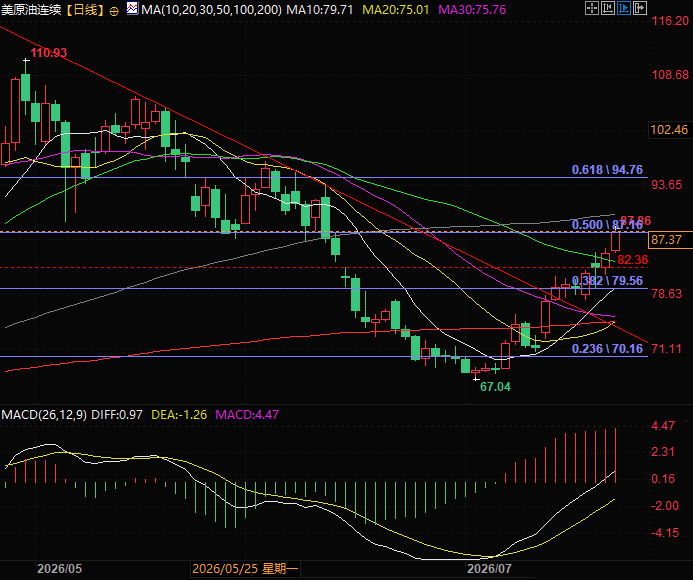 (WTI crude oil futures daily chart) At 16:12 Beijing time, WTI crude oil futures were trading at $87.52 per barrel.
Congressional "Political Tai Chi": The War Bill Behind the Evasive Approach
During the intense questioning by the Senate Appropriations Committee, U.S. Defense Secretary Peter Hegses's performance was a masterful political maneuver. Faced with senators' sharp questions about the "frequent changes in the justification for the war" and "whether it would turn into another indefinite war," Hegses skillfully circumvented the executive branch's legal circumvention of the War Powers Resolution's authorization, forcefully anchoring the core focus on the hard issues of "funding shortfall and national security." The Pentagon updated war spending to a staggering $37.5 billion and urgently pushed for an additional $88 billion in funding (of which $67.1 billion was directly earmarked for operations against Iraq). Hegses presented Congress with a hard choice: either provide the money or bear the consequences of cut-off pay, depleted ammunition depots, and a collapse of military deterrence. This strategy of "binding predetermined military operations to the congressional budget" actually helped the administration secure two of its most core interests: Hagers's congressional inquiry this time will most likely secure the key funds to keep the war machine running, while in effect bypassing the constitutional controversy over the formal authorization to declare war, and completing a disguised renewal of the legality of the war in the form of fiscal appropriations.Maximum Pressure and the "Gaoshan" Gamble: Short-Term Clashes May Escalate Explosively
With tactical coordination and financial planning from the rear, military pressure on the front lines is approaching Iran's ultimate red line. Following the 11th consecutive night of US airstrikes against Iran, Trump has focused his attention on the "Gazelle Hill" underground nuclear facility, deeply embedded in the mountainside. This air defense fortification, 80 to 100 meters deep, is Iran's "ultimate nuclear refuge" built after repeated attacks on its surface facilities. The US military's most powerful GBU-57 bunker buster bomb has a penetration limit of approximately 60 meters. The White House's statement about launching a high-intensity strike on the area suggests that the US military is highly likely to employ extreme tactics such as "continuous bunker busts." However, such tactics are inherently fraught with uncertainty. If the attack fails to penetrate, it will completely expose the upper limit of the US military's conventional strategic strike capabilities, potentially forcing Iran to adhere to its final restraint of "not building nuclear weapons." If the attack penetrates and reaches the core, it could easily trigger an extreme counterattack from Iran's new leadership, turning sporadic conflicts in the Gulf region into a full-scale war."Breaking down the wall on the flank": Red Sea countermeasures and the proxy crisis in Lebanon
While a high-pressure standoff continues on the front lines, a multi-pronged attack and counter-attack against Iran's proxy network is also underway: counterattacks are being launched in the Red Sea and the Gulf; the Houthi rebels in Yemen, supported by Iran, are blocking alternative oil routes to Saudi Arabia, creating a double blockade with Iran's control of the Strait of Hormuz; simultaneously, Iran is using Arash suicide drones to attack US military bases in Jordan and Bahrain, attempting to directly strike US frontline maintenance and logistical support points. Furthermore, the US is attempting to politically "drain" the breeding ground for Iranian proxies. Trump met with Lebanese President Aoun at the White House, publicly supporting the Lebanese government's takeover in the south, even offering the enticing promise of "restoring direct flights between the US and Lebanon after 40 years." The fundamental aim is to induce Lebanon's political landscape to sever ties with Hezbollah by supporting the official government and providing economic incentives, thereby geographically and politically removing Iran's "bow of resistance." Meanwhile, a coalition including Saudi Arabia has pledged to protect the Bab el-Mandeb Strait, making the overall situation extremely tense.The ultimate economic cost: soaring oil prices and a global energy "shock".
All these geopolitical tugs of war, military gambles, and the dismantling of flank bunkers ultimately triggered violent turmoil in the energy market. Shipping data showed that traffic of Very Large Crude Carriers (VLCCs) and liquefied natural gas (LNG) carriers in the Strait of Hormuz plummeted to zero at one point. The simultaneous shutdown of the two golden waterways, the Strait and the Red Sea, completely shattered market illusions of a "quick diplomatic breakthrough." Every high-profile statement from the US military on the front lines and the announcement of the "Hollow Mountain" airstrike fueled the panic in the global energy market. After stabilizing above the $82-83/barrel mark, WTI crude oil prices quickly broke through upwards, restarting a surge; domestic gasoline retail prices in the US also soared to over $4/gallon. This not only pushed domestic inflationary pressures in the US back to their peak and exacerbated voter anxiety ahead of the midterm elections, but also exposed the global economy to the enormous risks of a Great Depression and supply-side shock. Until the smoke clears from the "Gaoshan" conflict, oil prices will remain firmly tied to this highly volatile geopolitical gamble. Technically, as discussed in previous articles, oil prices experienced an island reversal pattern before retracing to fill the gap, and are currently at the near-term target price of $87.16. (WTI crude oil futures daily chart) At 16:12 Beijing time, WTI crude oil futures were trading at $87.52 per barrel.
- Risk Warning and Disclaimer
- The market involves risk, and trading may not be suitable for all investors. This article is for reference only and does not constitute personal investment advice, nor does it take into account certain users’ specific investment objectives, financial situation, or other needs. Any investment decisions made based on this information are at your own risk.