Bomb the ship, bomb the bridge! Trump's tough countermeasures against Iran, gold's resilience despite bearish news reveals important information.
2026-07-22 21:52:17
On Wednesday (July 22), during the European and American trading sessions, gold prices maintained a strong but volatile trend, defying a clear bearish signal. Currently, it is up 1.34% and trading at $4132 per ounce. US President Trump stated that from this moment forward, whenever the Islamic Republic of Iran fires on ships in the Strait of Hormuz, whether by missiles, rockets, drones, or any other equipment or weapon, the US will bomb and destroy a bridge or power plant, including facilities located near or within the capital, Tehran. This public statement on social media continues and escalates the US's previous countermeasures. The temporary ceasefire agreement between the US and Iran, originally intended to ease tensions, has completely collapsed, and bilateral military strikes have entered a phase of normalized escalation. Recently, the geopolitical game between the US and Iran has escalated comprehensively, with military confrontation continuing to intensify, diplomatic negotiations completely stalled, and the navigation crisis in the Strait of Hormuz rapidly escalating. But why isn't the market so panicked? 
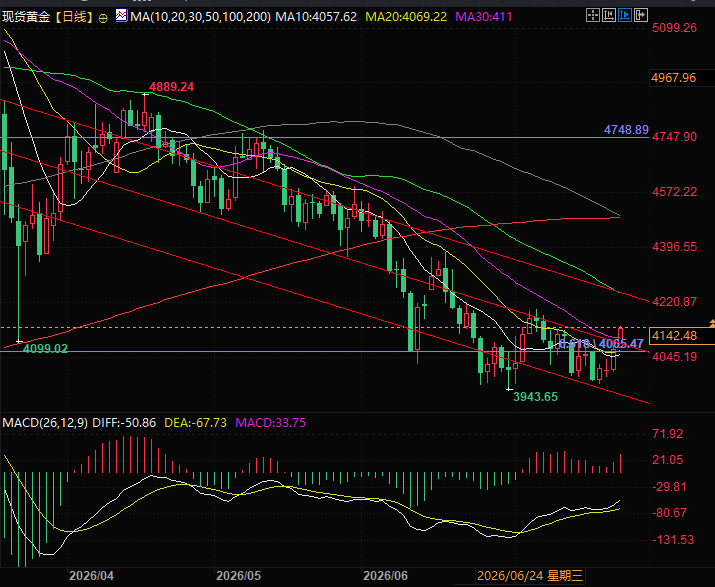 (Spot gold daily chart, source: EasyTrade) At 21:50 Beijing time, spot gold is currently trading at $4146 per ounce.
The US military's combined actions have gradually put Iran in a more subdued position regarding the situation.
Although the standoff and airstrikes in the Middle East continue, judging from the actual trends in the battlefield and geopolitical game, the US military is gradually establishing a comprehensive suppressive momentum against Iran through a series of combined measures, and the extreme risk of the situation spiraling out of control is being effectively contained.Targeting the funding chain precisely to cut off its economic lifeline
The US has moved beyond conventional sanctions, gaining deep insights into the oil tanker network and the underlying financial operations of Khamenei. By precisely targeting and severing Iran's dark web funding chains and oil smuggling routes, the US has fundamentally weakened the economic support for its long-term confrontation.Weakening conventional military forces and targeting the core "Gaoshan" nuclear facility.
While conducting precision strikes against Iranian military hangars, drone bases, and other facilities to weaken its conventional retaliatory capabilities, the US military has precisely focused its strategic attention on the highly concealed "Gazelle Hill" underground nuclear facility south of Natanz. The absolute military deterrent of the US has largely curbed Iran's attempts to escalate the situation to an extreme "nuclear game."Multinational cooperation to control key waterways and break the blockade threat
In response to the threat posed by the Houthi rebels in Yemen to the Red Sea and the Bab el-Mandeb Strait, the U.S. military, in conjunction with a multinational coalition including the UAE, launched a coordinated operation to regain control of key maritime chokepoints such as the Bab el-Mandeb Strait, ensuring that global energy and trade routes are not paralyzed.Additional military budget demonstrates long-term strategic resolve
With the U.S. military further increasing its military spending and logistical investment, the U.S. has demonstrated ample resource reserves and a determination to maintain long-term suppression in its tactical deployments, alleviating previous market concerns that the U.S. military might be hesitant to act or get bogged down in a protracted war of attrition.Market panic is gradually subsiding, and geopolitical premiums are facing a correction.
With the comprehensive intervention and suppression by the US military in terms of funding, military force, shipping lanes, and combat readiness, the evolution of the Middle East situation is shifting from initial "disorder and loss of control" to "controlled competition": Energy premiums have declined: Although crude oil prices had briefly surged, the extreme expectation of a complete disruption of the global energy supply chain has been broken as the risks to navigation in the Bab el-Mandeb and Strait of Hormuz have been substantially reduced, limiting the momentum for further price increases. Inflation and interest rate expectations have stabilized: The loss of momentum for sustained oil price increases has significantly alleviated the Federal Reserve's panic about being forced to maintain high interest rates for an extended period due to a second wave of inflation. Overall, financial markets are not as deeply mired in panic as previously expected, and funds are reassessing the actual impact of the Middle East situation on the global economy and macroeconomic monetary policy.Gold's resilience in the face of negative news suggests signs of a medium- to long-term bottom.
Conclusion: The current US-Iran situation is shifting from "spreading panic" to "marginal control under US military leadership," and overall market panic has significantly subsided. Meanwhile, gold prices are shifting from over-pricing inflation and rising interest rates to a more manageable inflation environment. Conversely, with a weak global economy and the potential for long-term interest rate cuts, gold's role as a hedge against geopolitical risks is beginning to re-emerge after being suppressed by inflation-driven interest rate increases. Currently, if the US-Iran conflict continues to escalate, gold prices also have a logical basis to maintain resilience. Technically, spot gold has consistently held above the 0.618 Fibonacci retracement level of 4065, and subsequently broke through the middle line of the descending channel, potentially breaking the downtrend. Current resistance is at the upper channel line, and support is at the middle channel line. (Spot gold daily chart, source: EasyTrade) At 21:50 Beijing time, spot gold is currently trading at $4146 per ounce.
- Risk Warning and Disclaimer
- The market involves risk, and trading may not be suitable for all investors. This article is for reference only and does not constitute personal investment advice, nor does it take into account certain users’ specific investment objectives, financial situation, or other needs. Any investment decisions made based on this information are at your own risk.