The pound is fluctuating around 1.3365, and the market is trading three possible inflation scenarios.
2026-07-22 21:00:22
On Wednesday, July 22, the UK's Consumer Price Index (CPI) rose 2.6% year-on-year in June, down from 2.8% in May, and only 0.1% month-on-month, the lowest level since the end of 2024. The core CPI remained at 2.6% year-on-year, with service price increases slowing to 3.6% from 3.7%, while goods price increases fell to 1.7% from 2.0%. Transport, food, and non-alcoholic beverages were the main contributors to the decline in inflation, with food prices rising 1.7% year-on-year, significantly lower than May's 2.2%. Following the data release, the pound traded mainly between 1.3360 and 1.3390 against the dollar. 
 The pound sterling is currently facing conflicting pricing factors. Higher UK interest rates and market pricing in a rate hike this year provide some interest rate differential support for the pound; however, as a net energy importer, rising oil and gas prices will increase import costs, compress real income, and increase the risk of an economic slowdown. The market currently expects a high probability of at least one 25 basis point rate hike this year, while also retaining some weight for a second hike. The baseline scenario remains that the Bank of England will maintain the interest rate at 3.75% in 2026, and then cumulatively lower it by 75 basis points to approximately 3% after confirming a sustainable return of inflation to 2% in 2027. However, this path is highly dependent on stable energy prices. If energy prices continue to rise, the market will increase its pricing in two 25 basis point rate hikes; only if energy prices fall significantly will policy discussions likely refocus on economic weakness and future room for rate cuts.
A 2.6% surface cooling rate is insufficient to lift the Bank of England's concerns.
The key point of this inflation data is not the 0.2 percentage point drop in the overall index, but rather that the cooling mainly came from volatile items such as fuel and food. Core inflation did not continue to decline, and service inflation remained at 3.6%, indicating that domestic wages, rents, and labor-intensive industry costs have not yet fully returned to levels matching the 2% target. The Bank of England is currently maintaining its interest rate at 3.75%, with the next policy decision scheduled for July 30. At the June meeting, a 7-2 vote was cast to keep rates unchanged, with two members advocating a 25 basis point increase to 4%. This voting structure is noteworthy because at the February meeting, four members still supported a rate cut, indicating that the policy divergence has shifted from discussing further easing to some members demanding a return to tightening. Therefore, lower-than-expected inflation in June only reduces the urgency of an immediate rate hike and cannot directly justify a rate cut. Monetary policy focuses on whether the energy shock can form a second transmission through wage negotiations, corporate pricing, and inflation expectations, rather than changes in fuel prices in a single month. As long as service inflation remains above 3%, the Bank of England lacks sufficient conditions to quickly adjust its policy stance.The real risk of energy shocks lies in their delayed transmission.
Brent crude oil prices have risen to around $94 per barrel, European natural gas benchmarks have exceeded €62 per megawatt-hour, and UK natural gas prices are approaching 148.75 pence per tsim pm. Over the past month, European natural gas prices have risen by nearly 50%, making energy costs the most volatile variable in the UK's inflation path once again. Societe Generale recently estimated that, based on current crude oil and natural gas forward curves, UK overall inflation may reach nearly 3.5% by the end of 2026, higher than its previous forecast of 3.0%. The government's reduction of VAT on residential electricity prices is expected to lower overall inflation by about 0.1 percentage points, but this is unlikely to fully offset the rise in wholesale energy prices. Energy shocks typically occur in three phases. The first phase is directly reflected in gasoline, diesel, heating oil, and residential energy bills; the second phase enters transportation, packaging, chemical, food processing, and storage costs; and only in the third phase can wage demands and long-term corporate pricing be affected. June data mainly recorded the previous brief decline in energy prices, while the impact of the recent resurgence in crude oil and natural gas prices has not yet fully entered end-user prices. Weak pricing power among businesses may limit the extent to which costs are passed on to consumers, but this does not mean the impact is gone. Some costs may translate into shrinking profit margins, slower hiring, or reduced investment, ultimately affecting the valuation of sterling assets through growth expectations and fiscal revenue.The pound's pricing has entered a tug-of-war between interest rate support and energy drag.
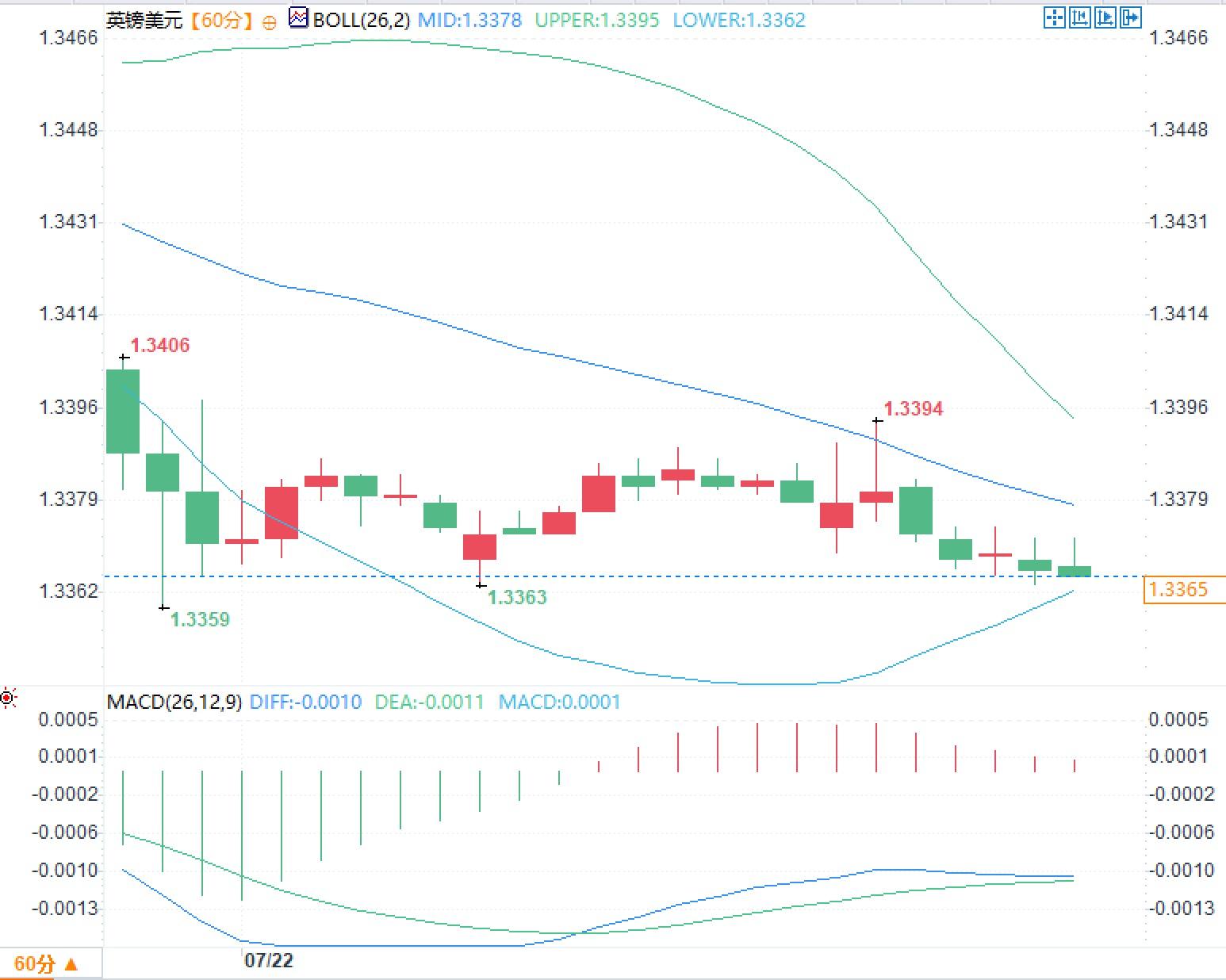
On the 60-minute chart of GBP/USD, the Bollinger Band's middle line continues to slope downwards, and the exchange rate has repeatedly failed to stabilize above the 1.3394-1.3406 area, indicating a lack of continuity in the short-term rebound. The MACD indicator's DIFF is approximately -0.0010, DEA is approximately -0.0011, and the histogram has only slightly turned positive, reflecting a weakening of downward momentum, but the trend reversal signal is not yet sufficient. The pound sterling is currently facing conflicting pricing factors. Higher UK interest rates and market pricing in a rate hike this year provide some interest rate differential support for the pound; however, as a net energy importer, rising oil and gas prices will increase import costs, compress real income, and increase the risk of an economic slowdown. The market currently expects a high probability of at least one 25 basis point rate hike this year, while also retaining some weight for a second hike. The baseline scenario remains that the Bank of England will maintain the interest rate at 3.75% in 2026, and then cumulatively lower it by 75 basis points to approximately 3% after confirming a sustainable return of inflation to 2% in 2027. However, this path is highly dependent on stable energy prices. If energy prices continue to rise, the market will increase its pricing in two 25 basis point rate hikes; only if energy prices fall significantly will policy discussions likely refocus on economic weakness and future room for rate cuts.
- Risk Warning and Disclaimer
- The market involves risk, and trading may not be suitable for all investors. This article is for reference only and does not constitute personal investment advice, nor does it take into account certain users’ specific investment objectives, financial situation, or other needs. Any investment decisions made based on this information are at your own risk.