Crude oil trading alert: Geopolitical tensions are driving risk premiums; oil prices have broken through the downtrend line and are expected to continue rising.
2026-07-23 09:34:18
WTI crude oil prices continued their upward trend in Asian trading on Thursday, rising to around $88.50 per barrel at one point, marking their fifth consecutive day of gains. This rapid rebound in oil prices was mainly driven by escalating tensions in the Middle East, with market concerns about a potential further expansion of supply disruptions prompting the energy market to re-induce geopolitical risk premiums.  Recent market focus has been on the security of key energy transport routes in the Middle East. The US has stated that it may consider targeting related infrastructure if Iran takes further action against shipping activities in the Strait of Hormuz, while Iran has warned of retaliatory measures against regional energy targets linked to the US. Market concerns are growing that the tense relationship could impact crude oil production, transportation, and export capacity, creating new uncertainties for global energy supplies. The Strait of Hormuz's importance has once again been highlighted. This region handles a significant proportion of global crude oil and refined product transportation; severe disruptions to shipping could lead to temporary supply chain disruptions. The market is reassessing the Middle East supply risk premium, pushing WTI crude oil prices back up rapidly to around $87 in the short term . Meanwhile, security concerns regarding shipping in the Red Sea have further exacerbated market anxieties. Market reports indicate that the Houthi rebels, closely aligned with Iran, recently launched missile and drone attacks on two Saudi oil tankers, marking the first direct attacks on tankers in the region. As the Red Sea is a crucial shipping route connecting major Asian powers, Europe, and the Middle East energy markets, increased risks could affect some crude oil transport arrangements and force some shipping companies to increase security costs. Market participants believe that the simultaneous escalation of risks in the Red Sea and tensions in the Strait of Hormuz presents the energy market with a "dual-channel risk." If major shipping routes remain threatened, crude oil prices may continue to be supported. However, investors are also concerned about demand-side pressures; slowing global economic growth and a high-interest-rate environment may still limit further price increases. From the supply side, the market is currently focused on whether oil-producing countries will adjust their production strategies and changes in global crude oil inventories. If geopolitical risks continue to escalate while inventories decline at a faster pace, oil prices may gain further upward momentum. Conversely, if tensions show signs of easing, the current risk premium may fall rapidly, pushing oil prices back to fundamentals. Furthermore, the US crude oil market remains influenced by the dollar's performance and inflation expectations. Recent fluctuations in the dollar index have impacted dollar-denominated crude oil prices. If energy prices continue to rise, the market may reassess global inflationary pressures and influence future monetary policy expectations of major central banks. Currently, investors are closely monitoring developments in the Middle East, the security of crude oil transportation, and US energy inventory data in the coming trading days. If the conflict escalates further, the market may continue to price in supply disruptions; however, if there are signs of improvement in diplomatic channels, the previous gains in oil prices may also face profit-taking pressure. The daily chart for WTI crude oil shows a clear rebound structure after several days of continuous price increases, with short-term moving averages gradually turning upwards, indicating bullish momentum. Currently, oil prices are approaching the $89 area, with resistance at the $89-$90 range. A break above this range could lead to further testing of the $92 resistance level. Support levels are first around $85, followed by the $82.50 area. A break below $85 could indicate a cooling of short-term risk sentiment, leaving room for a price correction. The MACD indicator shows increasing bullish momentum, but after continuous gains, short-term overbought pressure should be watched for. On the 4-hour chart, prices maintain an upward trend, with short-term moving averages providing support, and the RSI indicator remaining in the strong zone, indicating that buying pressure still dominates. However, after continuous gains, the price has widened its distance from the short-term moving averages, suggesting a technical correction is needed. If oil prices can stabilize above $86, there is still a possibility of challenging $89 or even $90; if they fall below $85, they may enter a period of adjustment and retest the support around $83.
 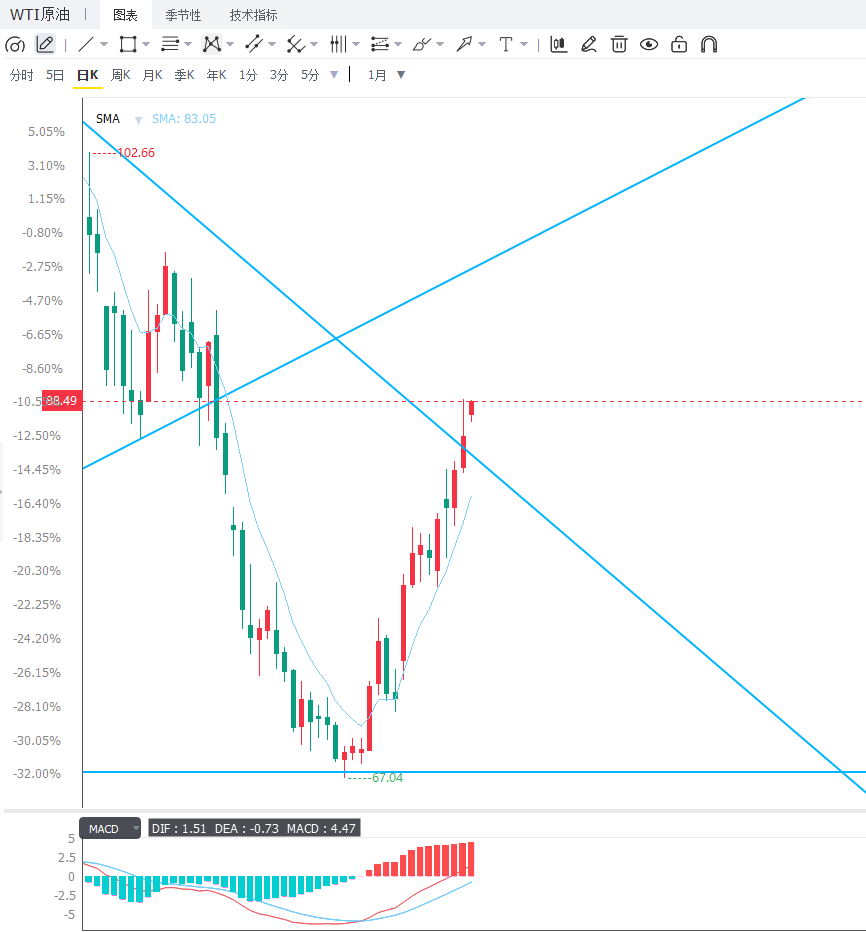 Editor's Summary: The core driver of the current WTI crude oil price increase has shifted from purely supply and demand factors to geopolitical risks. Escalating shipping security issues in the Middle East have refocused market attention on the stability of global energy supply, driving a rebound in risk premiums. In the short term, as long as shipping risks in the Strait of Hormuz and the Red Sea persist, oil prices may maintain a relatively strong trend. However, investors also need to pay attention to the risks of slowing demand growth, inventory changes, and rapid reversals in market sentiment. The future direction of oil prices will depend on whether supply risks escalate further and the ability of major economies to withstand rising energy prices. If supply concerns continue to widen, WTI may challenge the $90 level; if the situation eases, oil prices may return to being driven by fundamentals. Overall, the crude oil market is in a high-volatility phase, with both risk factors and trading opportunities present.
Recent market focus has been on the security of key energy transport routes in the Middle East. The US has stated that it may consider targeting related infrastructure if Iran takes further action against shipping activities in the Strait of Hormuz, while Iran has warned of retaliatory measures against regional energy targets linked to the US. Market concerns are growing that the tense relationship could impact crude oil production, transportation, and export capacity, creating new uncertainties for global energy supplies. The Strait of Hormuz's importance has once again been highlighted. This region handles a significant proportion of global crude oil and refined product transportation; severe disruptions to shipping could lead to temporary supply chain disruptions. The market is reassessing the Middle East supply risk premium, pushing WTI crude oil prices back up rapidly to around $87 in the short term . Meanwhile, security concerns regarding shipping in the Red Sea have further exacerbated market anxieties. Market reports indicate that the Houthi rebels, closely aligned with Iran, recently launched missile and drone attacks on two Saudi oil tankers, marking the first direct attacks on tankers in the region. As the Red Sea is a crucial shipping route connecting major Asian powers, Europe, and the Middle East energy markets, increased risks could affect some crude oil transport arrangements and force some shipping companies to increase security costs. Market participants believe that the simultaneous escalation of risks in the Red Sea and tensions in the Strait of Hormuz presents the energy market with a "dual-channel risk." If major shipping routes remain threatened, crude oil prices may continue to be supported. However, investors are also concerned about demand-side pressures; slowing global economic growth and a high-interest-rate environment may still limit further price increases. From the supply side, the market is currently focused on whether oil-producing countries will adjust their production strategies and changes in global crude oil inventories. If geopolitical risks continue to escalate while inventories decline at a faster pace, oil prices may gain further upward momentum. Conversely, if tensions show signs of easing, the current risk premium may fall rapidly, pushing oil prices back to fundamentals. Furthermore, the US crude oil market remains influenced by the dollar's performance and inflation expectations. Recent fluctuations in the dollar index have impacted dollar-denominated crude oil prices. If energy prices continue to rise, the market may reassess global inflationary pressures and influence future monetary policy expectations of major central banks. Currently, investors are closely monitoring developments in the Middle East, the security of crude oil transportation, and US energy inventory data in the coming trading days. If the conflict escalates further, the market may continue to price in supply disruptions; however, if there are signs of improvement in diplomatic channels, the previous gains in oil prices may also face profit-taking pressure. The daily chart for WTI crude oil shows a clear rebound structure after several days of continuous price increases, with short-term moving averages gradually turning upwards, indicating bullish momentum. Currently, oil prices are approaching the $89 area, with resistance at the $89-$90 range. A break above this range could lead to further testing of the $92 resistance level. Support levels are first around $85, followed by the $82.50 area. A break below $85 could indicate a cooling of short-term risk sentiment, leaving room for a price correction. The MACD indicator shows increasing bullish momentum, but after continuous gains, short-term overbought pressure should be watched for. On the 4-hour chart, prices maintain an upward trend, with short-term moving averages providing support, and the RSI indicator remaining in the strong zone, indicating that buying pressure still dominates. However, after continuous gains, the price has widened its distance from the short-term moving averages, suggesting a technical correction is needed. If oil prices can stabilize above $86, there is still a possibility of challenging $89 or even $90; if they fall below $85, they may enter a period of adjustment and retest the support around $83. Editor's Summary: The core driver of the current WTI crude oil price increase has shifted from purely supply and demand factors to geopolitical risks. Escalating shipping security issues in the Middle East have refocused market attention on the stability of global energy supply, driving a rebound in risk premiums. In the short term, as long as shipping risks in the Strait of Hormuz and the Red Sea persist, oil prices may maintain a relatively strong trend. However, investors also need to pay attention to the risks of slowing demand growth, inventory changes, and rapid reversals in market sentiment. The future direction of oil prices will depend on whether supply risks escalate further and the ability of major economies to withstand rising energy prices. If supply concerns continue to widen, WTI may challenge the $90 level; if the situation eases, oil prices may return to being driven by fundamentals. Overall, the crude oil market is in a high-volatility phase, with both risk factors and trading opportunities present.
- Risk Warning and Disclaimer
- The market involves risk, and trading may not be suitable for all investors. This article is for reference only and does not constitute personal investment advice, nor does it take into account certain users’ specific investment objectives, financial situation, or other needs. Any investment decisions made based on this information are at your own risk.