The US House of Representatives passed a massive defense bill, and the ongoing conflict with Iran continues to fuel the fiscal deficit.
2026-07-23 10:08:15
The US House of Representatives' passage of the massive $1.15 trillion NDAA, coupled with the ongoing conflict with Iran which has increased the fiscal deficit and geopolitical risks, suggests that long-term fiscal sustainability controversies and inflationary pressures may also weaken the US dollar's strong foundation. On Thursday (July 23) during Asian trading hours, the US dollar index rose and then fell back, currently trading around 101.05. The US House of Representatives passed the 2027 National Defense Authorization Act (NDAA) on Wednesday by a narrow margin of 216 votes to 212. Although the bill ultimately passed, the strong dissent within the party has foreshadowed intense competition in subsequent Senate deliberations and negotiations between the two houses. 
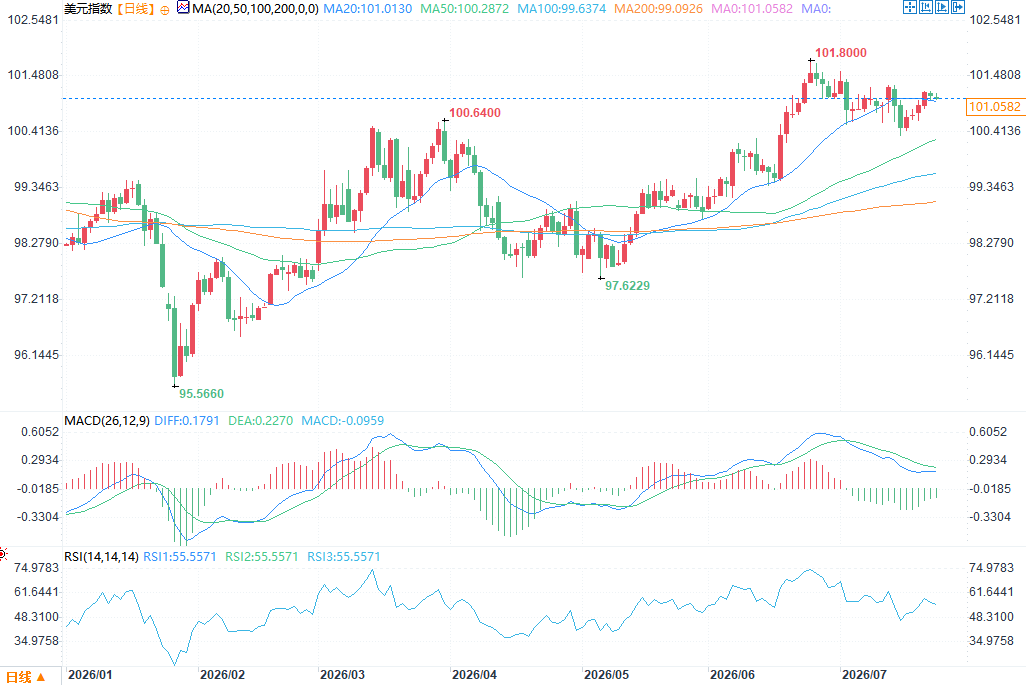 (US Dollar Index Daily Chart, Source: EasyForex) At 10:06 AM Beijing time on July 23, the US Dollar Index was at 101.05.
The staggering $1.15 trillion military expenditure: "National security necessity" versus "sacrifice of social welfare"
The $1.15 trillion in military spending authorized by the NDAA sets a new record for the US defense budget. Republicans emphasize that this funding is crucial to supporting US military operations in Iran and will also be used for defense system research and development, equipment procurement, and personnel welfare. With the conflict in Iran lasting nearly five months, the Pentagon has confirmed that the conflict has cost $37.5 billion. The urgent need for frontline supplies, ammunition depletion, and troop rotation has become the core argument for Republicans pushing for this massive appropriation. However, Democrats point to a logical paradox—while the Trump administration and its Republican colleagues are drastically cutting social welfare spending, the Pentagon is being given an "unlimited check." This contrast is particularly sensitive with the election approaching, and Democratic lawmakers question whether there should be a choice between national security and public welfare. In the House vote, only six Democrats voted in favor, while opponents included almost the entire Democratic Party, demonstrating widespread opposition within the party to this level of spending.The Iran conflict – an “unpopular conflict” becomes a political burden
What truly ignited the Democratic opposition was the ongoing conflict in Iraq. This military operation, which began with the joint US-Israeli airstrikes on February 28, has triggered a chain reaction in the Strait of Hormuz and the Red Sea region, severely impacting the global energy supply chain. The Pentagon's $37.5 billion bill for the conflict represents only the confirmed direct expenditures so far; as the conflict drags on, the final figure will rise significantly. For the Democrats, this conflict is not only costly but also faces increasing public pressure. Since the outbreak of the conflict, anti-war sentiment in the United States has continued to rise, especially the spillover effects of the conflict on oil prices and domestic inflation, which have already been felt acutely by ordinary voters. The collective vote of Democratic lawmakers against the conflict is both a rejection of the conflict policy and a preemptive response to the political climate of an election year.Israel Clause – A Test of Alliances Under the Shadow of Gaza
Another controversial clause in the bill is the plan to significantly expand military-technical cooperation between the United States and Israel. Supporters argue that strengthening US-Israel defense cooperation is a necessary measure to maintain the strategic order in the Middle East. However, Democrats point out that, given the large number of Palestinian civilian casualties caused by Israel's military operation in Gaza, expanding military cooperation with Israel at this time is inappropriate both morally and politically. In recent years, calls to reduce support for Israel have been growing in the United States, especially among young voters and progressives, where criticism of Israel's Gaza policy has become the mainstream narrative. This clause in the NDAA is tantamount to detonating a political bomb within the Democratic Party—touching both fundamental differences in foreign policy and sensitive nerves regarding mobilization during the election.A Look Ahead at the Legislative Process – Senate Battle Imminent, the Road to Negotiations Facing Numerous Challenges
Each year, after the House of Representatives and the Senate pass their respective versions of the National Defense Authorization Act, negotiators from the two houses' Armed Services Committees must negotiate and finalize a compromise version before submitting it to both houses for a vote. If the compromise version passes Congress, the bill is sent to the White House for Trump's signature or veto. The 216-212 vote in the House version this time foreshadows an exceptionally difficult negotiation process. The Senate version has not yet begun its review, and the Democrats hold leverage in both houses to veto controversial clauses. The three major points of contention—authorization for the Iran conflict, expansion of military cooperation with Israel, and the cap on total military spending—will undoubtedly become the focus of the negotiations. While the White House has expressed support for increased defense spending, its position on specific clauses remains unclear, and the involvement of the executive branch may further complicate the legislative process.Summary: Record military spending reflects the dual divide in US domestic and foreign policies.
The hard-won passage of the $1.15 trillion National Defense Authorization Act in the House of Representatives is far more than a simple budget vote; it is a concentrated reflection of the triple rifts in American foreign policy, military strategy, and domestic politics. Externally, the conflicts with Iran and Gaza are testing America's alliance system and moral stance in the Middle East; domestically, the zero-sum game between military spending and social welfare will continue to tear apart both parties and their respective internal camps throughout the election campaign. Although the bill narrowly escaped the House hurdle, the differences are far from being bridged, and the struggle continues on the road to its final signing into law. (US Dollar Index Daily Chart, Source: EasyForex) At 10:06 AM Beijing time on July 23, the US Dollar Index was at 101.05.
- Risk Warning and Disclaimer
- The market involves risk, and trading may not be suitable for all investors. This article is for reference only and does not constitute personal investment advice, nor does it take into account certain users’ specific investment objectives, financial situation, or other needs. Any investment decisions made based on this information are at your own risk.