Trump's threat to "attack ships or blow up bridges" ignites a crisis in the Middle East's two straits, sending international oil prices to a six-week high.
2026-07-23 09:36:14
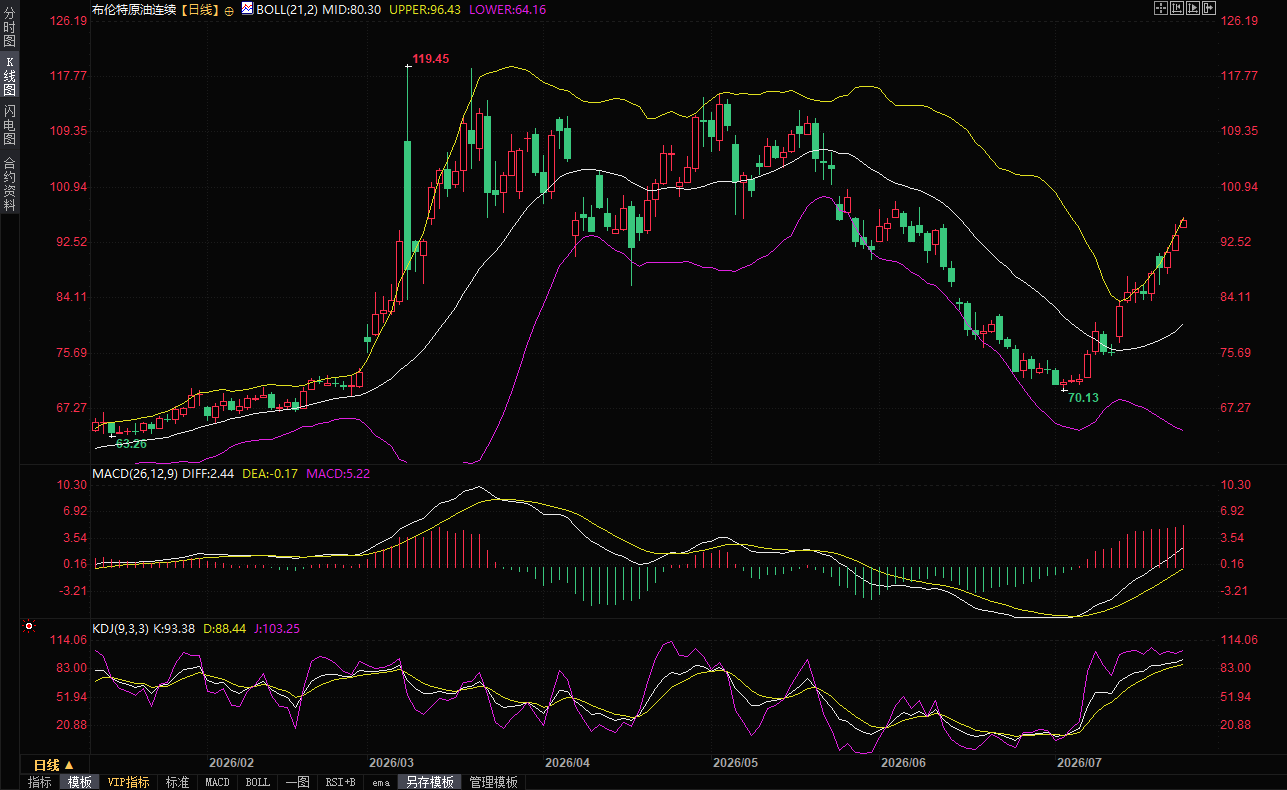
International crude oil futures prices surged on Wednesday (July 22), driven by a confluence of geopolitical risks and tightening fundamentals. London Brent crude oil futures for September delivery rose $3.06, or 3.36%, to settle at $94.07 a barrel, after hitting a high of $95.47 during the session, the highest level since June 11. US West Texas Intermediate (WTI) crude oil futures for September delivery rose $2.49, or 2.95%, to settle at $86.83 a barrel. The three-month Brent crude oil spread widened to $9.26 a barrel, the largest increase since May 22, with the backwardation further widening, reflecting strong market expectations of tight short-term supply. In early Asian trading on Thursday (July 23), oil prices continued their upward trend, with Brent crude briefly breaking through $96 a barrel, reaching a near six-week high of $96.40 a barrel by 9:30 AM. 
Trump's threat to "attack the ship or blow up the bridge" escalates
The immediate trigger for this round of oil price surge stems from the latest military threat issued by US President Donald Trump against Iran. On July 22, Trump stated explicitly on social media: "From this moment forward, whenever Iran fires at ships in the Strait of Hormuz, whether with missiles, rockets, drones, or any other device or weapon, the United States will bomb and destroy one of Iran's bridges or power plants, including facilities located near or within the city of Tehran." This statement marks a significant increase in the geographical precision of the US threat—from a general reference to Iranian infrastructure to the exact coordinates of Tehran's urban area. The day before, Trump had publicly stated that the US would "soon" strike Iran's underground nuclear facility at Ghazan, and that it would be "very powerful."Iran responds strongly: blockade of the Strait and fuel cut-off in retaliation
In response to the US threats, Iran issued a strong statement. Iranian Foreign Minister Araqchi emphasized on social media on the evening of July 22 that any attack on Iranian infrastructure would provoke a "resolute, forceful, and decisive" response, and that any party involved in or supporting such attacks would be considered a legitimate target. The Central Headquarters of the Iranian Armed Forces, Hatem Anbia, stated on the same day that if the US acted on its threats, Iranian forces would block oil exports from the Middle East and target the region's oil, gas, electricity, and economic infrastructure. The Iranian Islamic Revolutionary Guard Corps issued a statement on July 23 claiming control and a "complete blockade" of the Strait of Hormuz, prohibiting any oil tankers from entering or leaving the region while the US continues its "provocations" in the area. Iranian Parliament Speaker Ghalibaf stated on July 22 that the situation in the Strait of Hormuz would not return to its pre-war state, stating that the logic of this war is "either everyone has it, or nobody has it."The attack on the oil tanker continues to escalate.
Escalating geopolitical tensions have been accompanied by a series of maritime clashes. On July 22, the UK's Maritime Trade Operations Centre reported that an oil tanker was hit by an unidentified projectile approximately 70 nautical miles southwest of Al Shuqaiq, Saudi Arabia, causing a fire on board. On July 23, Iran's Islamic Revolutionary Guard Corps stated that three oil tankers, "incited by the United States," were blocked while attempting to pass through a mine-strewn channel south of the Strait of Hormuz; one exploded and caught fire, while the other two returned to port. Meanwhile, the Houthi rebels in Yemen, allied with Iran, opened a new front in the Red Sea. Early on July 23, the Houthis announced that they had attacked two Saudi oil tankers in the Red Sea using ballistic missiles, cruise missiles, and drones for violating their embargo. Maritime safety reports confirmed that one of the Saudi-flagged tankers had been attacked in the Red Sea. This "dual-strait crisis"—with both the Strait of Hormuz and the Bab el-Mandeb Strait facing navigational risks simultaneously—further exposes the vulnerability of the global energy supply chain.US forces launched strikes for the 12th consecutive night.
U.S. Central Command announced on social media on July 22 that the U.S. military launched a new round of strikes against Iranian military targets at 5:30 p.m. Eastern Time (5:30 a.m. Beijing Time on July 23). This marks the 12th consecutive night of U.S. military action against Iran. The U.S. military stated that this operation will continue to weaken Iran's ability to threaten commercial shipping in the relevant waters. U.S. Central Command reiterated that "Iran does not control the Strait of Hormuz," and stated that since the reimposition of the naval blockade against Iran on July 14, it has forced nine merchant ships to change course and one merchant ship to lose its navigation capability. U.S. Secretary of State Marco Rubio stated explicitly on the same day that the U.S. military will continue its attacks as long as Iran attempts to control shipping traffic.Tightening fundamentals coexist with an unexpected increase in inventory.
Beyond geopolitical risks, the fundamentals of the US crude oil market are also tightening. Data from the US Energy Information Administration (EIA) shows that for the week ending July 17, US commercial crude oil inventories increased by 2 million barrels to 411.7 million barrels, 6% lower than the five-year average. This data contrasts sharply with market expectations—analysts had previously predicted a decrease of approximately 1.1 million barrels. The unexpected increase in inventories was mainly due to a slowdown in refinery activity: US refinery crude oil processing fell by 58,000 barrels per day last week, refinery utilization rates dropped slightly to 96.1%, crude oil exports decreased while imports increased. However, in Cushing, Oklahoma, the WTI futures delivery point, inventories decreased by 674,000 barrels to 19.4 million barrels, already below the market's perceived minimum operating level of approximately 20 million barrels. Cushing inventories continue to decline, approaching the lower limit of operating levels, meaning that the spot price discovery mechanism will be more susceptible to marginal supply and demand changes. US crude oil production fell from record highs last week, further weakening the buffer capacity of domestic supply. Regarding refined product inventories, gasoline inventories increased by 765,000 barrels to 211.3 million barrels, while distillate fuel inventories increased by 1.4 million barrels to 109.6 million barrels. Gasoline inventories are 7% below the five-year average, and distillate fuel inventories are 10% below the average.Market Outlook: Double Risks Resonating
In its latest report, HSBC stated that the recent rebound in oil prices reflects renewed concerns about the Strait of Hormuz following the breakdown of the US-Iran ceasefire, and future trends depend on whether diplomacy can restore predictable shipping traffic. Kim Fustier, senior global oil and gas analyst at HSBC, noted, "The core issue remains unresolved: who manages the passage and how?" Goldman Sachs issued a more severe warning: if shipping disruptions in the Strait of Hormuz continue to worsen, Brent crude prices could rise above $120 per barrel in the fourth quarter. However, Goldman Sachs' baseline scenario remains a gradual easing of tensions in the Middle East, with Brent crude averaging $80 per barrel in the fourth quarter. Currently, global energy transport faces "dual-strait risks" from the Strait of Hormuz and the Bab el-Mandeb Strait. The EU naval escort mission Aspides stated that the risk of attacks by Houthi rebels on ships linked to Israel, the US, or Saudi Arabia has significantly increased. Several Asian refiners have begun planning to load crude oil at Yanbu port in Saudi Arabia, transporting it via the Suez Canal or around Africa to Asia to reduce shipping risks.Editor's Summary
Brent crude oil broke through $96 and WTI crude oil briefly reached $88, both hitting six-week highs. This surge is driven by the combined effects of the escalating US-Iran conflict and the pressure on the global energy supply chain. Trump's threat to "attack ships or blow up bridges" targets Tehran, while Iran responded with a "complete blockade" of the Strait of Hormuz and threats to cut off regional oil exports. Neither side shows any sign of backing down. The Houthi rebels have opened a new front in the Red Sea, putting both the Bab el-Mandeb Strait and the Strait of Hormuz at risk of obstruction. This has plunged approximately one-fifth of the world's oil shipments through these critical waterways into unprecedented uncertainty. On the supply side, Cushing inventories are nearing their operating floor, and US production has declined from record highs, providing independent support for fundamentals. Although commercial crude oil inventories unexpectedly increased by 2 million barrels last week, overall inventories remain below the five-year average. Goldman Sachs warned that Brent crude could break $120 if the situation continues to deteriorate, while HSBC emphasized that the core issue lies in the ownership of the shipping lanes. In the short term, geopolitical premiums remain the core variable driving oil prices, and any diplomatic breakthrough or escalation of conflict will trigger a sharp market reaction.Frequently Asked Questions
Q1: Why did Trump's threat to "attack ships or blow up bridges" trigger such a sharp reaction in oil prices? A: The Strait of Hormuz is the world's most important oil shipping chokepoint, with approximately one-fifth of global oil shipments passing through it. The key to Trump's threat lies in the significantly increased geographical precision—from broadly referring to Iranian infrastructure to specifying "facilities near or within Tehran." This means the US strike target could expand to infrastructure in Iran's core areas, significantly increasing the probability of escalation. The market interprets this as a signal that the US-Iran confrontation has entered a new phase, thus driving up geopolitical premiums. Q2: What is the actual impact of Iran's threat to "completely blockade" the Strait of Hormuz? A: The Iranian Islamic Revolutionary Guard Corps has explicitly announced its control and "complete blockade" of the Strait of Hormuz, prohibiting any oil tankers from entering or leaving without Iranian coordination. Iranian Parliament Speaker Ghalibaf further stated that the situation in the strait "will not return to the pre-war state," emphasizing that "either everyone has it, or nobody has it." If the blockade continues, approximately 17 million barrels of Gulf crude oil exports per day will face the risk of disruption, which is enough to drive a significant increase in oil prices. Goldman Sachs predicts that Brent crude could break through $120 in the fourth quarter if the disruption continues. Question 3: Why didn't the unexpected 2 million barrel increase in US crude oil inventories suppress oil prices? Answer: EIA data shows that commercial crude oil inventories increased by 2 million barrels to 411.7 million barrels in the week ending July 17, while the market had previously expected a decrease of 1.1 million barrels. The increase in inventories was mainly due to decreased refinery utilization and reduced exports. However, this negative factor was offset by two factors: first, Cushing delivery point inventories decreased by 674,000 barrels to 19.4 million barrels, already below minimum operating levels; second, overall inventories are still 6% lower than the five-year average. The dominant role of geopolitical risks outweighed the short-term disturbances in inventory data. Question 4: What impact will the Houthi attacks in the Red Sea have on oil prices? Answer: On July 23, the Houthi rebels announced attacks on two Saudi oil tankers in the Red Sea, meaning that global energy transportation faces a "dual-strait crisis"—the Strait of Hormuz and the Bab el-Mandeb Strait are simultaneously threatened. The Bab el-Mandeb Strait, the southern entrance to the Red Sea, is a crucial waterway connecting Asia and Europe. The simultaneous risk to navigation in these two critical waterways significantly increases the vulnerability of the global energy supply chain, forcing tankers to divert routes, increasing transportation costs and time, and further pushing up oil prices. Question 5: What key variables will determine the next move in oil prices? Answer: In the short term, oil price movements mainly depend on three variables: first, whether US-Iran diplomacy can resume—HSBC points out that the core issue lies in the ownership of the passageway; second, the sustainability and intensity of US military strikes—the US has launched strikes against Iran for 12 consecutive nights; and third, the actual navigation status of the Strait of Hormuz—current shipping volume has shrunk significantly. Goldman Sachs' baseline scenario is a gradual easing of tensions in the Middle East, with Brent crude averaging $80 in the fourth quarter; however, in an extreme scenario where the strait is disrupted, oil prices could exceed $120. At 09:33 Beijing time, Brent crude is currently trading at $96.10 per barrel.- Risk Warning and Disclaimer
- The market involves risk, and trading may not be suitable for all investors. This article is for reference only and does not constitute personal investment advice, nor does it take into account certain users’ specific investment objectives, financial situation, or other needs. Any investment decisions made based on this information are at your own risk.