Silver prices paused after four consecutive days of gains, amid a tug-of-war between safe-haven buying and expectations of interest rate hikes.
2026-07-23 10:50:16
On Thursday (July 23) during the Asian session, spot silver, after hitting a new high of $60.89 per ounce since July 13, saw a slight pullback and is currently trading around $59.50 per ounce. Although the Middle East conflict has pushed up oil prices, exacerbated inflation concerns, and strengthened market expectations for further interest rate hikes by the Federal Reserve—a combination that typically weighs on silver, a non-interest-bearing asset—a stronger market force is currently at play: escalating geopolitical risks are causing institutional capital to withdraw from the stock market and flow into tangible safe-haven assets such as silver. In the struggle between the "interest rate hike headwind" and the "safe-haven tailwind," the latter is temporarily dominating the direction of silver prices. 
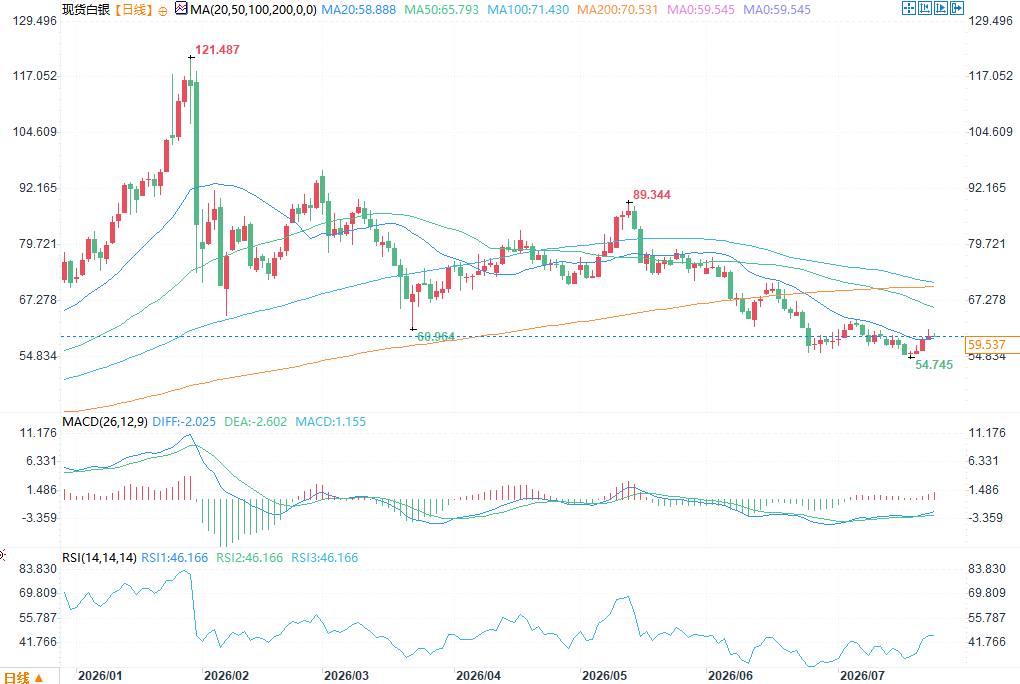 (Spot silver daily chart, source: EasyForex)
The Middle East powder keg ignites safe-haven demand – the Strait of Hormuz and the Red Sea are in crisis.
The recent deterioration of the situation in the Middle East has exceeded market expectations. Following their military strikes, the US and Iran have issued stern threats to each other. US President Trump downplayed the possibility of immediate negotiations with Tehran, while the Houthi rebels continue to threaten to disrupt shipping routes in the Red Sea. Trump pledged on Tuesday that he would respond if the group interfered with the waterways, but did not specify concrete action plans. More significantly, Iran's top military command stated through official channels that if the US attacks Iranian nuclear facilities, Tehran will expand its strikes to target all US and allied assets in the region. This statement suggests that the conflict could escalate from a dual blockade of the Strait of Hormuz and the Red Sea to a full-scale confrontation covering the entire Middle East. From the perspective of silver's safe-haven properties, the driving logic of this round of buying differs from previous ones. Past safe-haven buying was mostly triggered by sudden events and was relatively short-lived. However, the current situation presents a multi-layered risk structure of "threats to two shipping chokepoints + nuclear facility disputes + spillover effects from proxy conflicts," making institutional demand for safe-haven assets more persistent. Silver, as a special commodity combining the safe-haven attributes of precious metals with anticipated demand from industrial metals, has received dual support in this environment.Rising Interest Rate Hike Expectations: The Market Pricing Paradox of Inflation Transmission and Policy Black Window
Parallel to the risk-averse logic is the continuously rising expectation of interest rate hikes. The Middle East conflict has driven up oil prices, and the rise in energy prices is transmitting to broader inflation. Federal Reserve Chairman Warsh has repeatedly emphasized recently that inflation remains the central bank's core concern. This cautious stance has been echoed by several Fed officials in recent weeks. Policymakers are now in the customary pre-FOMC meeting quiet period. At next week's policy meeting, the market widely expects the central bank to maintain the federal funds rate unchanged. However, market policy expectations go far beyond this—the CME FedWatch tool shows that traders are currently pricing in a greater than 71% probability of at least a 25 basis point rate hike at the September meeting. This constitutes a market pricing "paradox": silver prices have risen continuously against the backdrop of a greater than 70% probability of a rate hike, seemingly violating traditional pricing logic. But a deeper interpretation is that the market is pricing in a scenario where "interest rate hikes cannot effectively curb inflation"—geopolitical shocks push up energy prices from the supply side, the transmission efficiency of monetary policy is already limited, and massive fiscal spending (US$1.15 trillion NDAA) further offsets the tightening effect. In this environment, silver's anti-inflationary properties are actually strengthened by expectations of interest rate hikes.The core logic of bullish and bearish forces – who will dominate the direction in the next stage?
Silver prices are currently hovering around the key psychological level of $59-60/ounce, with both bullish and bearish arguments fully expressed, resulting in a highly sensitive equilibrium in the market. The core of the bullish argument is that the ongoing and unpredictable nature of the Middle East conflict means safe-haven demand will not subside quickly. The dual blockade of the Red Sea and the Strait of Hormuz directly impacts the global energy supply chain, and high oil prices are pushing up inflation expectations. Simultaneously, the trend of institutional investors withdrawing from the stock market and shifting to physical assets is accelerating. If Iranian nuclear facilities are attacked, the conflict will escalate significantly, potentially pushing silver prices above $60 and opening up further upside potential. The core of the bearish argument is the continued rise in interest rate hike expectations, which will increase the opportunity cost of holding non-interest-bearing assets. CFTC positioning data shows that speculative net long positions are already at a high level; any sign of easing tensions could trigger a rapid pullback as long positions are liquidated. Furthermore, if the Federal Reserve raises interest rates as expected in September and signals further tightening, a stronger dollar will directly suppress silver prices. The balance between bulls and bears hinges on a key variable: whether the situation in the Middle East continues to deteriorate or experiences a temporary easing. If the conflict maintains its current intensity, silver prices are expected to stabilize above $60 and move towards the $62-$65 range; however, if there are substantial signs of a ceasefire or a diplomatic breakthrough, silver prices may quickly retreat to the $55-$57 range.Technical Analysis – $60 Mark Becomes a Key Watershed
From a technical perspective, spot silver has closed higher for four consecutive days, indicating strong short-term momentum. The current price is just a step away from the psychological and technical significance of the $60/ounce level. This level is both a psychological and technically important one – it's a psychological barrier and a resistance zone that has been tested multiple times since 2026. If silver prices effectively break through $60 and close above this level for two consecutive days, it will confirm the continuation of the medium-term upward trend, with upside targets at $62.00 and $65.00. Conversely, if prices encounter resistance and fall back, the support levels to watch are $57.50 (the previous breakout level) and $58.89 (near the 20-day moving average). (Spot silver daily chart, source: EasyForex)Silver prices have entered a tug-of-war between "safe-haven premium" and "interest rate hike discount".
Spot silver is currently at a sensitive juncture where multiple macroeconomic forces converge. The escalating geopolitical risks in the Middle East provide a solid safe-haven foundation for silver prices, while inflationary expectations stemming from oil prices reinforce the allocation logic of silver as a hard asset. However, the FedWatch tool shows an over 70% probability of a September rate hike, meaning that the downward pressure on non-interest-bearing assets from rising interest rates has not disappeared, but is merely temporarily masked by risk aversion in the current environment. Over the next week to month, the direction of silver prices will heavily depend on two main themes: first, the actual evolution of the Middle East situation—an escalation of conflict would lead to a break above $60 and further upward movement, while a de-escalation would trigger profit-taking; second, the policy signals from the Federal Reserve after the FOMC meeting—if Warsh reiterates inflation concerns and strengthens expectations of a September rate hike, the upside potential for silver prices will be substantially compressed. The battle between bulls and bears has entered a heated phase, and the outcome of the struggle around the $60 mark will determine the direction and tone of silver prices in the next stage. At 10:49 AM Beijing time on July 23, spot silver was trading at $59.71 per ounce.- Risk Warning and Disclaimer
- The market involves risk, and trading may not be suitable for all investors. This article is for reference only and does not constitute personal investment advice, nor does it take into account certain users’ specific investment objectives, financial situation, or other needs. Any investment decisions made based on this information are at your own risk.