Japanese fiscal concerns weighed on the yen, with the USD/JPY pair consolidating around 163.
2026-07-23 11:12:17
The dollar edged lower against the yen in early Asian trading on Thursday, trading around 163.10, but the yen remained weak overall, near multi-year lows. The foreign exchange market is currently trading on domestic fiscal risks in Japan, changes in Bank of Japan policy, and shifts in global risk aversion, keeping the dollar/yen pair highly volatile.  One of the key reasons for the recent continued pressure on the yen is market concerns about Japan's fiscal situation. The high level of Japanese government debt and uncertainty surrounding fiscal policy have weakened market confidence in yen-denominated assets. Against the backdrop of a relatively strong US dollar, the yen has faced significant pressure, pushing the USD/JPY exchange rate to remain high for an extended period. However, recent signals of a policy shift from the Bank of Japan (BOJ) have provided some support for the yen. The BOJ previously ended its long-term easing policy framework and raised its policy rate to 1.0% in June. Some officials have recently hinted that if the economic and inflationary environment meets expectations, further normalization of interest rates is possible. Market interest rate data shows that investors are increasing their bets on further BOJ rate hikes. The current overnight index swap market indicates an approximately 84% probability of a BOJ rate hike at its October meeting, up from approximately 72% previously . This change reflects a market reassessment of Japan's monetary policy path, providing some short-term buying support for the yen. Meanwhile, the Japanese government remains highly vigilant regarding abnormal fluctuations in the foreign exchange market. Finance Minister Satsuki Katayama stated on Wednesday that the government is prepared to take "appropriate and bold action" and emphasized that its stance on foreign exchange intervention remains unchanged. If the yen continues to depreciate rapidly, leading to increased import costs, Japanese authorities may increase verbal intervention or even take concrete measures to stabilize the exchange rate. Market participants believe that the key variable for USD/JPY currently lies in the interplay between expectations of Bank of Japan policy and the risk of government intervention. If the Bank of Japan continues to send hawkish signals, and the market believes the Japanese government may take action, the yen may gain momentum for a short-term rebound. On the other hand, escalating tensions in the Middle East may still support the dollar in the short term. Recent escalation of regional tensions has led to safe-haven flows into dollar assets, keeping the dollar index resilient. Tensions between the US and Iran have further intensified, with Iran stating it will take retaliatory measures if its infrastructure is attacked. Since the dollar typically receives safe-haven support during global risk events, geopolitical risks may limit the downside for USD/JPY. Investors are watching changes in risk sentiment, US interest rate expectations, and future policy signals from the Bank of Japan. If global safe-haven demand continues to strengthen, the dollar may maintain its relative advantage; however, if the market begins to bet on further tightening by the Bank of Japan, the yen's upside potential may expand. The daily chart for USD/JPY shows that although the exchange rate has slightly retreated from recent highs, it remains in a high-level consolidation pattern overall. The current price is trading around 163, with resistance at the 164.00-165.00 area, which is also a key psychological resistance level. A break above 165 could lead to a retest of multi-year highs. Support levels are first at 162.00, then around 160.50. Technically, the MACD remains in bullish territory, but the histogram is contracting, indicating a slowdown in upward momentum and a rebalancing phase between bulls and bears. Looking at the USD/JPY 4-hour chart, a short-term pullback is evident, with the price breaking below some short-term moving averages, but the overall trend hasn't clearly reversed. The RSI indicator has retreated from its highs, suggesting a cooling of short-term buying pressure. If the price holds above 162.00, it could retest the 164 area; a break below 162 could lead to further corrections towards 160.50. The market still needs to focus on whether the Japanese government releases stronger intervention signals and changes in expectations regarding the Bank of Japan's future policies.
 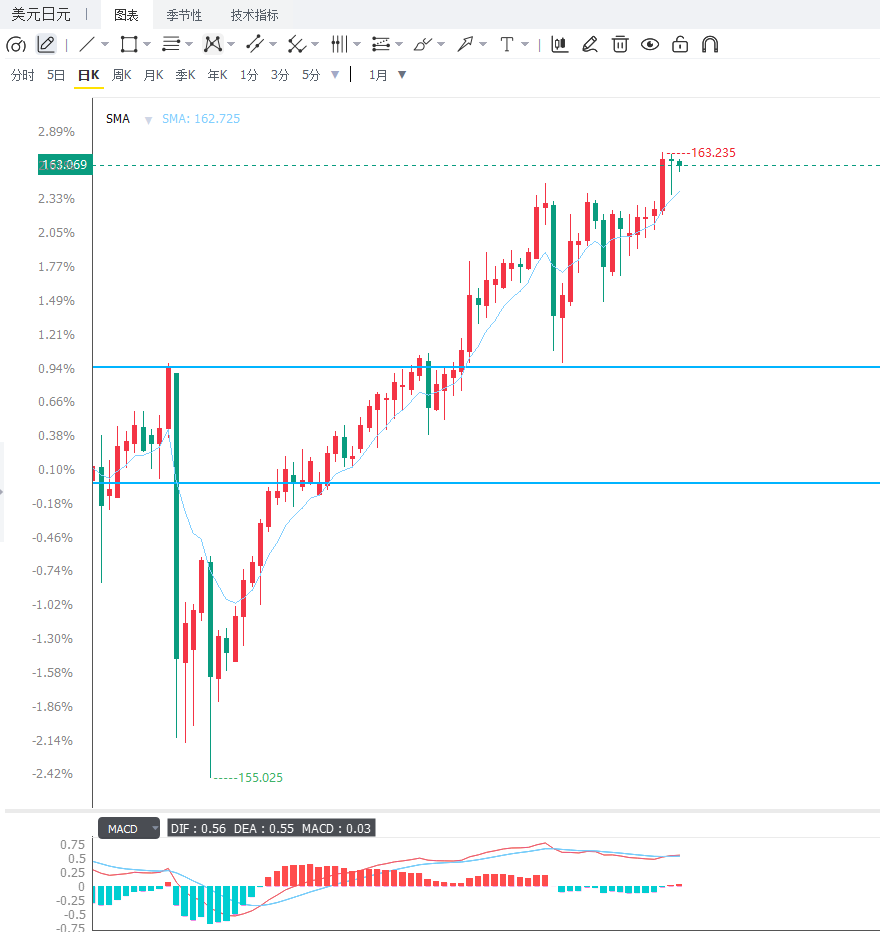 Editor's Summary: The USD/JPY pair is currently in a phase of policy divergence and intertwined risk events. On the one hand, Japan's fiscal pressure and the prolonged low-interest-rate environment continue to limit the yen's performance; on the other hand, rising expectations of the Bank of Japan's policy normalization and the risk of government intervention provide potential support for the yen. In the short term, the US dollar may still be driven by global safe-haven demand, keeping the USD/JPY pair fluctuating at high levels. However, as market expectations for a Bank of Japan interest rate hike continue to strengthen, the yen's further depreciation potential may be limited. Future exchange rate movements will depend on Japanese policy actions, changes in US interest rates, and global risk sentiment. If Japanese authorities take more proactive measures to stabilize the exchange rate, the USD/JPY pair may face significant downward pressure; conversely, if safe-haven sentiment continues to rise, the exchange rate may still have a chance to retest the 164-165 area.
One of the key reasons for the recent continued pressure on the yen is market concerns about Japan's fiscal situation. The high level of Japanese government debt and uncertainty surrounding fiscal policy have weakened market confidence in yen-denominated assets. Against the backdrop of a relatively strong US dollar, the yen has faced significant pressure, pushing the USD/JPY exchange rate to remain high for an extended period. However, recent signals of a policy shift from the Bank of Japan (BOJ) have provided some support for the yen. The BOJ previously ended its long-term easing policy framework and raised its policy rate to 1.0% in June. Some officials have recently hinted that if the economic and inflationary environment meets expectations, further normalization of interest rates is possible. Market interest rate data shows that investors are increasing their bets on further BOJ rate hikes. The current overnight index swap market indicates an approximately 84% probability of a BOJ rate hike at its October meeting, up from approximately 72% previously . This change reflects a market reassessment of Japan's monetary policy path, providing some short-term buying support for the yen. Meanwhile, the Japanese government remains highly vigilant regarding abnormal fluctuations in the foreign exchange market. Finance Minister Satsuki Katayama stated on Wednesday that the government is prepared to take "appropriate and bold action" and emphasized that its stance on foreign exchange intervention remains unchanged. If the yen continues to depreciate rapidly, leading to increased import costs, Japanese authorities may increase verbal intervention or even take concrete measures to stabilize the exchange rate. Market participants believe that the key variable for USD/JPY currently lies in the interplay between expectations of Bank of Japan policy and the risk of government intervention. If the Bank of Japan continues to send hawkish signals, and the market believes the Japanese government may take action, the yen may gain momentum for a short-term rebound. On the other hand, escalating tensions in the Middle East may still support the dollar in the short term. Recent escalation of regional tensions has led to safe-haven flows into dollar assets, keeping the dollar index resilient. Tensions between the US and Iran have further intensified, with Iran stating it will take retaliatory measures if its infrastructure is attacked. Since the dollar typically receives safe-haven support during global risk events, geopolitical risks may limit the downside for USD/JPY. Investors are watching changes in risk sentiment, US interest rate expectations, and future policy signals from the Bank of Japan. If global safe-haven demand continues to strengthen, the dollar may maintain its relative advantage; however, if the market begins to bet on further tightening by the Bank of Japan, the yen's upside potential may expand. The daily chart for USD/JPY shows that although the exchange rate has slightly retreated from recent highs, it remains in a high-level consolidation pattern overall. The current price is trading around 163, with resistance at the 164.00-165.00 area, which is also a key psychological resistance level. A break above 165 could lead to a retest of multi-year highs. Support levels are first at 162.00, then around 160.50. Technically, the MACD remains in bullish territory, but the histogram is contracting, indicating a slowdown in upward momentum and a rebalancing phase between bulls and bears. Looking at the USD/JPY 4-hour chart, a short-term pullback is evident, with the price breaking below some short-term moving averages, but the overall trend hasn't clearly reversed. The RSI indicator has retreated from its highs, suggesting a cooling of short-term buying pressure. If the price holds above 162.00, it could retest the 164 area; a break below 162 could lead to further corrections towards 160.50. The market still needs to focus on whether the Japanese government releases stronger intervention signals and changes in expectations regarding the Bank of Japan's future policies. Editor's Summary: The USD/JPY pair is currently in a phase of policy divergence and intertwined risk events. On the one hand, Japan's fiscal pressure and the prolonged low-interest-rate environment continue to limit the yen's performance; on the other hand, rising expectations of the Bank of Japan's policy normalization and the risk of government intervention provide potential support for the yen. In the short term, the US dollar may still be driven by global safe-haven demand, keeping the USD/JPY pair fluctuating at high levels. However, as market expectations for a Bank of Japan interest rate hike continue to strengthen, the yen's further depreciation potential may be limited. Future exchange rate movements will depend on Japanese policy actions, changes in US interest rates, and global risk sentiment. If Japanese authorities take more proactive measures to stabilize the exchange rate, the USD/JPY pair may face significant downward pressure; conversely, if safe-haven sentiment continues to rise, the exchange rate may still have a chance to retest the 164-165 area.
- Risk Warning and Disclaimer
- The market involves risk, and trading may not be suitable for all investors. This article is for reference only and does not constitute personal investment advice, nor does it take into account certain users’ specific investment objectives, financial situation, or other needs. Any investment decisions made based on this information are at your own risk.