Gold's rebound comes to an abrupt halt: How the US-Iran conflict extinguished technical buying.
2026-07-24 18:49:01
On Friday, July 24, spot gold prices traded around $4,060 per ounce. The escalating conflict between the US and Iran, coupled with shipping risks in the Strait of Hormuz, pushed up oil prices. Brent crude has recently fluctuated around $97 to $100 per barrel, as market concerns about sticky inflation and the path of interest rates intensified. Ahead of the Federal Reserve meeting on July 28-29, while interest rate hike expectations did not dominate pricing, the pressure of tightening financial conditions will continue to weigh on gold if the conflict does not ease. 
 In the medium term, gold remains constrained by rising real interest rates and the dollar's liquidity environment. High energy prices due to the conflict have further reinforced market pricing in a "higher and longer" interest rate path. Unless there is a significant easing of the conflict or a substantial decline in inflation data, the pattern of gold prices trading below the middle band is unlikely to change quickly. A decisive break below the support level around $3950 would open up further downside potential; a re-establishment and upward break above the middle band would require a substantial improvement in fundamentals.
The technical rebound lacks fundamental support.
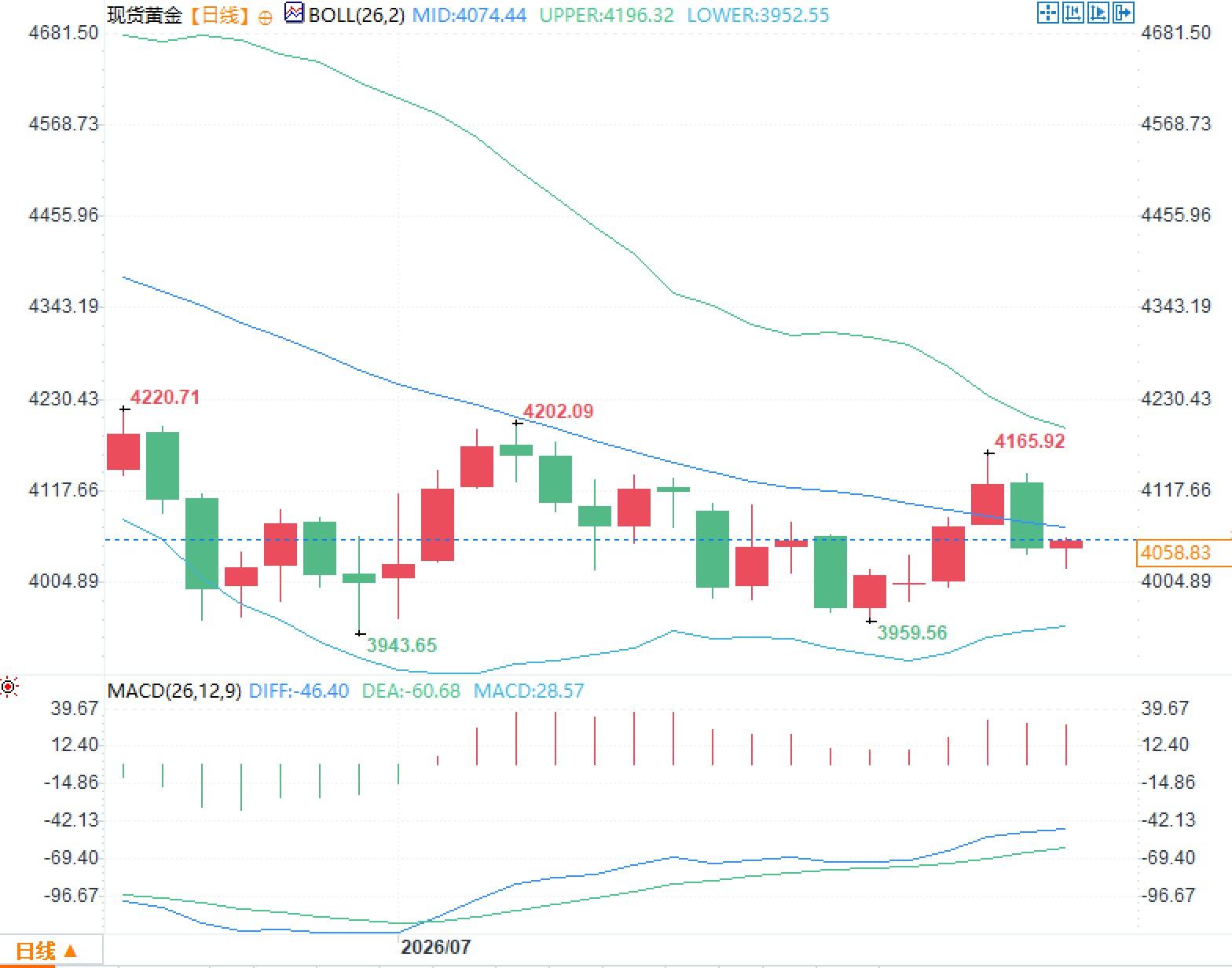
Spot gold recently rebounded from a low of around $3,959, briefly reaching a high of $4,165, but subsequently fell back quickly. The Bollinger Bands are at $4,196 and $3,952 respectively, with the price fluctuating around the middle band, failing to hold above it. From a market structure perspective, this rebound lacks sustained inflows of new funds. Safe-haven demand should have provided support against the backdrop of conflict, but inflation concerns stemming from rising oil prices quickly offset this effect. As traders reassessed the interest rate path, the cost of holding gold increased, making it difficult for technical buying to generate effective momentum. The price's repeated oscillations between $4,050 and $4,100 reflect that both bulls and bears are awaiting clearer fundamental signals.The ongoing conflict between the US and Iran continues to push up oil prices and interest rate expectations.
The US-Iran conflict has entered a sustained phase, with both sides continuing their actions around the Strait of Hormuz. The conflict has directly pushed up the risk premium for crude oil, with Brent crude briefly exceeding $100 per barrel after the escalation, though it has since retreated but remains at a high level. Rising oil prices affect gold through two channels: firstly, by directly pushing up inflation expectations, with market concerns intensifying regarding the stickiness of US PCE inflation; and secondly, by passively tightening financial conditions, increasing upward pressure on real interest rates. As a zero-yield asset, gold faces increased opportunity costs in a rising interest rate environment. As long as the conflict does not show substantial easing, high oil prices and upward revisions to interest rate expectations will continue to suppress gold prices. However, if there are signs of easing in the conflict, it could trigger a dovish repricing of interest rate expectations, thus providing some support for gold.Risks and Market Pricing of the Fed's July Meeting
The next Federal Reserve policy meeting is scheduled for July 28-29. Current market pricing indicates that the probability of maintaining the current interest rate remains dominant, at approximately 76%, while the probability of a 25 basis point rate hike is around 23%. Newly appointed Chairman Kevin Warsh has repeatedly emphasized in recent congressional testimony and public appearances that "prices are still too high," and mentioned the need for "systemic changes" in monetary policy to address inflation. At the European Central Bank Forum, Warsh stated that while inflation expectations have eased somewhat, they are still not satisfactory, and reiterated that he would not accept an inflation target higher than 2%. Although the market does not favor a rate hike at the July meeting, if the conflict escalates further and pushes up oil prices, the possibility of the Fed releasing a more hawkish signal at the meeting cannot be ruled out. Warsh previously deliberately avoided giving clear guidance on the short-term policy path at the Sintra Forum, emphasizing that policymakers would have "full discussions." If the situation in the Middle East does not improve, the market's pricing of subsequent rate hikes may be further revised upwards, putting additional pressure on gold. Conversely, if the conflict eases, a decline in interest rate expectations will provide breathing room for gold prices.Gold Price Technical Analysis and Medium-Term Pressure
From a daily chart perspective, since the pullback from its highs, spot gold has seen the Bollinger Bands gradually narrow, with the middle band sloping downwards. Prices have rebounded after repeatedly testing the lower band, but the rebound heights have been decreasing. The MACD indicator has been below the zero line for a long time. Recently, prices found some support around $4050, but there is dense resistance in the $4100-$4160 area, making a breakout difficult. In the medium term, gold remains constrained by rising real interest rates and the dollar's liquidity environment. High energy prices due to the conflict have further reinforced market pricing in a "higher and longer" interest rate path. Unless there is a significant easing of the conflict or a substantial decline in inflation data, the pattern of gold prices trading below the middle band is unlikely to change quickly. A decisive break below the support level around $3950 would open up further downside potential; a re-establishment and upward break above the middle band would require a substantial improvement in fundamentals.
- Risk Warning and Disclaimer
- The market involves risk, and trading may not be suitable for all investors. This article is for reference only and does not constitute personal investment advice, nor does it take into account certain users’ specific investment objectives, financial situation, or other needs. Any investment decisions made based on this information are at your own risk.