Gold Trading Alert: US-Iran Ceasefire Suddenly! Oil Prices Plunge 6%, Gold Prices Jump Over $40; This Week to Test with Fed Decision
2026-07-27 07:26:02
The sudden pause in the US-Iran military confrontation sent shockwaves through global markets. International oil prices opened sharply lower on Monday (July 27), with US crude oil plunging over 6% to $83.10 per barrel at one point, easing inflation concerns. Spot gold, however, opened more than $40 higher, rising as much as 1% to $4096.63 per ounce, and is currently trading around $4085 per ounce, a gain of approximately 0.8%. Meanwhile, US stock index futures rose across the board, with S&P 500 futures up 0.65% and Nasdaq futures up 1.2%. Behind this series of chain reactions is the Trump administration's decision to "leave room for maneuver" in diplomatic negotiations, and Iran's simultaneous suspension of retaliatory actions. However, whether the brief rebound in gold prices can be sustained depends on a genuine easing of tensions in the Middle East, the clarity of the Federal Reserve's policy path, and the market's repricing of inflation and interest rates. 
 Adrian Day, president of Adrian Day Asset Management, stated that while cautiously optimistic, the market is not yet out of the woods, with the Federal Reserve still potentially raising interest rates, while major Asian economies are slowing and implementing stimulus measures. Encouragingly, gold prices have been largely flat over the past seven days – initially falling before rising – despite escalating tensions in Iran, higher oil prices and the dollar, and rising expectations of a Fed rate hike before the end of the year. When any asset or market doesn't fall in the face of negative news, it's a bullish signal. Rich Checkan, president and COO of Asset Strategies International, believes there are two opposing forces at play: oil prices above $100 a barrel and strong support at $4,000. After several tests of the $4,000 support level, he believes it will hold, but as long as Middle East tensions keep oil prices and inflation concerns high, gold prices will struggle to rise significantly. FXTM Market Analysis Manager Lukman Otunuga pointed out that Brent crude oil's breakthrough of $100 once dealt a heavy blow to gold, and the chain reaction is now established. High oil prices exacerbate inflation concerns, push up bets on a Fed rate hike, leading to a stronger dollar and higher Treasury yields, putting gold, which has zero yields, at downside risk. He warned that while technical forces may drive prices slightly higher, geopolitical tensions could limit any room for a sustained gold recovery. Forex Senior Market Strategist James Stanley is more optimistic, believing that the $4,000 level has held well so far, and demand has emerged when it is tested below. Large players with a long-term perspective, such as central banks, pension funds, and hedge funds, will see this as an opportunity. With the Fed meeting coming up next week and the stock market correction beginning to show some pain, he expects Warsh to try to support President Trump by sounding less hawkish than many expected. In the long term, we are not expected to see tightening or a balanced budget in the short term, so the bullish logic for gold remains even in this temporary contrarian context. SIA Wealth Management Chief Market Strategist Colin Cieszynski holds a neutral stance. He believes that gold has already experienced a significant surge, and many war-related factors have been priced in. However, the drop from $5,500 to $4,000 has not completely eliminated all war concerns. Prices are already high, and there are concerns that this could lead to interest rate hikes. Inflation data has been lagging, and if oil prices continue to rise, inflation may rebound in another month or two. Based on this, the dollar may begin to strengthen, creating headwinds for gold. Gold is currently stabilizing somewhere in the middle and needs three to six months of consolidation. He does not expect significant volatility in the gold market around the time of the Fed's interest rate decision next week, believing that it is currently the height of summer, and volatility has already been high. The Fed does not want to create further disruptions, and gold prices are likely to remain within the recent range of $3,960 to $4,170 in the coming week.
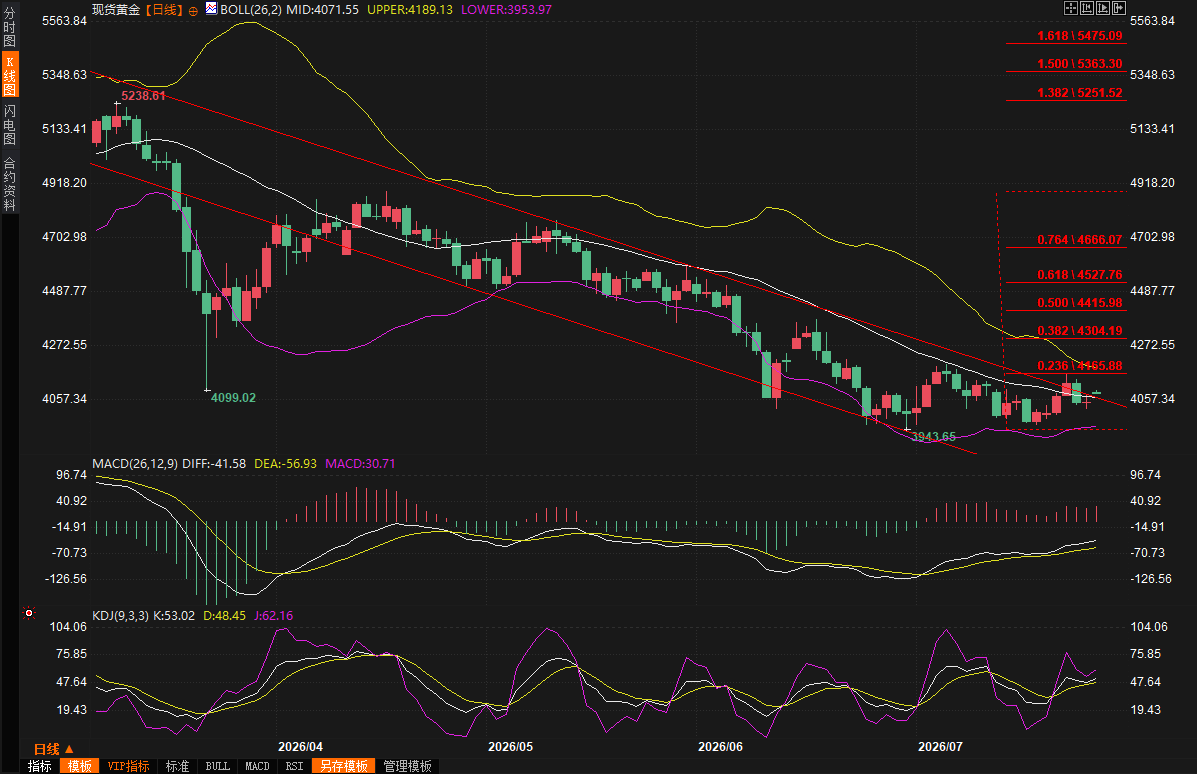 (Spot gold daily chart, source: FX678) At 07:22 Beijing time, spot gold is currently trading at $4085.69 per ounce.
The military pause ignited diplomatic hopes, and market concerns about supply disruptions quickly subsided.
U.S. Ambassador to the United Nations Mike Walz stated on Sunday (July 26) that President Trump had decided to leave some room for diplomatic efforts toward Iran after two consecutive nights without airstrikes. The Iranian military also simultaneously announced a suspension of retaliatory strikes against U.S. allies in the Middle East, citing the two consecutive nights of U.S. attacks. Previously, after 13 days of continuous U.S. strikes against Iran, operations were suspended starting late Friday, with the Iranian army stating that Tehran had suspended its response. Although the two countries reached a ceasefire agreement in April and signed a 60-day memorandum of understanding for peace talks in June, conflict has recently reignited over control of the Strait of Hormuz. Iranian military spokesman Mohammad Akraminia emphasized that Iran's actions were retaliatory in nature, and that if the U.S. insists on continuing the war, especially through airstrikes, the situation will escalate further. The suspension of military operations has rekindled hopes for a resumption of negotiations between the U.S. and Iran. Previously, Iran had closed the strait again after the fighting resumed, and reportedly detained six ships attempting to cross in the past 24 hours. Meanwhile, internal signals from within the U.S. are also noteworthy. CNN, citing Pentagon sources, reported that military action against Iran had been "paused," while The New York Times reported that ammunition shortages and the risk of escalating regional conflict prompted the US to shelve its escalation plans. However, Ambassador Walz firmly denied any shortages, stating that the US military possessed all the necessary resources and criticizing the leak of related information. A senior Iranian official told the media that Tehran's position was clear—to respond to attacks with attacks, and if the US ceased its attacks, Iran would also cease its actions; this message had been conveyed to the US . However, a senior Iranian source indicated that Tehran was "more skeptical than optimistic" about the pause, generally believing it to be a tactical adjustment rather than a genuine change of heart, and that Iran had learned too many lessons from being deceived by the US. According to multiple media reports, Trump made the pause decision after a meeting last Friday, where Chairman of the Joint Chiefs of Staff General Kane and several senior military and political advisors expressed concerns about further action. Vice President Vance had reservations about continuing the attacks, and US Middle East Commander General Cooper also recommended halting the bombing, as the operation's effectiveness was nearing its limit. This pause directly alleviated market concerns about the supply chain in the Strait of Hormuz. The decline in oil prices not only eased inflation concerns but also eased pressure on the Federal Reserve to raise interest rates. The US dollar index opened lower and continued to fall, dropping as much as 0.23% to 101.22. Gold, as a traditional safe-haven asset, rebounded quickly, driven by both falling oil prices and a temporary easing of geopolitical tensions, and regained its position above the $4,050 mark.Gold prices held key support, but expectations of a Fed rate hike still pose upward resistance.
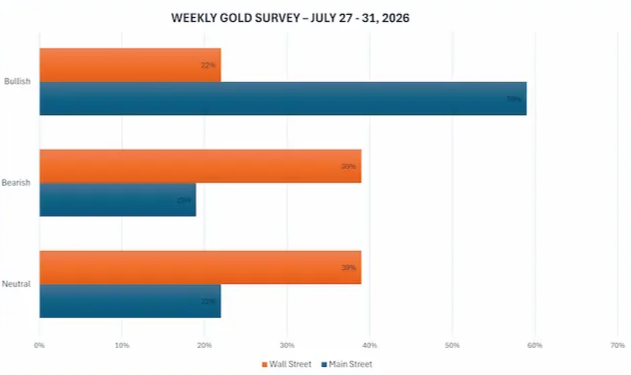
Spot gold rose slightly by 0.1% on Friday, closing at $4,053.29 per ounce, with a cumulative weekly gain of 0.9%. Independent metals trader Tai Wong noted that despite rising yields, gold and silver appear to be finding support around $3,950 and $55 respectively. If the conflict escalates sharply, a break below these levels triggering stop-loss orders cannot be ruled out, but gold seems poised for a rebound. A clear decision by the Federal Reserve to maintain interest rates next week would be beneficial for gold prices. ING analysts believe that the recent strength in gold prices appears to be primarily driven by bargain hunting and short covering. Gold prices have pulled back sharply from record highs earlier this year, and high oil prices and rising yields may limit any rebound. Therefore, $4,000 will be a key level to watch in the short term. The latest Kitco News weekly gold survey shows that Wall Street is bearish or hesitant about the short-term outlook for gold, while sentiment improved after gold prices held above the $4,000 support level again. Adrian Day, president of Adrian Day Asset Management, stated that while cautiously optimistic, the market is not yet out of the woods, with the Federal Reserve still potentially raising interest rates, while major Asian economies are slowing and implementing stimulus measures. Encouragingly, gold prices have been largely flat over the past seven days – initially falling before rising – despite escalating tensions in Iran, higher oil prices and the dollar, and rising expectations of a Fed rate hike before the end of the year. When any asset or market doesn't fall in the face of negative news, it's a bullish signal. Rich Checkan, president and COO of Asset Strategies International, believes there are two opposing forces at play: oil prices above $100 a barrel and strong support at $4,000. After several tests of the $4,000 support level, he believes it will hold, but as long as Middle East tensions keep oil prices and inflation concerns high, gold prices will struggle to rise significantly. FXTM Market Analysis Manager Lukman Otunuga pointed out that Brent crude oil's breakthrough of $100 once dealt a heavy blow to gold, and the chain reaction is now established. High oil prices exacerbate inflation concerns, push up bets on a Fed rate hike, leading to a stronger dollar and higher Treasury yields, putting gold, which has zero yields, at downside risk. He warned that while technical forces may drive prices slightly higher, geopolitical tensions could limit any room for a sustained gold recovery. Forex Senior Market Strategist James Stanley is more optimistic, believing that the $4,000 level has held well so far, and demand has emerged when it is tested below. Large players with a long-term perspective, such as central banks, pension funds, and hedge funds, will see this as an opportunity. With the Fed meeting coming up next week and the stock market correction beginning to show some pain, he expects Warsh to try to support President Trump by sounding less hawkish than many expected. In the long term, we are not expected to see tightening or a balanced budget in the short term, so the bullish logic for gold remains even in this temporary contrarian context. SIA Wealth Management Chief Market Strategist Colin Cieszynski holds a neutral stance. He believes that gold has already experienced a significant surge, and many war-related factors have been priced in. However, the drop from $5,500 to $4,000 has not completely eliminated all war concerns. Prices are already high, and there are concerns that this could lead to interest rate hikes. Inflation data has been lagging, and if oil prices continue to rise, inflation may rebound in another month or two. Based on this, the dollar may begin to strengthen, creating headwinds for gold. Gold is currently stabilizing somewhere in the middle and needs three to six months of consolidation. He does not expect significant volatility in the gold market around the time of the Fed's interest rate decision next week, believing that it is currently the height of summer, and volatility has already been high. The Fed does not want to create further disruptions, and gold prices are likely to remain within the recent range of $3,960 to $4,170 in the coming week.On the eve of the Federal Reserve meeting, the interplay of interest rate path and geopolitical risks is driving gold price movements.
Global financial markets will face multiple challenges this week. The Federal Reserve will announce its interest rate decision on Wednesday, with the market widely expecting it to maintain the federal funds rate at 3.50%-3.75%. Due to the 27% surge in oil prices this month exacerbating inflation concerns, the market has already priced in a rate hike of approximately 44 basis points before the end of the year. Investors will closely watch the FOMC statement and Chairman Warsh's press conference for clues about the future policy path. JPMorgan Chase's chief U.S. economist, Michael Feroli, expects the Fed to keep rates unchanged at this week's meeting, but anticipates at least two members will cast hawkish dissenting votes, as some on the committee are losing patience with persistently high inflation. According to data from the CME FedWatch tool, the probability of the Fed keeping rates unchanged in July is 63.7%, with a 36.3% probability of a 25 basis point rate hike. By September, the probability of keeping rates unchanged is 19.6%, with a 55.2% probability of a 25 basis point rate hike and a 25.2% probability of a 50 basis point rate hike. By December, the probability of maintaining the current interest rate is only 7.8%, the probability of a cumulative 25 basis point rate hike is 30.9%, the probability of at least a 50 basis point rate hike is as high as 61.5%, and the probability of at least one rate hike this year is as high as 92.2% . These data indicate that although this week's meeting may leave rates unchanged, the pressure to raise rates this year remains significant, potentially limiting the upside potential for gold prices. On the economic data front, the US will release June durable goods orders, July consumer confidence index, preliminary Q2 GDP, June PCE price index and personal income and spending data, as well as the final July University of Michigan consumer sentiment index. These data will provide the market with the latest assessment of economic resilience and inflation trends. The Bank of England is expected to keep its interest rate unchanged at 3.75% on Thursday, the Bank of Japan is expected to keep its interest rate unchanged at 1% on Friday, and the Eurozone will also release a flurry of data. These multiple factors are expected to dominate market movements.Summary: Gold prices are under short-term pressure, but the long-term fundamentals remain unchanged; the $4,000 level is a key point to watch.
The sudden halt to US-Iran military operations did provide a brief respite for the market. Falling oil prices eased concerns about inflation and supply disruptions, allowing gold to stabilize and rebound above $4,000, while stock index futures also strengthened. However, doubts about Iran's sincerity regarding the US ceasefire, potential risks in the Strait of Hormuz, and the high probability of a Fed rate hike this year all constitute significant resistance to further gold price increases. Wall Street analysts are generally cautious, while Main Street investors have become more optimistic after the support level held. In the short term, gold prices may continue to fluctuate within the $3,960-$4,170 range, with the $4,000 level determining the next direction. From a longer-term perspective, the fundamental logic of gold as a safe-haven and inflation hedge remains unchanged despite the military halt. As long as a truly lasting diplomatic breakthrough in the Middle East situation fails to materialize, the potential risk of a rebound in oil prices and inflation will persist; and if the Fed is forced to raise rates under inflationary pressure, it could further suppress gold prices. Investors need to closely monitor the wording of this week's Fed decision, the subsequent developments in the Iranian situation, and upcoming economic data. In an environment of continued high uncertainty, gold's safe-haven appeal may re-emerge at crucial moments, but its potential for significant short-term gains may be limited. The market is at a crossroads of multiple challenges, and the next move in gold prices will depend on the final balance of these intertwined factors. (Spot gold daily chart, source: FX678) At 07:22 Beijing time, spot gold is currently trading at $4085.69 per ounce.
- Risk Warning and Disclaimer
- The market involves risk, and trading may not be suitable for all investors. This article is for reference only and does not constitute personal investment advice, nor does it take into account certain users’ specific investment objectives, financial situation, or other needs. Any investment decisions made based on this information are at your own risk.