Is USD/JPY 163 the "end" or the "midpoint"? The Bank of Japan's next move will determine the nation's fate.
2026-07-27 08:43:02
In October 2025, Sanae Takaichi was elected Prime Minister of Japan with a promise to "revitalize the economy and restore household purchasing power." At that time, food inflation had exceeded 7%, and voters were weary of decades of stagnation and rising living costs. Nine months later, this governing platform clashed head-on with three forces—geopolitical shocks, fiscal fragility, and monetary policy dilemmas—threatening not only the progress of her policy agenda but also potentially shaking the foundations of the world's third-largest economy. The question facing Tokyo, Washington, and global financial markets is no longer "whether Japan can sustain its post-deflationary recovery," but rather "whether Japan's system possesses sufficient consistency and credibility to cope with a systemic crisis of its own making." Japan's current predicament is most directly reflected in the USD/JPY exchange rate. On Monday (July 27) in early Asian trading, the USD/JPY remained volatile at high levels, currently trading around 163.50, its highest level since December 1986. Meanwhile, the US Treasury's semi-annual currency report concluded that the yen was "significantly undervalued" and unusually called for further interest rate hikes by the Bank of Japan. Behind the exchange rate lies a systemic predicament affecting the lifeline of the Japanese economy—the promise of "revitalization" in Kaohsiung, the dilemma of raising interest rates by the central bank, and the expansion of government debt are converging at the 163 mark to form a stress test on the resilience of the Japanese system. 
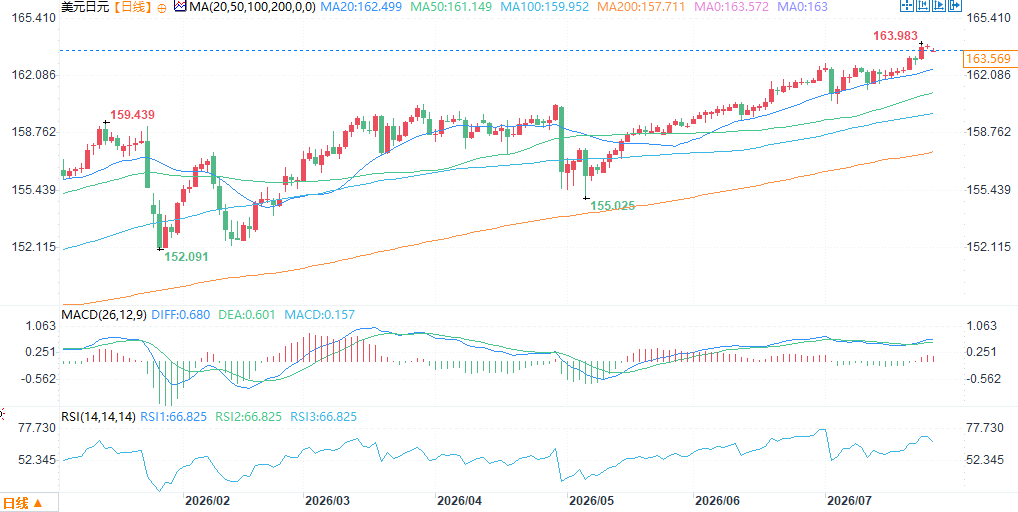 (USD/JPY daily chart, source: FX678) At 8:38 AM Beijing time on July 27, the USD/JPY exchange rate was 163.55/56.
Fifty years of debt accumulation
The roots of Japan's current predicament can be traced back decades. In the late 1980s, government debt was about 60% of GDP—a manageable level by any international standard. The bursting of the asset bubble and the subsequent bailout of the financial sector pushed that ratio to 130% by the late 1990s. The 2008 global financial crisis and the spending pressures from a rapidly aging population led to a continued widening of the fiscal deficit, with regular government spending exceeding tax revenue by about 10%. By 2020, the debt-to-GDP ratio had reached 260%. More stringent budgets and modest improvements in growth are expected to bring the ratio below 230% by 2025, but deep-seated structural imbalances will remain unresolved. Approximately 90% of Japanese government bonds are held domestically—by local banks, insurance funds, and household savings equivalent to about one-third of GDP—which has historically shielded Japan from the foreign capital flight that has crippled other indebted nations. However, as Jack Salmon, a researcher at the Mercator Center at George Mason University, warned in February 2026: “Japan has never been a reassuring counterexample to debt concerns. The fact that Japan is now testing the limits of its debt tolerance should finally end the illusion that developed economies can borrow indefinitely without consequences.”Precision strikes based on geopolitical shocks
This warning gained urgent specificity on February 28, 2026. The US-Israeli strikes on Iran ignited a broader conflict in the Middle East, sending shockwaves through global energy markets. No G7 country is more vulnerable to such shocks than Japan. The country relies on imports of oil and gas transported via the Persian Gulf for approximately 90% of its energy needs, and on imported food for about half of its calorie intake—mostly fertilizer—whose supply chains now run through disputed waters. Within weeks of the escalation, Japanese natural gas prices soared to record highs. The war is projected to reduce Japan's GDP growth rate by 0.2 percentage points in the next fiscal year—a small figure on its own, but far-reaching when combined with an economy already weakened by external trade shocks. Trump's 15% tariffs on all Japanese exports and 50% tariffs on steel and aluminum have already depressed export-dependent manufacturing. Several analysts assess that even before the first missile struck Iranian infrastructure, the Japanese economy was already on the verge of recession.The Bank of Japan's Dilemma
After a decade of unconventional stimulus, the Bank of Japan embarked on a cautious normalization path in 2024, only to find itself facing an inflationary environment fundamentally altered by geopolitical supply shocks. In its quarterly outlook report for April 2026, the central bank explicitly warned of the risk of “significant inflation overshooting” given the immense uncertainty stemming from the Middle East wars. By June, as businesses passed on rising oil prices at a “relatively rapid pace,” as described by Governor Shinichi Uchida, the Bank of Japan raised its short-term policy rate by 25 basis points to 1%—the highest level since 1995. This decision was a landmark event: Japan had not seen such borrowing costs in 31 years. However, in reality, monetary policy remains deeply accommodative. Inflation has been running almost consistently above the 2% target since 2022, but the cumulative tightening since exiting negative interest rates in 2024 has been only 110 basis points. BNP Paribas, in its June 30 analysis, aptly outlined this dilemma: the Bank of Japan must tighten enough to curb inflation while avoiding instability in the bond market and public finances—a balance made even more precarious by the fact that the central bank's balance sheet will exceed 120% of GDP by early 2024, making it a dominant player in the Japanese government bond market. The sustainability of public finances has become dependent on the central bank's absorption of bond issuance—a situation analysts describe as de facto fiscal dominance.Market turmoil triggered by the 370 trillion yen blueprint
It was against this backdrop of monetary caution and fiscal fragility that the Takashi City government's draft economic blueprint, released on June 30, triggered a shockwave in financial markets. This document, officially titled "Basic Policy for Economic and Fiscal Management and Reform," proposed injecting approximately 370 trillion yen (about US$2.3 trillion) of public and private funds into 17 industrial sectors over 14 years. Targeted industries included artificial intelligence, semiconductors, biotechnology, defense, energy, and shipbuilding, with the goal of doubling Japan's real economic growth rate to over 1% "as soon as possible." The markets were not convinced. An early draft contained a statement that "appropriate management of monetary policy is crucial for achieving a strong economy"—which investors interpreted as a political signal from the government pressuring the central bank to suppress interest rates. The reaction was swift and fierce. Japanese government bond yields surged to 2.8%, the highest level in 29 years. The yen depreciated rapidly under the dual pressures of widening interest rate differentials and rising import costs. Kelvin Lam, Asia expert at Pantheon Macroeconomics, captured the market's anxiety: "As long as you don't explain how you're going to finance the spending, you're heading towards a Truss moment." This analogy, drawing parallels to the former British Prime Minister whose £45 billion unfunded tax cut plan triggered a bond market collapse, was not ignored within his own party, with senior members privately expressing concerns that "investment plans could trigger an economic meltdown."Government emergency remedies
Authorities launched an emergency damage control operation. During the party leaders' debate on July 15, Takaichi was forced into a defensive position by Yuichiro Tamaki, the leader of the Democratic Party for the People, who questioned whether the government's fiscal recklessness had triggered market shocks. The Prime Minister avoided answering, insisting that "exchange rates and interest rates are driven by a variety of factors" and that an unapproved draft could not have caused such turmoil. By the time the Cabinet formally approved the final version of the blueprint on July 21, the wording had been revised to explicitly confirm that "the specific methods of monetary policy are determined by the Bank of Japan," in accordance with Article 3 of the Bank of Japan Law. The document further stipulated that monetary policy should "contribute to achieving stable inflation"—a statement intended to assure the market that the government was not seeking to place the central bank under its growth agenda. However, the substantive spending commitments remained unchanged, and the financing methods—through tax increases, spending redistribution, or further borrowing—remained conspicuously unresolved.US Treasury intervention and warnings of yen depreciation
In the days that followed, a series of data and diplomatic signals highlighted the depth of Japan's predicament. On July 23, the U.S. Treasury Department released its semi-annual currency report, concluding that the yen's real effective exchange rate had depreciated by 51% between the end of 2011 and the end of April 2026, resulting in a "significant undervaluation of the yen." The report warned that excessive currency volatility was "undesirable" and explicitly called on the Bank of Japan to further raise interest rates, arguing that "the normalization of monetary policy will help anchor inflation expectations and reduce excessive exchange rate volatility." The yen had previously fallen below 163 against the dollar, a 40-year low, and Japanese authorities had threatened intervention if volatility became excessive. The timing of the U.S. Treasury's intervention was intriguing—it came as Takashi Masaki was preparing to travel to Washington for a White House meeting with Trump, whose main grievances against Japan—the size of the bilateral trade deficit and the undervaluation of the yen—were precisely the issues emphasized in the report.Hidden pressures behind inflation data
Meanwhile, Japan's June inflation data paints a picture of accumulating pressure beneath a calm surface. Core consumer prices, excluding fresh food, rose 1.6% year-on-year, falling below the central bank's 2% target for the fifth consecutive month. Food inflation slowed due to falling rice prices, while services inflation fell to 1.2%. However, the producer price index surged 7.1% in June, the fastest pace in more than three years, driven by rising fuel and import costs due to the Middle East conflict and a weaker yen. Analysts at Capital Economics, Moody's Analytics, and Nomura Securities agree that the current weakness in consumer prices is temporary, a product of government subsidies and base effects, and that underlying inflation could rebound to above 2% in the fourth quarter of 2026 as wholesale cost pressures pass to households. Robert Brusca of Haver Analytics points out that the government's inflation-control program has effectively "window-dressed" the data, creating a misleading impression of price stability while masking the accumulating pressures that will ultimately require a more aggressive monetary response.The delicate trade-offs at the central bank's July meeting
By July 24, three sources familiar with the Bank of Japan's deliberations told the media that the central bank would maintain its warnings about the risk of inflation overshooting at its July 30-31 policy meeting, but hinted that the probability of the worst-case scenario—a severe supply disruption triggering a sharp price surge and forcing a rapid interest rate hike—had decreased since April. This tone represents a calibrated shift: with the basic framework of a peace agreement between the US and Iran in negotiations, the direct oil price shock is fading, but broader inflationary forces—including AI-related demand and continued yen weakness—still warrant continued vigilance. The central bank is expected to keep interest rates unchanged at 1%, while raising its growth forecasts due to easing geopolitical uncertainty. Analysts surveyed by the media expect the next rate hike (to 1.25%) to occur between October and December, while BNP Paribas predicts the terminal interest rate will reach 2% by the end of 2027.The superposition of vulnerabilities
What emerges from this timeline is not a single crisis, but a series of overlapping vulnerabilities that exacerbate each other in a self-reinforcing cycle. A weak yen increases import costs → pushes up inflation → forces the central bank to tighten → drives up debt servicing costs (debt already exceeds 200% of GDP) → reduces the fiscal space needed by the Hokkaido municipal government to finance its industrial transformation. Meanwhile, the government's expansionary spending plans—regardless of their supply-side orientation—erode market confidence in fiscal sustainability, pushing up bond yields, depressing the yen, and further exacerbating inflationary pressures that necessitate further tightening. The Bank of Japan's attempt to restore the price discovery mechanism in the Japanese government bond market by reducing bond purchases—necessary after years of artificially suppressed yields—adds yet another layer of upward pressure to borrowing costs. (USD/JPY daily chart, source: FX678) At 8:38 AM Beijing time on July 27, the USD/JPY exchange rate was 163.55/56.
- Risk Warning and Disclaimer
- The market involves risk, and trading may not be suitable for all investors. This article is for reference only and does not constitute personal investment advice, nor does it take into account certain users’ specific investment objectives, financial situation, or other needs. Any investment decisions made based on this information are at your own risk.