Declining demand for the US dollar as a safe haven, coupled with a pullback in oil prices, kept the USD/CAD pair in a slight consolidation phase.
2026-07-27 14:34:02
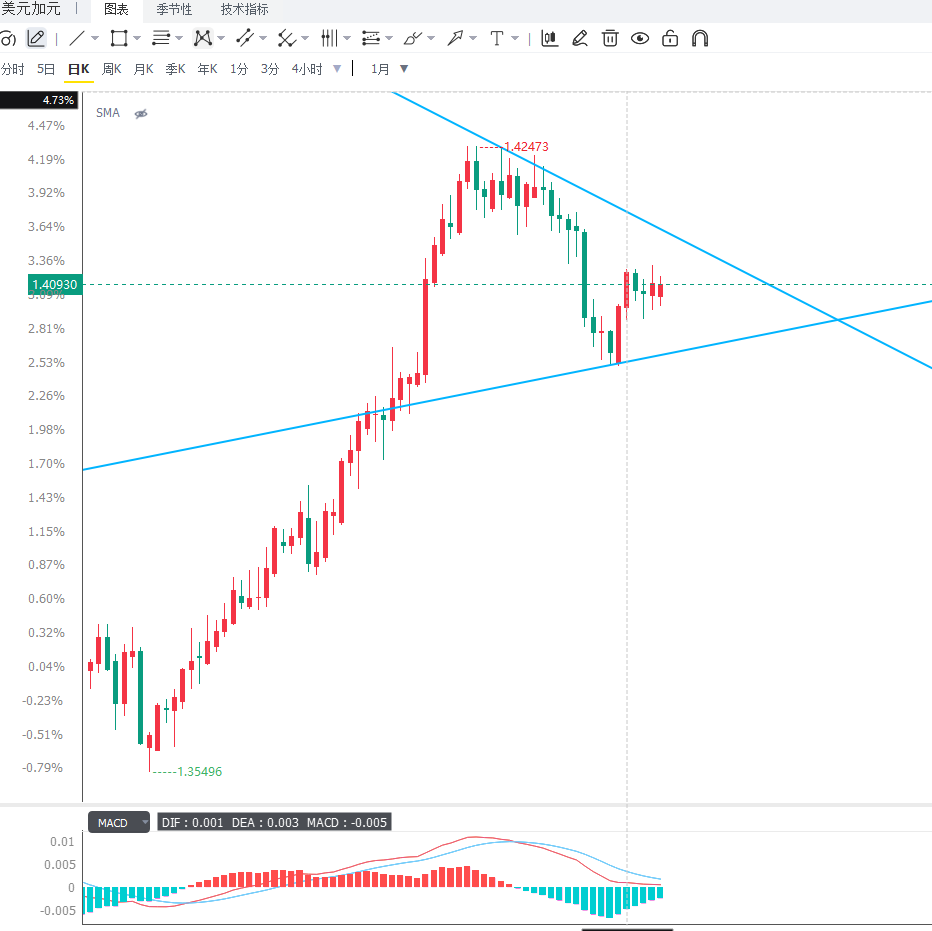
The US dollar retreated against the Canadian dollar in Asian trading on Monday, hovering around 1.4090, ending a slight upward trend. A weaker dollar was the main driver of the decline in USD/CAD, as improved market risk sentiment following the US-Iran truce reduced demand for safe-haven assets in the dollar.  The 13-day tensions that followed fueled risk aversion in global markets, supporting the US dollar. However, the US's suspension of related actions and Iran's halt to further actions against US allies prompted investors to reassess the possibility of further escalation of the conflict. The US's desire to leave room for a potential diplomatic solution boosted sentiment towards risk assets and weakened the dollar's short-term performance. However, market concerns about energy supply risks remain. Recent concerns about shipping security in the Red Sea region have resurfaced, with the Houthi rebels in Yemen claiming to have attacked Saudi energy facilities along the Red Sea coast, raising concerns about the stability of oil transportation. If key energy routes are disrupted, global oil supply could remain under pressure, potentially pushing up oil price volatility again. Meanwhile, falling oil prices limited further gains for the Canadian dollar. The Canadian dollar is a typical commodity currency, and its movements are strongly correlated with international oil prices. WTI crude oil opened sharply lower on Monday, falling by more than 5%, with prices retreating to around $84.50. The rapid pullback in oil prices weakened Canada's energy export advantage, limiting the Canadian dollar's rise . From a monetary policy perspective, the market is awaiting the latest policy signals from the Federal Reserve. The market widely expects the Federal Reserve to maintain stable interest rates at this week's meeting and may readjust its policy direction at future meetings. However, some investors are still betting that the Fed may release a more hawkish message, meaning that the dollar's trajectory remains highly uncertain. If the Fed continues to emphasize inflation risks and maintains a high-interest-rate environment, the dollar may regain support, driving a rebound in USD/CAD. But if energy prices stabilize and the market lowers its expectations for Fed tightening, the Canadian dollar may have further room for recovery. Currently, USD/CAD's movement is mainly influenced by both the dollar and oil prices. On the one hand, easing Middle East risks have reduced demand for the dollar as a safe haven; on the other hand, falling oil prices have weakened support for the Canadian dollar. Going forward, the market will focus on the Fed meeting, changes in crude oil inventories, and global energy supply risks. From a daily chart perspective, USD/CAD has recently been fluctuating above 1.4000, remaining in a high-level consolidation phase. The exchange rate was previously supported by safe-haven demand for the dollar, but with improved market sentiment, downward pressure has emerged. Currently, key support levels to watch are 1.4050 and 1.4000. A break below these levels could lead to a further test of the 1.3950 area. Resistance is seen in the 1.4150-1.4200 area; a break above this level could resume the short-term uptrend. The daily chart shows a tug-of-war between bulls and bears, with the trend direction awaiting confirmation from macroeconomic factors. On the 4-hour chart, USD/CAD's short-term momentum has weakened, with the price entering a consolidation phase after breaking below recent highs. The MACD indicator shows contracting upward momentum, and the RSI has fallen to neutral territory, indicating declining short-term buying power. However, the continued weakness in oil prices limits the Canadian dollar's upside potential. If the exchange rate holds above 1.4050, a short-term rebound could test the 1.4120-1.4150 area; a break below 1.4050 could open up further downside potential, with the 1.4000 psychological level to watch. The current 4-hour chart suggests a consolidation phase.
  The USD/CAD pair has recently been influenced by both changes in safe-haven demand for the US dollar and oil price movements. A temporary easing of tensions in the Middle East has weakened the dollar's upward momentum, but the rapid decline in oil prices has limited the Canadian dollar's performance, thus restricting its downside potential. In the short term, USD/CAD is likely to continue fluctuating around the dollar's trajectory, Federal Reserve policy expectations, and changes in the energy market. If oil prices stabilize and rebound, the Canadian dollar may find support; if the Federal Reserve releases hawkish signals, the US dollar may strengthen again. Investors should pay close attention to policy meetings and energy market developments to determine the next breakout direction for the pair.
The 13-day tensions that followed fueled risk aversion in global markets, supporting the US dollar. However, the US's suspension of related actions and Iran's halt to further actions against US allies prompted investors to reassess the possibility of further escalation of the conflict. The US's desire to leave room for a potential diplomatic solution boosted sentiment towards risk assets and weakened the dollar's short-term performance. However, market concerns about energy supply risks remain. Recent concerns about shipping security in the Red Sea region have resurfaced, with the Houthi rebels in Yemen claiming to have attacked Saudi energy facilities along the Red Sea coast, raising concerns about the stability of oil transportation. If key energy routes are disrupted, global oil supply could remain under pressure, potentially pushing up oil price volatility again. Meanwhile, falling oil prices limited further gains for the Canadian dollar. The Canadian dollar is a typical commodity currency, and its movements are strongly correlated with international oil prices. WTI crude oil opened sharply lower on Monday, falling by more than 5%, with prices retreating to around $84.50. The rapid pullback in oil prices weakened Canada's energy export advantage, limiting the Canadian dollar's rise . From a monetary policy perspective, the market is awaiting the latest policy signals from the Federal Reserve. The market widely expects the Federal Reserve to maintain stable interest rates at this week's meeting and may readjust its policy direction at future meetings. However, some investors are still betting that the Fed may release a more hawkish message, meaning that the dollar's trajectory remains highly uncertain. If the Fed continues to emphasize inflation risks and maintains a high-interest-rate environment, the dollar may regain support, driving a rebound in USD/CAD. But if energy prices stabilize and the market lowers its expectations for Fed tightening, the Canadian dollar may have further room for recovery. Currently, USD/CAD's movement is mainly influenced by both the dollar and oil prices. On the one hand, easing Middle East risks have reduced demand for the dollar as a safe haven; on the other hand, falling oil prices have weakened support for the Canadian dollar. Going forward, the market will focus on the Fed meeting, changes in crude oil inventories, and global energy supply risks. From a daily chart perspective, USD/CAD has recently been fluctuating above 1.4000, remaining in a high-level consolidation phase. The exchange rate was previously supported by safe-haven demand for the dollar, but with improved market sentiment, downward pressure has emerged. Currently, key support levels to watch are 1.4050 and 1.4000. A break below these levels could lead to a further test of the 1.3950 area. Resistance is seen in the 1.4150-1.4200 area; a break above this level could resume the short-term uptrend. The daily chart shows a tug-of-war between bulls and bears, with the trend direction awaiting confirmation from macroeconomic factors. On the 4-hour chart, USD/CAD's short-term momentum has weakened, with the price entering a consolidation phase after breaking below recent highs. The MACD indicator shows contracting upward momentum, and the RSI has fallen to neutral territory, indicating declining short-term buying power. However, the continued weakness in oil prices limits the Canadian dollar's upside potential. If the exchange rate holds above 1.4050, a short-term rebound could test the 1.4120-1.4150 area; a break below 1.4050 could open up further downside potential, with the 1.4000 psychological level to watch. The current 4-hour chart suggests a consolidation phase. The USD/CAD pair has recently been influenced by both changes in safe-haven demand for the US dollar and oil price movements. A temporary easing of tensions in the Middle East has weakened the dollar's upward momentum, but the rapid decline in oil prices has limited the Canadian dollar's performance, thus restricting its downside potential. In the short term, USD/CAD is likely to continue fluctuating around the dollar's trajectory, Federal Reserve policy expectations, and changes in the energy market. If oil prices stabilize and rebound, the Canadian dollar may find support; if the Federal Reserve releases hawkish signals, the US dollar may strengthen again. Investors should pay close attention to policy meetings and energy market developments to determine the next breakout direction for the pair.
- Risk Warning and Disclaimer
- The market involves risk, and trading may not be suitable for all investors. This article is for reference only and does not constitute personal investment advice, nor does it take into account certain users’ specific investment objectives, financial situation, or other needs. Any investment decisions made based on this information are at your own risk.