A sudden ceasefire between the US and Iran caused the yen to rebound "passively," making the US and Japanese central bank meetings key to future direction.
2026-07-27 14:59:09
On Monday (July 27) during Asian trading hours, the USD/JPY pair saw a slight pullback, currently down about 0.2% and trading around 163.50. Renewed diplomatic efforts between the US and Iran have rekindled hopes for a ceasefire, boosting investor risk appetite and reducing demand for the dollar as a safe haven. Meanwhile, the US Treasury's semi-annual currency report, which previously concluded that the yen was "significantly undervalued" and unusually called for further interest rate hikes from the Bank of Japan, provided additional support for the yen. However, the Federal Reserve and the Bank of Japan will announce their interest rate decisions this week, with the market expecting both central banks to hold rates steady—but the Bank of Japan's policy path guidance could be a key variable determining the direction of the USD/JPY pair. 
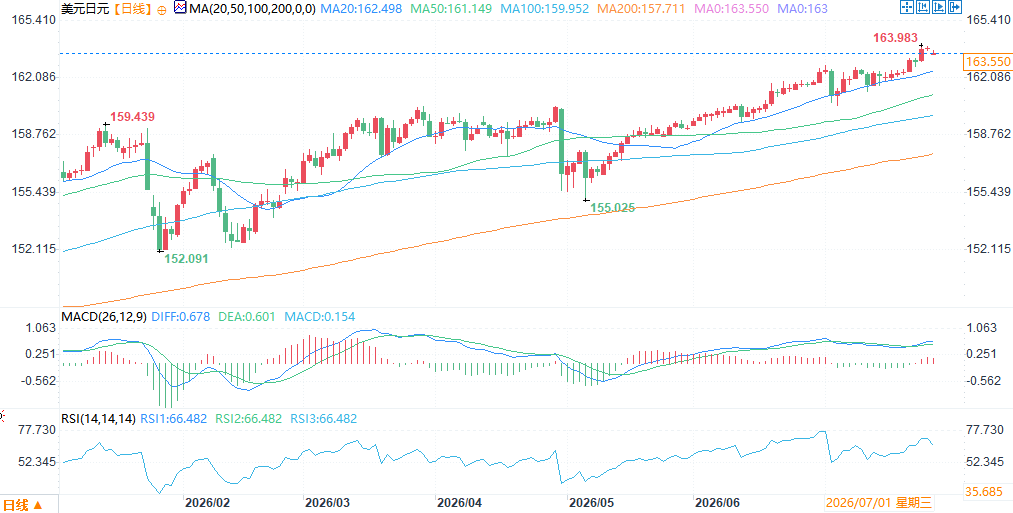 (USD/JPY daily chart, source: FX678) Key variables: US-Iran diplomatic progress - if negotiations break down, the US dollar will regain safe-haven buying, pushing USD/JPY higher; FOMC statement wording - if the hawkish tone is stronger than expected, USD/JPY could rise above 165; Bank of Japan statement wording - if the hawkish tone is strengthened, USD/JPY may fall below 163.
The US-Iran ceasefire is reshaping market risk appetite.
Last weekend, Washington confirmed a pause in its strikes against Iran, stating that its list of targets within Iran had been exhausted and that continuing bombing without resuming large-scale military operations was "not very meaningful." While Iran simultaneously suspended its attacks, it maintained its stance of "responding to attacks with attacks." This "diplomatic window" fueled market expectations that the five-month-long conflict might be turning a corner. The market reaction was a typical "risk appetite return" pattern: safe-haven assets (the US dollar) were sold off, while risk assets saw buying. The US dollar index fell 0.25% to around 101.20, while S&P 500 futures rose nearly 1%. The yen's strength in this environment was more "passive"—that is, the weakening dollar pushed the dollar down against the yen, rather than the yen itself strengthening. In fact, the yen's performance against other currencies was not particularly outstanding, indicating that the yen's rise lacked independent interest rate or fundamental support.The Federal Reserve is expected to hold rates steady and may not provide forward guidance.
The Federal Reserve will announce its interest rate decision this Wednesday. The market widely expects the Fed to keep rates unchanged—CME FedWatch shows the probability of a July rate hike has fallen from last week's high. However, the real focus will be on the wording of the policy statement and Fed Chairman Warsh's remarks. Warsh clearly stated at the last press conference that "so-called forward guidance is not applicable at this policy juncture"—meaning that after this meeting, the market will lack a clear policy anchor. TD Securities expects the Fed statement to remain cautious, but hawkish momentum is building, and two members (Harmark and Logan) may vote against it. For USD/JPY, if the Fed releases hawkish signals (hinting at a September rate hike), the dollar may rebound quickly, pushing the exchange rate above 165; if the statement is dovish, the dollar may weaken further, providing additional support for the yen.Ahead of the Bank of Japan meeting
This Friday, the Bank of Japan (BOJ) will announce its interest rate decision. The market widely expects the BOJ to keep interest rates unchanged at 1%, but the wording of its policy statement will be more closely watched than the Federal Reserve's decision. According to the latest media survey, 86% of economists expect the BOJ to raise interest rates to 1.25% by the fourth quarter, up from 79% in the June survey. This means that market expectations for a BOJ rate hike are rising—even if rates remain unchanged this week, the direction of a rate hike has already been widely priced in. The key challenge for the BOJ is how to maintain the current interest rate while simultaneously signaling to the market that the rate hike cycle is not over. If the statement is hawkish (emphasizing upside risks to inflation and the transmission effect of a weak yen on prices), the yen may receive support, and the USD/JPY exchange rate may experience a short-term correction; if the statement is dovish (emphasizing more downside risks to the economy), the yen may depreciate more rapidly, and the USD/JPY exchange rate may further challenge the 165 level.Technical Analysis
The USD/JPY pair is currently trading near 163.50, in the middle of its recent trading range. Resistance: The first resistance zone is 164.00-164.20 (recent highs and a psychological level); a break above this zone would target 164.50-165.00. Support: The first support level is 163.00-163.20 (near last week's lows); a break below this zone would target 162.50-162.80. (USD/JPY daily chart, source: FX678) Key variables: US-Iran diplomatic progress - if negotiations break down, the US dollar will regain safe-haven buying, pushing USD/JPY higher; FOMC statement wording - if the hawkish tone is stronger than expected, USD/JPY could rise above 165; Bank of Japan statement wording - if the hawkish tone is strengthened, USD/JPY may fall below 163.The yen received a breather at the start of the week with meetings from the two major central banks, but its direction depends on policy signals.
The yen passively strengthened amid a rebound in risk appetite following the US-Iran ceasefire, with the USD/JPY pair falling back to around 163.50. However, the yen's rise lacks independent interest rate support—this week's Federal Reserve and Bank of Japan meetings are the key to determining its direction. The Fed's hawkish stance and the Bank of Japan's guidance on its interest rate path will jointly determine the short-term direction of USD/JPY this week. If the Fed is more hawkish than expected, USD/JPY could rise to around 165; if the Bank of Japan releases stronger signals of interest rate hikes, USD/JPY could fall below 163. Before the policy signals from the two central banks become clear, USD/JPY will likely consolidate within the 163.00-164.50 range. For traders, Wednesday's Fed decision and Friday's Bank of Japan decision are the real highlights of the week—before these meetings, any directional bets may face two-way risks. At 14:53 Beijing time on July 27, USD/JPY was trading at 163.53/54.- Risk Warning and Disclaimer
- The market involves risk, and trading may not be suitable for all investors. This article is for reference only and does not constitute personal investment advice, nor does it take into account certain users’ specific investment objectives, financial situation, or other needs. Any investment decisions made based on this information are at your own risk.