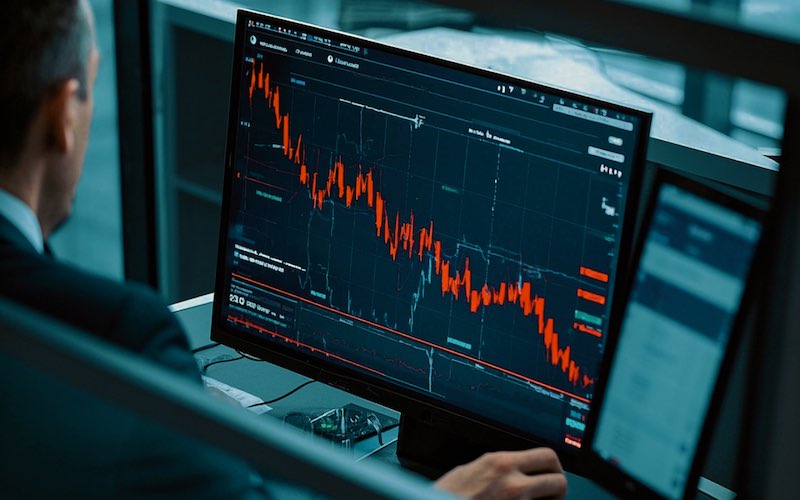
A midnight ceasefire triggered a stampede; is this a correction or a trend reversal for crude oil?
2026-07-27 21:19:03
On Monday (July 27), during the European and American trading sessions, international oil prices experienced a sharp drop followed by a slight rebound. Prices hit new lows throughout the day, with WTI crude currently trading around 84, down 5.87%, having fallen by more than 6% at one point. Brent crude even fell by more than 10% at one point. Recently, driven by renewed tensions in the US-Iran conflict, international oil prices rebounded sharply, rising nearly 40% in half a month. Later, news of a ceasefire between the US and Iran outside of trading hours triggered a surge in profit-taking and short-selling, leading to a significant drop in international oil prices at the open. 
Diplomatic Situation: No Direct Negotiations Between the US and Iran; Iran Upholds its Bottom Line on Navigation Channel Sovereignty
Despite a brief pause in the military conflict between the US and Iran in the Middle East, the diplomatic deadlock between the two sides has not been substantially broken, and the core contradictions of the geopolitical game remain unresolved. Iranian Foreign Ministry spokesman Baghae publicly stated on the 27th that the current special talks between Iran and Oman on the Strait of Hormuz are independent consultations and have nothing to do with the United States. At the same time, Iran clearly stated its core position: the overall situation in the Strait of Hormuz has not changed, and the primary goal at this stage is to defend national sovereignty, not to advance negotiations with the US. Regarding relations with the US, Iran confirmed that it is currently only communicating with the US through third-party intermediaries and that the conditions for initiating direct dialogue are not yet in place. It directly criticized the US's continued military strikes, stating that they have completely undermined the atmosphere needed for diplomatic negotiations and failed to fulfill the previously reached understandings and consensus. Furthermore, Iran reiterated its responsibility to maintain the safety of international shipping, but firmly stated that it will not allow the Strait of Hormuz to become a channel threatening its national security, and strongly criticized the military actions of the US and Israel for continuing to escalate tensions in the Middle East and completely undermining the foundation of regional stability. Meanwhile, Iran continues to accuse European countries, arguing that the withdrawal of the US and Europe and the lack of fulfillment of obligations by all parties have allowed the legacy of the Iran nuclear deal to fester and become a deep-seated cause of regional conflict.Navigation data: The Strait of Hormuz remains sluggish, and shipping risk aversion has not subsided.
Expectations of diplomatic easing have not translated into a positive response in the energy shipping market, with traffic on key global oil transport routes remaining sluggish. Data from ship tracking agencies shows that the daily average number of vessels passing through the Strait of Hormuz last weekend remained at a low level of only 6 to 12, roughly the same as the sluggish levels before the US suspended its military strikes against Iran. This data clearly demonstrates that even with news of progress in US-Iran mediation, shipowners and shipping companies have not eased their risk aversion, and there has been no substantial recovery in their willingness to pass through the Strait of Hormuz, leaving the supply risks of major global oil transport routes persistent.The Red Sea demonstrates resilience: no full-scale withdrawal has occurred in the Bab el-Mandeb Strait, and the risks depend on the evolution of the situation.
In contrast to the continued sluggishness of the Strait of Hormuz, the Bab el-Mandeb Strait (Red Sea route) has shown a certain degree of market resilience. After a brief decline in traffic volume the previous week, many vessels that had previously changed their routes returned to the waterway and completed transit transport over the weekend, reflecting that some shipping companies are still willing to retain the Red Sea transit route under the current risk model.Conflict Outreach: Geopolitical rivalry spreads, regional risks escalate further.
Beyond the core conflicts in the Middle East, geopolitical risks continue to spread outwards, exacerbating uncertainty in the oil market. The Deputy Speaker of the Iranian Parliament publicly stated that Iran will respond strongly to Ukraine's provocative actions in the Caspian Sea, and bluntly stated that Ukraine will pay the price for this action and expresses deep regret. The emergence of a new geopolitical front further complicates the regional power struggle surrounding Iran, compounded by the existing US-Iran standoff and the instability in the Red Sea, resulting in a continuous expansion of the overall geopolitical risk dimension. Ukraine's actions are highly intriguing, suggesting a degree of control and a perception of Iran's limited ability to retaliate.Viewpoints and Technical Analysis:
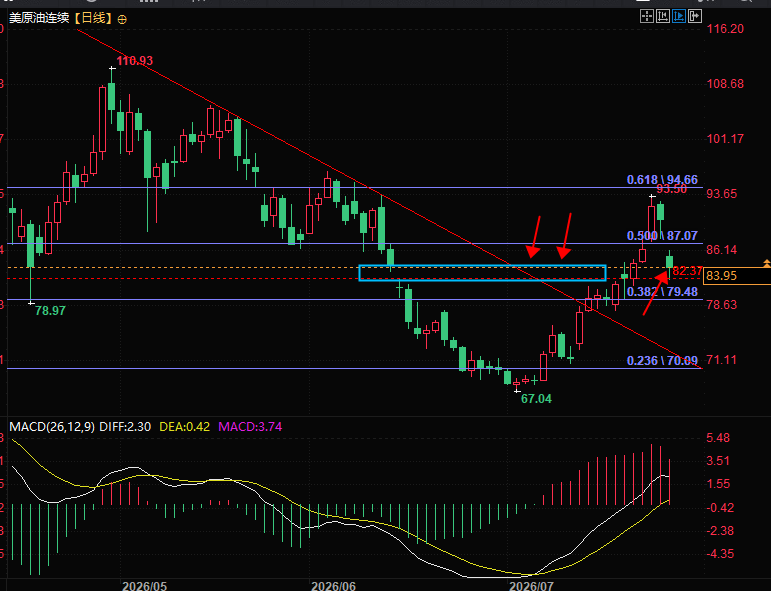
On the surface, the risks of a US-Iran conflict have not subsided, and oil prices should theoretically remain high. However, as Iran is continuously weakened, its bargaining chips may actually be decreasing. Currently, Iran's repeated blockades of the Strait of Hormuz are causing numerous problems for global energy inflation, while the US is actively maintaining navigation through the strait. The market seems to be forgetting that Iran is the victim of aggression and is gradually beginning to believe that Iran is the cause of rising international oil prices. Simultaneously, due to the US's continued blockade of Iran's financial resources, from online currency transfers to actual crude oil exports, Iran's bargaining chips are actually decreasing. If Iran waits until it has no cards left to play, it may have no room for negotiation at the table. Therefore, Iran may choose to negotiate when it deems it worthwhile, giving up some bargaining chips in exchange for more tangible benefits and the lifting of the blockade. This will force the market to place bets before seeing its last card, as Iran cannot wait until it has no cards left to play before choosing to negotiate. From a technical perspective, WTI crude oil has retreated from its highs, breaking through the important level of 87 and finding support near the previous gap. The current resistance level is around 87.07, near the 0.500 level.Institutional Viewpoint:
HSBC's U.S. interest rate strategist, Diraj Narullah, stated in an interview that rising oil prices have led the market to again anticipate that the Federal Reserve may need to maintain a tight monetary policy for a longer period. However, he also pointed out that despite rising energy prices, inflation expectations remain generally manageable. He believes this is because Federal Reserve officials continue to send clear signals, stating their commitment to price stability and preventing the impact of oil price shocks from transmitting to long-term inflation expectations. IG market analyst Tony Sicamor stated that market expectations for a diplomatic breakthrough have increased. "More and more people are hoping for a viable diplomatic solution. If all parties can restart the 14-point Memorandum of Understanding (MOU) and reach a clearer arrangement on the control of the Strait of Hormuz, it will be a solid start." MST Marquee analyst Sol Kavone stated that even if the military conflict eases, shipping traffic is unlikely to recover quickly. Even if shipping traffic in the Strait of Hormuz rebounds, the process is likely to be slow and the recovery limited. Many shipping companies remain cautious and will only arrange for more empty ships to enter the strait after the situation is fully confirmed to be safe. At 21:11 Beijing time, WTI futures were trading at $84.28 per barrel.- Risk Warning and Disclaimer
- The market involves risk, and trading may not be suitable for all investors. This article is for reference only and does not constitute personal investment advice, nor does it take into account certain users’ specific investment objectives, financial situation, or other needs. Any investment decisions made based on this information are at your own risk.