Kaohsiung polls plummet; two central bank decisions put the yen to a critical test.
2026-07-27 21:54:05
Sanae Kaoichi's cabinet approval rating plummeted by 10 percentage points to 58%, marking the rapid fading of her honeymoon period. This change is not accidental, but rather an inevitable result of the divergence between her policy orientation and the public's actual feelings: Rising inflation and cost of living (the core reason): The expectation of expansionary fiscal and monetary easing policies since Kaoichi took office has exacerbated inflationary pressures and the depreciation of the yen, leading to persistently high costs of imported goods such as food and energy. Public dissatisfaction with her policies to address rising prices has increased significantly. Misalignment between radical agendas and people's livelihood demands: While the hardline defense expansion, constitutional amendments, and the highly controversial "second capital" legislative agenda have solidified the conservative base, the forceful implementation in the Diet has provoked resentment among neutral voters towards the "hardline style" and "neglect of people's livelihoods." However, it must be said that Sanae Takaichi's camp is also a "stock market expert." They dissolved the House of Representatives when their approval rating exceeded 69%, ultimately securing a two-thirds majority. Under normal circumstances, there is no immediate risk of a forced revocation of the cabinet by the opposition parties. The primary test will be the LDP presidential election in September 2027, with the risk of losing power only in the July 2028 House of Councillors election. However, there is a well-known "Aoki's Law" in Japanese politics: if the cabinet's approval rating plus the LDP's approval rating is less than 50%, the government enters a state of "brain death." Once this indicator is triggered, market expectations for "a change of party president/political turmoil" will instantly reach their peak, causing sharp fluctuations in the yen. 
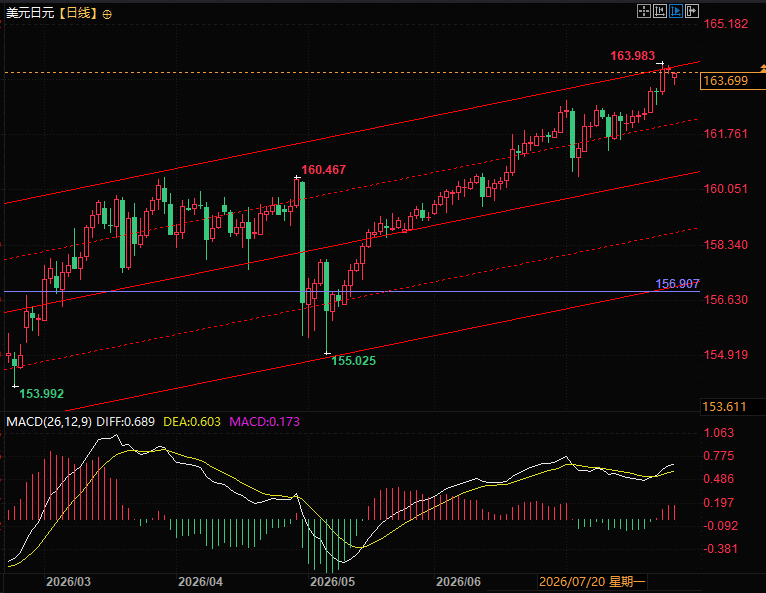 (USD/JPY daily chart, source: FX678)
Stability of Governance and Prediction of Political Trends
Despite a slight decline in approval ratings, given the structure of Japan's political system, the legal risk of the Takashi cabinet being impeached or forcibly removed from office by the Diet in the short term (within the next 12 months) is extremely low. The real decisive hurdle lies within the party and in subsequent elections: Legal Moat: A Supermajority in the House of Representatives Locks in External Risks The Liberal Democratic Party (LDP) and its ruling partners hold a vast majority of seats in the House of Representatives, making a no-confidence motion initiated by the opposition parties virtually impossible to pass. External parliamentary pressures prevent them from forcing the cabinet to resign, forming a "hard line of defense" for their governance. Real Hidden Dangers: A drop in approval ratings translates into "internal party vote anxiety." A significant decline in approval ratings doesn't mean "collapse tomorrow," but it will have a strong "slow-burning corrosive effect": Loss of the initiative to dissolve the House of Representatives: During a period of declining approval ratings, Takashi loses his strongest political bargaining chip for proactively dissolving the House and calling an early election, and can only passively respond to Diet inquiries. Gathering of Internal Challengers: LDP members are always most concerned about their own constituency seats. If Kaohsiung's approval rating remains low, local councilors and members of parliament will anticipate it becoming "vote poison." Party faction leaders and potential rivals will secretly consolidate their votes, accumulating momentum for a potential "graceful" showdown in the September 2027 Liberal Democratic Party presidential election. Policy will be caught in a tug-of-war: to salvage its poll numbers, Kaohsiung will be forced to grapple with either "adhering to a radical right-wing agenda" or "compromising on livelihood subsidies," significantly reducing its policy space.Macroeconomic Financial Perspective and Daily Exchange Rate Analysis
In the foreign exchange market, the market is closely watching how the Japanese political situation will affect the yen's exchange rate through policy transmission mechanisms. On Monday, geopolitical risks eased somewhat as the US and Iran suspended hostilities and opened the door to negotiations, leading to a rebound in global assets and a pullback in the USD/JPY pair. Although USD/JPY retreated from its 40-year high of nearly 164.00, it remained in a high-level consolidation around 163.50, and the overall upward trend remained intact. It should be noted that the recent phase of yen recovery is more due to the unwinding of long positions in the US dollar (short covering) triggered by the stabilization of the Middle East situation, rather than a substantial and strong support from the yen's own fundamentals. In addition, ahead of the upcoming interest rate decisions by the Federal Reserve (Fed) and the Bank of Japan (BoJ) this week, investors are generally cautious and avoiding blindly establishing one-sided positions. Technically, USD/JPY has undergone a slight pullback after rising to the upper rail of its ascending channel. There is still a possibility of testing the upper rail; keep an eye on this level, as it is a key turning point. (USD/JPY daily chart, source: FX678)Institutional Viewpoint:
Regarding the future trend of the foreign exchange market, analysts at MUFG Bank noted, "The decline in energy prices at the beginning of the week did provide Japanese policymakers with a valuable respite and helped to slow the upward momentum of USD/JPY." However, MUFG subsequently warned that this respite might be temporary: "If the Bank of Japan (BoJ) fails to provide clear hawkish forward guidance this week, the yen will remain highly vulnerable to further weakness, especially if the Federal Reserve (Fed) unexpectedly releases hawkish policy signals at its meeting this week, further highlighting the downward pressure on the yen." Market strategists pointed out that Prime Minister Sanae Takashi's approval rating has fallen to its lowest level since taking office, which could prompt the government to adopt a more accommodative stance on spending and tax policies, thereby triggering investor concerns about Japanese government bonds and the yen. Nomura Securities Chief Strategist Naka Matsuzawa stated that if the polls continue to deteriorate, the government may more aggressively pursue existing policies, which would be detrimental to Japanese government bonds and the yen. He further pointed out that strengthening reflationary policies would threaten global bond markets and the yen, and could also negatively impact the Japanese stock market, as it implies a decline in the government's ability to implement policies. SMBC Nikko Securities strategist Rinto Maruyama added that public discontent stems primarily from the government's failure to effectively address rising prices, and this discontent will drive the government to further expand fiscal spending and strengthen related measures. Kaohsiung City's previously promised food consumption tax reduction has yet to materialize, and the policy has been criticized for its lack of fiscal rationale. At 21:46 Beijing time, the USD/JPY exchange rate was 163.69/70.- Risk Warning and Disclaimer
- The market involves risk, and trading may not be suitable for all investors. This article is for reference only and does not constitute personal investment advice, nor does it take into account certain users’ specific investment objectives, financial situation, or other needs. Any investment decisions made based on this information are at your own risk.