A chart: The shipping market softens and cools down; the Baltic Dry Index ends its three-day winning streak.
2026-07-27 23:00:04
Latest data shows that on July 27, 2026, the Baltic Dry Index (BDI) closed at 2696 points, a four-day low, down 1.71% from the previous day, marking the largest drop since July 20, 2026. Looking at the short-term charts, the BDI has seen positive growth 5 times, negative growth 6 times, and zero growth 0 times in the last 11 BDI readings. Specifically, the Panamax Freight Index (BPI) closed at 1999 points, down 1.24% from the previous day; the Capesize Freight Index (BCI) closed at 4200 points, down 1.98%; and the Supramax Freight Index (BSI) closed at 1670 points, down 1.42%. For detailed charts of the Baltic Dry Index and its three main sub-indices, including the latest 720-day and 10-year trends, please refer to the charts provided by FX678. 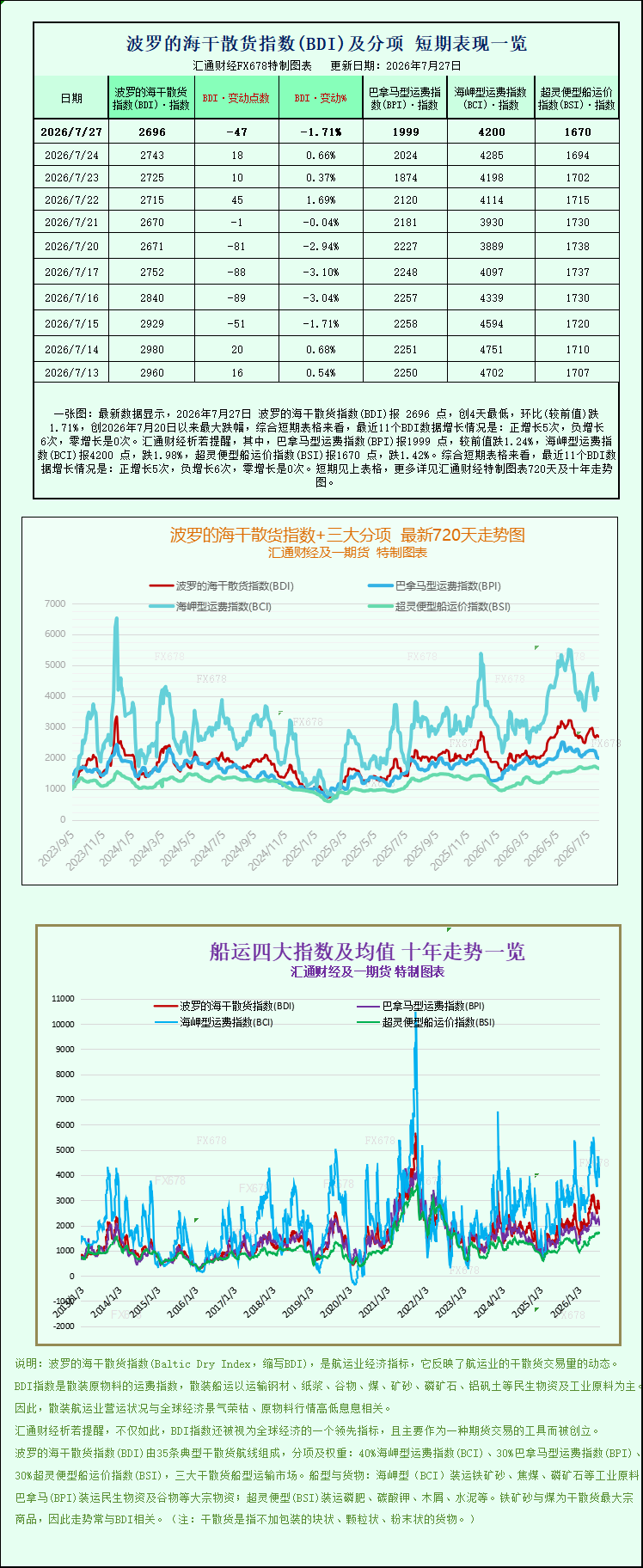 The global shipping market has entered a period of correction, with the Baltic Dry Index (BDI), a key indicator, officially ending its three-day winning streak on Monday, July 27. This decline was not due to fluctuations in a single vessel type, but rather a result of weakening freight rates across all vessel types. This, coupled with weak downstream demand for bulk commodities and diverging market expectations, brought the previous recovery momentum in the shipping market to a halt, casting uncertainty over the pace of global dry bulk trade recovery. As the core benchmark index for the global dry bulk shipping market, the Baltic Dry Index primarily tracks freight rates for the three major dry bulk carrier types: Capesize, Panamax, and Supramax. It directly reflects the supply and demand of global seaborne commodities such as iron ore, coal, and grain, and is considered a "barometer" of the global real economy and commodity trade. This correction marks the first decline in the index since July 21, signifying the complete end of the short-term shipping market rebound. Specific data shows that the core Baltic Dry Index fell sharply by 47 points, a drop of 1.7%, closing at 2696 points. Freight rates across all vessel types declined, indicating significant pressure on the overall market. Capesize vessels, the largest in size and carrying the largest volume of commodities, led the market decline, becoming the main drag on the index. Data shows that the Capesize index fell 85 points, a drop of 2%, closing at 4200 points, the lowest level since July 23, indicating a significant short-term drop in freight rates. In terms of actual operating revenue, the profit margins of Capesize vessels also contracted. This vessel type mainly carries bulk cargoes of 150,000 tons or more, with core transport categories including essential industrial raw materials such as iron ore and thermal coal, making it a core vessel type connecting heavy industry trade. On that day, the average daily operating revenue of Capesize vessels decreased by $770 to $34,587, directly reflecting the cooling trend in orders for industrial raw material shipping. Industry analysts point out that the core reason for the sharp drop in Capesize freight rates is the continued weakening of demand from China's industrial sector. As the world's largest consumer of iron ore and coal, the operating conditions of China's steel industry directly dominate dry bulk shipping demand. Recently, the profit margins of domestic steel companies have continued to decline, industry production enthusiasm has contracted, and steel mills' demand for raw material restocking has cooled significantly, directly leading to a decline in iron ore seaborne procurement. Meanwhile, the market had previously speculated on the introduction of economic stimulus policies in China this week, which initially boosted shipping market sentiment and caused a slight rebound in freight rates. However, market expectations became cautious before the stimulus policies were implemented, and sentiment quickly declined after the previous positive effects were priced in. Coupled with the seasonally weak demand during the traditional summer off-season for shipping, these multiple factors offset each other, causing iron ore prices to fall sharply and further suppressing the support for Capesize freight rates. In addition to large Capesize vessels, the market for medium-sized Panamax vessels also continued its weak trend, with the decline further confirming the overall softening trend in the shipping market. Data shows that the Panamax index fell 25 points, or 1.2%, to close at 1999 points, a new low since May 1st of this year, with the weak market trend deepening. Panamax vessels mainly carry cargo of 60,000 to 70,000 tons, with core transport categories being energy commodities such as thermal coal and grains, as well as agricultural products, catering to both industrial and consumer trade needs. The significant drop in freight rates indicates a comprehensive cooling of global demand for bulk commodities via sea freight. The profitability data is equally unfavorable, with average daily revenue for Panamax vessels falling by $223 to $17,990, and profitability continuing to decline. On the one hand, global industrial production enters a seasonal off-season during the summer, leading to a contraction in overseas coal procurement demand; on the other hand, global grain trade is stable, with no concentrated rush to transport or hoarding, resulting in insufficient growth in agricultural product sea freight orders. This dual weakness in demand has led to an oversupply of Panamax vessels, putting continued pressure on freight rates. This index correction is characterized by a general decline across all vessel types, completely eliminating market differentiation, with even small and medium-sized vessels not immune. The Supramax vessel index also declined, continuing the overall market downturn. Compared to larger vessels, Supramax vessels offer greater flexibility and are suitable for transporting a wider variety of small-batch dry bulk cargoes. Their falling freight rates further illustrate the lack of structural bright spots in current dry bulk shipping demand, with the overall market supply and demand situation leaning towards a loose balance. Looking at the current market trend, the three consecutive days of index increases were mainly driven by optimistic market expectations for global economic recovery and China's pro-growth policies, coupled with the release of short-term restocking demand in some regions, leading to a temporary recovery in freight rates. However, this rebound lacks substantial demand support and is a short-term sentiment-driven market. As expectations are gradually digested and the off-season demand weakness becomes apparent, a market correction is inevitable. The core contradiction in the current shipping market lies in weak demand. The slowdown in global industrial recovery, the weak recovery of the domestic steel industry, and insufficient activity in commodity trading are the core factors suppressing freight rates. Industry institutions indicate that the Baltic Dry Index may continue its weak and volatile trend in the short term, with subsequent market movements highly dependent on the effectiveness of domestic stimulus policies and the pace of recovery in downstream industrial demand. If the pro-growth policies are successfully implemented and steel mill operating rates rebound, the demand for iron ore and coal shipping is expected to recover, leading to a rebound in the index. Conversely, if demand remains weak, coupled with ample shipping capacity in the market, dry bulk freight rates may face further pressure, and a strong rebound in the market is unlikely in the short term.
The global shipping market has entered a period of correction, with the Baltic Dry Index (BDI), a key indicator, officially ending its three-day winning streak on Monday, July 27. This decline was not due to fluctuations in a single vessel type, but rather a result of weakening freight rates across all vessel types. This, coupled with weak downstream demand for bulk commodities and diverging market expectations, brought the previous recovery momentum in the shipping market to a halt, casting uncertainty over the pace of global dry bulk trade recovery. As the core benchmark index for the global dry bulk shipping market, the Baltic Dry Index primarily tracks freight rates for the three major dry bulk carrier types: Capesize, Panamax, and Supramax. It directly reflects the supply and demand of global seaborne commodities such as iron ore, coal, and grain, and is considered a "barometer" of the global real economy and commodity trade. This correction marks the first decline in the index since July 21, signifying the complete end of the short-term shipping market rebound. Specific data shows that the core Baltic Dry Index fell sharply by 47 points, a drop of 1.7%, closing at 2696 points. Freight rates across all vessel types declined, indicating significant pressure on the overall market. Capesize vessels, the largest in size and carrying the largest volume of commodities, led the market decline, becoming the main drag on the index. Data shows that the Capesize index fell 85 points, a drop of 2%, closing at 4200 points, the lowest level since July 23, indicating a significant short-term drop in freight rates. In terms of actual operating revenue, the profit margins of Capesize vessels also contracted. This vessel type mainly carries bulk cargoes of 150,000 tons or more, with core transport categories including essential industrial raw materials such as iron ore and thermal coal, making it a core vessel type connecting heavy industry trade. On that day, the average daily operating revenue of Capesize vessels decreased by $770 to $34,587, directly reflecting the cooling trend in orders for industrial raw material shipping. Industry analysts point out that the core reason for the sharp drop in Capesize freight rates is the continued weakening of demand from China's industrial sector. As the world's largest consumer of iron ore and coal, the operating conditions of China's steel industry directly dominate dry bulk shipping demand. Recently, the profit margins of domestic steel companies have continued to decline, industry production enthusiasm has contracted, and steel mills' demand for raw material restocking has cooled significantly, directly leading to a decline in iron ore seaborne procurement. Meanwhile, the market had previously speculated on the introduction of economic stimulus policies in China this week, which initially boosted shipping market sentiment and caused a slight rebound in freight rates. However, market expectations became cautious before the stimulus policies were implemented, and sentiment quickly declined after the previous positive effects were priced in. Coupled with the seasonally weak demand during the traditional summer off-season for shipping, these multiple factors offset each other, causing iron ore prices to fall sharply and further suppressing the support for Capesize freight rates. In addition to large Capesize vessels, the market for medium-sized Panamax vessels also continued its weak trend, with the decline further confirming the overall softening trend in the shipping market. Data shows that the Panamax index fell 25 points, or 1.2%, to close at 1999 points, a new low since May 1st of this year, with the weak market trend deepening. Panamax vessels mainly carry cargo of 60,000 to 70,000 tons, with core transport categories being energy commodities such as thermal coal and grains, as well as agricultural products, catering to both industrial and consumer trade needs. The significant drop in freight rates indicates a comprehensive cooling of global demand for bulk commodities via sea freight. The profitability data is equally unfavorable, with average daily revenue for Panamax vessels falling by $223 to $17,990, and profitability continuing to decline. On the one hand, global industrial production enters a seasonal off-season during the summer, leading to a contraction in overseas coal procurement demand; on the other hand, global grain trade is stable, with no concentrated rush to transport or hoarding, resulting in insufficient growth in agricultural product sea freight orders. This dual weakness in demand has led to an oversupply of Panamax vessels, putting continued pressure on freight rates. This index correction is characterized by a general decline across all vessel types, completely eliminating market differentiation, with even small and medium-sized vessels not immune. The Supramax vessel index also declined, continuing the overall market downturn. Compared to larger vessels, Supramax vessels offer greater flexibility and are suitable for transporting a wider variety of small-batch dry bulk cargoes. Their falling freight rates further illustrate the lack of structural bright spots in current dry bulk shipping demand, with the overall market supply and demand situation leaning towards a loose balance. Looking at the current market trend, the three consecutive days of index increases were mainly driven by optimistic market expectations for global economic recovery and China's pro-growth policies, coupled with the release of short-term restocking demand in some regions, leading to a temporary recovery in freight rates. However, this rebound lacks substantial demand support and is a short-term sentiment-driven market. As expectations are gradually digested and the off-season demand weakness becomes apparent, a market correction is inevitable. The core contradiction in the current shipping market lies in weak demand. The slowdown in global industrial recovery, the weak recovery of the domestic steel industry, and insufficient activity in commodity trading are the core factors suppressing freight rates. Industry institutions indicate that the Baltic Dry Index may continue its weak and volatile trend in the short term, with subsequent market movements highly dependent on the effectiveness of domestic stimulus policies and the pace of recovery in downstream industrial demand. If the pro-growth policies are successfully implemented and steel mill operating rates rebound, the demand for iron ore and coal shipping is expected to recover, leading to a rebound in the index. Conversely, if demand remains weak, coupled with ample shipping capacity in the market, dry bulk freight rates may face further pressure, and a strong rebound in the market is unlikely in the short term.
- Risk Warning and Disclaimer
- The market involves risk, and trading may not be suitable for all investors. This article is for reference only and does not constitute personal investment advice, nor does it take into account certain users’ specific investment objectives, financial situation, or other needs. Any investment decisions made based on this information are at your own risk.