While the immediate forecast for US second-quarter GDP appears robust, it also hints at a downside risk to the economy throughout the year.
2026-07-28 19:40:03
The ongoing conflict in Iran continues to weigh on the U.S. economic outlook, but the full impact of the Middle East crisis may be difficult to discern in this week's second-quarter GDP report. While geopolitical tensions have pushed up global energy prices and introduced new volatility into financial markets, the Q2 data primarily reflects economic activity from April to June, a period when many of the most severe shocks were still unfolding and had not yet fully materialized.  The U.S. Bureau of Economic Analysis (BEA) will release official second-quarter GDP data on July 30. Based on the median forecast, it is expected to roughly match the first quarter's annualized real growth rate of 2.1%. The Capital Spectator's median forecast has now been revised upward to 2.1% from 1.8% on July 18, while the Econoday consensus is slightly higher at 2.3%. This modest upward revision reflects stronger-than-expected retail sales data and resilient industrial production data in recent weeks, which have helped offset some of the drag from rising early input costs.
 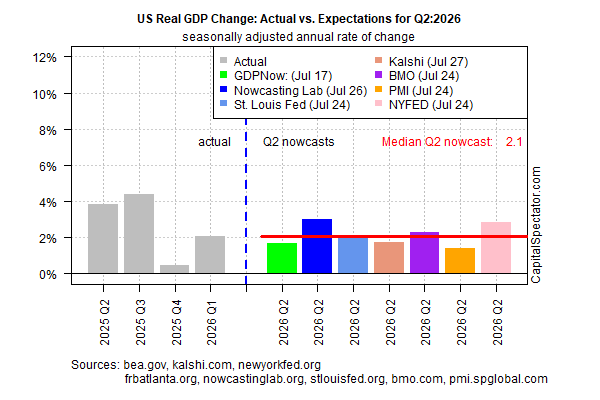 (Forecasts of US GDP growth for Q2 2026 from various institutions in late July 2026) Overall, the second quarter is expected to demonstrate the resilience of the economy again, despite a series of macroeconomic shocks. From stubborn inflation data to persistent supply chain frictions and evolving monetary policy expectations, the US economy, driven primarily by domestic demand rather than external trade, has shown underlying strength. The conflict with Iran remains a major risk, keeping energy prices high and increasing costs through the supply chain, while also increasing pressure on the Federal Reserve to tighten policy. Crude oil prices hovering around or above $100 per barrel have begun to push up gasoline prices at gas stations, increase transportation and logistics costs, and bring broader producer price pressures. These effects tend to be lagged, so Q2 GDP may still appear relatively unaffected, while the real economic costs will accumulate in the third and fourth quarters. The threat of further escalation continues to loom over markets, and ongoing geopolitical uncertainty amounts to a "tax" on growth—pushing up energy costs, disrupting trade flows, and tilting inflation risks to the upside. Businesses faced higher hedging costs and delayed investment decisions, while consumers reduced their purchasing power for non-essential goods due to increased energy and food budgets. Beyond energy, the conflict also indirectly impacted global trade routes and investor sentiment. Rising shipping and insurance costs in affected regions put moderate upward pressure on imported goods prices and reinforced the Federal Reserve's cautious stance on interest rate cuts. Nevertheless, consumer spending remained stable, thanks to income growth and continued modest employment increases in the labor market. Real disposable personal income continued to rise slightly, supported by wage growth in the service sector and cooling, though still high, housing costs. Households also drew on savings accumulated in earlier years, helping to maintain spending on durable goods and services.
 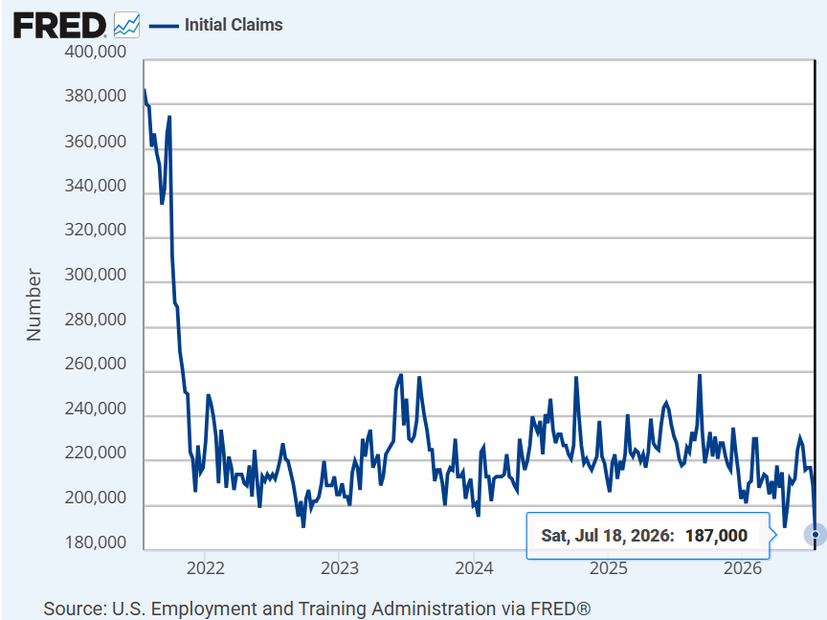 (Data from the St. Louis Federal Reserve Bank's economic database shows that after a decline from its peak, initial jobless claims in the US have remained at a healthy level of 200,000-240,000 for an extended period. This figure is projected to further decrease to an extremely low 187,000 by July 2026, indicating an optimistic outlook for the job market.) Layoffs remain scarce, with new jobless claims falling to 187,000 last week, the lowest level since 1969. This remarkable strength in initial jobless claims data highlights the resilience of the labor market, which has far exceeded many analysts' expectations despite multiple shocks. Half-century low jobless claims coupled with oil prices at $100 indicate that the labor market has virtually no slack, a combination that could become problematic if the conflict continues. Tight labor markets typically translate into stronger wage bargaining power, which benefits workers in the short term but embeds higher labor costs that businesses will ultimately pass on to consumers, further complicating the inflationary situation. A brief lull in US-Iran hostilities suggests some improvement, but after five months of on-and-off fighting, future visibility remains low. Diplomatic efforts and ceasefire negotiations appear fragile, and markets are pricing in the possibility of renewed disruptions to oil supplies or shipping lanes in the Strait of Hormuz. Consequently, the Federal Reserve will find it increasingly difficult to ignore signals of rising inflation. Core PCE inflation readings remain stubbornly above the Fed's 2% target, and any sustained energy price shocks could re-accelerate overall inflation, forcing policymakers to maintain a restrictive stance for longer than previously anticipated. Given that everything is highly dependent on energy price movements, geopolitical stability, and the tightness of the labor market, the first half of the year may not serve as a reliable guide to the second half. Analysts increasingly predict a "high-uncertainty" environment in the second half of 2026, where benchmark growth could slow if oil prices remain high or businesses reduce capital spending due to heightened risk aversion. Downside risks include a more severe blow to consumer confidence or the re-emergence of supply chain bottlenecks, while upside surprises could come from a faster resolution of conflicts or stronger productivity growth. In short, while the upcoming second-quarter GDP data is likely to paint a mild and resilient picture, investors and policymakers should look beyond the surface. The second half of 2026 faces distinctly different risks, shaped primarily by forces outside of traditional cyclical drivers.
The U.S. Bureau of Economic Analysis (BEA) will release official second-quarter GDP data on July 30. Based on the median forecast, it is expected to roughly match the first quarter's annualized real growth rate of 2.1%. The Capital Spectator's median forecast has now been revised upward to 2.1% from 1.8% on July 18, while the Econoday consensus is slightly higher at 2.3%. This modest upward revision reflects stronger-than-expected retail sales data and resilient industrial production data in recent weeks, which have helped offset some of the drag from rising early input costs. (Forecasts of US GDP growth for Q2 2026 from various institutions in late July 2026) Overall, the second quarter is expected to demonstrate the resilience of the economy again, despite a series of macroeconomic shocks. From stubborn inflation data to persistent supply chain frictions and evolving monetary policy expectations, the US economy, driven primarily by domestic demand rather than external trade, has shown underlying strength. The conflict with Iran remains a major risk, keeping energy prices high and increasing costs through the supply chain, while also increasing pressure on the Federal Reserve to tighten policy. Crude oil prices hovering around or above $100 per barrel have begun to push up gasoline prices at gas stations, increase transportation and logistics costs, and bring broader producer price pressures. These effects tend to be lagged, so Q2 GDP may still appear relatively unaffected, while the real economic costs will accumulate in the third and fourth quarters. The threat of further escalation continues to loom over markets, and ongoing geopolitical uncertainty amounts to a "tax" on growth—pushing up energy costs, disrupting trade flows, and tilting inflation risks to the upside. Businesses faced higher hedging costs and delayed investment decisions, while consumers reduced their purchasing power for non-essential goods due to increased energy and food budgets. Beyond energy, the conflict also indirectly impacted global trade routes and investor sentiment. Rising shipping and insurance costs in affected regions put moderate upward pressure on imported goods prices and reinforced the Federal Reserve's cautious stance on interest rate cuts. Nevertheless, consumer spending remained stable, thanks to income growth and continued modest employment increases in the labor market. Real disposable personal income continued to rise slightly, supported by wage growth in the service sector and cooling, though still high, housing costs. Households also drew on savings accumulated in earlier years, helping to maintain spending on durable goods and services. (Data from the St. Louis Federal Reserve Bank's economic database shows that after a decline from its peak, initial jobless claims in the US have remained at a healthy level of 200,000-240,000 for an extended period. This figure is projected to further decrease to an extremely low 187,000 by July 2026, indicating an optimistic outlook for the job market.) Layoffs remain scarce, with new jobless claims falling to 187,000 last week, the lowest level since 1969. This remarkable strength in initial jobless claims data highlights the resilience of the labor market, which has far exceeded many analysts' expectations despite multiple shocks. Half-century low jobless claims coupled with oil prices at $100 indicate that the labor market has virtually no slack, a combination that could become problematic if the conflict continues. Tight labor markets typically translate into stronger wage bargaining power, which benefits workers in the short term but embeds higher labor costs that businesses will ultimately pass on to consumers, further complicating the inflationary situation. A brief lull in US-Iran hostilities suggests some improvement, but after five months of on-and-off fighting, future visibility remains low. Diplomatic efforts and ceasefire negotiations appear fragile, and markets are pricing in the possibility of renewed disruptions to oil supplies or shipping lanes in the Strait of Hormuz. Consequently, the Federal Reserve will find it increasingly difficult to ignore signals of rising inflation. Core PCE inflation readings remain stubbornly above the Fed's 2% target, and any sustained energy price shocks could re-accelerate overall inflation, forcing policymakers to maintain a restrictive stance for longer than previously anticipated. Given that everything is highly dependent on energy price movements, geopolitical stability, and the tightness of the labor market, the first half of the year may not serve as a reliable guide to the second half. Analysts increasingly predict a "high-uncertainty" environment in the second half of 2026, where benchmark growth could slow if oil prices remain high or businesses reduce capital spending due to heightened risk aversion. Downside risks include a more severe blow to consumer confidence or the re-emergence of supply chain bottlenecks, while upside surprises could come from a faster resolution of conflicts or stronger productivity growth. In short, while the upcoming second-quarter GDP data is likely to paint a mild and resilient picture, investors and policymakers should look beyond the surface. The second half of 2026 faces distinctly different risks, shaped primarily by forces outside of traditional cyclical drivers.
- Risk Warning and Disclaimer
- The market involves risk, and trading may not be suitable for all investors. This article is for reference only and does not constitute personal investment advice, nor does it take into account certain users’ specific investment objectives, financial situation, or other needs. Any investment decisions made based on this information are at your own risk.