A chart shows that shipping freight rates are generally weak, with the Baltic Dry Index falling to its lowest level in more than three weeks.
2026-07-28 22:50:04
Latest data shows that the Baltic Dry Index (BDI) closed at 2664 points on July 28, 2026, a new low since July 2, 2026, down 1.19% month-on-month, marking the second consecutive day of decline (including zero growth). Looking at the short-term charts, the BDI has seen positive growth 4 times, negative growth 7 times, and zero growth in the last 11 BDI data points. Specifically, the Panamax Freight Index (BPI) closed at 1988 points, down 0.55% from the previous value; the Capesize Freight Index (BCI) closed at 4140 points, down 1.43%; and the Supramax Freight Index (BSI) closed at 1648 points, down 1.32%. For detailed charts of the latest 720-day and 10-year trends of the Baltic Dry Index and its three main sub-indices, please refer to the charts specially created by FX678. 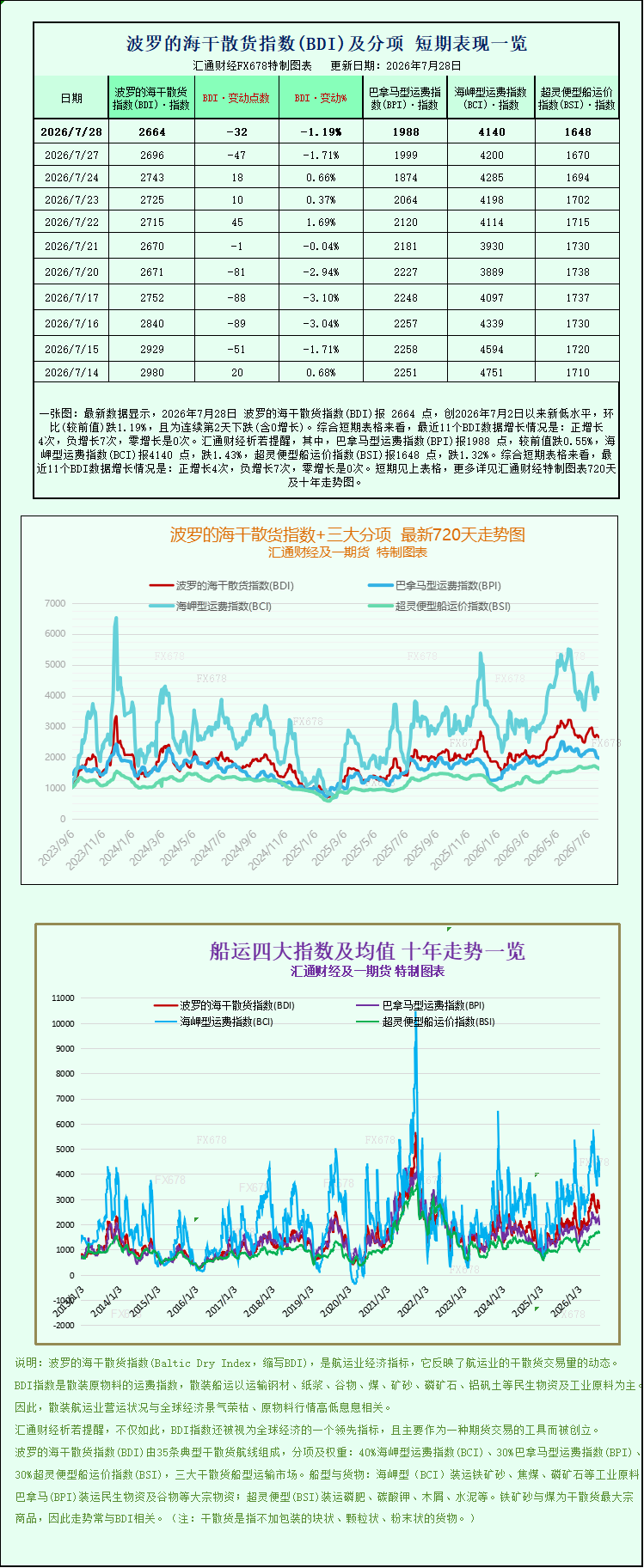 The global dry bulk shipping market has been under continued pressure recently, with freight rates falling across the board. On July 28, the Baltic Dry Index (BDI) saw a decline across the board, with the composite index falling to its lowest point in more than three weeks. Freight rates for all types of vessels, including large, medium, and small vessels, fell simultaneously, reflecting a temporary cooling in global demand for commodity shipping and a decline in international trade freight activity. As a core indicator of the global dry bulk shipping market, the Baltic Dry Index primarily tracks the freight rate trends of industrial raw materials and commodities such as iron ore, coal, and grain. It is an important leading indicator for assessing global industrial production, trade circulation, and macroeconomic vitality. This across-the-board decline sends a clear signal of weak global demand for commodity shipping. Data shows that on July 28, the Baltic Dry Index fell 32 points, a drop of 1.2%, finally closing at 2664 points, the lowest closing level in nearly three weeks since July 2. This index decline was not due to fluctuations in a single vessel type, but rather a result of overall market weakness. Freight rates for the three major dry bulk carriers—Capesize, Panamax, and Supramax—fell simultaneously, covering various long-haul and short-haul shipping routes, indicating a continued loose supply-demand balance in the market. Looking at the industry context, the dry bulk shipping market experienced a brief recovery in early July, with freight rates on some routes rising slightly. However, as downstream demand weakened, the upward momentum quickly faded, and freight rates continued to decline, completely reversing the previous moderate recovery trend. Capesize vessels, the mainstay of large-scale ocean shipping, became a significant drag on the index. Data shows that the Capesize vessel index fell 60 points that day, a drop of 1.4%, closing at 4140 points, the lowest value since July 22. These vessels primarily carry ultra-large quantities of cargo, typically around 150,000 tons, with core commodities being essential industrial raw materials such as iron ore and thermal coal. They are a core shipping force connecting global mineral resource exporting countries with industrial producing countries. In terms of specific profitability, the average daily revenue for Capesize vessels decreased by $539 to $34,048, further shrinking the profit margin for vessel operations. The core driver of this decline in Capesize freight rates was the contraction in seaborne iron ore demand due to production restrictions in China's steel industry. The domestic commodity futures market and the shipping market moved in tandem; on July 28th, Dalian iron ore futures continued their weak trend, marking the third consecutive trading day of decline. Currently, China's steel industry is in a period of adjustment. As the world's largest iron ore consumer, many major domestic steel companies have received notices of production restrictions and maintenance, proactively slowing down production and reducing blast furnace operating rates, directly leading to a significant reduction in iron ore procurement demand and weak growth in ocean-going iron ore orders. Although recent shipments from major global iron ore producing countries have declined somewhat, alleviating the pressure of oversupply in the shipping market and limiting the decline in freight rates and futures prices, this cannot reverse the core trend of weak demand and is insufficient to support a stabilization and recovery in shipping rates. While the decline in the Panamax vessel market, the mainstay of medium-sized mainline shipping, was relatively mild, the weakness was more persistent, hitting a multi-month low. The Panamax index fell 11 points, or 0.6%, to 1988 points, marking its lowest closing level since late April this year. The duration of the weak market was far longer than that of large vessels. Panamax vessels, with a deadweight tonnage of 60,000 to 70,000 tons, primarily handle short- and medium-haul and transoceanic trunk line transportation of bulk commodities such as coal, grain, and fertilizers globally. They are widely used in energy and agricultural trade. Their continued decline in freight rates reflects a simultaneous cooling in global energy restocking demand and agricultural product distribution demand. Profitability data shows that the average daily revenue of Panamax vessels decreased by $94 to $17,896, with continued pressure on the profitability of small and medium-sized ocean-going vessels. The small dry bulk vessel market was also not immune, with the downward trend further intensifying. The Supramax index fell 22 points, or 1.3%, to close at 1648 points, its lowest level since June 12. Supramax vessels, known for their high flexibility and wide route adaptability, primarily serve regional, small-batch bulk commodity transportation. The significant drop in freight rates indicates a general cooling of global regional commodity trade activity, with a widespread contraction in maritime demand for both industrial raw material replenishment and the distribution of consumer agricultural products. The simultaneous decline across all vessel types confirms the absence of structural opportunities in the current dry bulk shipping market, highlighting the overall supply-demand imbalance. Industry analysts stated that the across-the-board decline in the Baltic Dry Index is a result of weakening demand and cooling market expectations. In the short term, the maintenance and production restrictions at domestic steel companies have not yet ended, making a significant recovery in maritime demand for industrial bulk raw materials such as iron ore and coal unlikely. Coupled with the slowdown in industrial recovery in many parts of the world and weak demand for commodity restocking, the dry bulk shipping market will remain in a period of adjustment. In the medium to long term, the future market trend will depend heavily on the strength of the recovery in domestic industrial production, the recovery of global energy trade demand, and the increase in orders during the peak season for grain transportation in the Northern Hemisphere. If downstream demand remains weak, shipping rates may continue to fluctuate weakly.
The global dry bulk shipping market has been under continued pressure recently, with freight rates falling across the board. On July 28, the Baltic Dry Index (BDI) saw a decline across the board, with the composite index falling to its lowest point in more than three weeks. Freight rates for all types of vessels, including large, medium, and small vessels, fell simultaneously, reflecting a temporary cooling in global demand for commodity shipping and a decline in international trade freight activity. As a core indicator of the global dry bulk shipping market, the Baltic Dry Index primarily tracks the freight rate trends of industrial raw materials and commodities such as iron ore, coal, and grain. It is an important leading indicator for assessing global industrial production, trade circulation, and macroeconomic vitality. This across-the-board decline sends a clear signal of weak global demand for commodity shipping. Data shows that on July 28, the Baltic Dry Index fell 32 points, a drop of 1.2%, finally closing at 2664 points, the lowest closing level in nearly three weeks since July 2. This index decline was not due to fluctuations in a single vessel type, but rather a result of overall market weakness. Freight rates for the three major dry bulk carriers—Capesize, Panamax, and Supramax—fell simultaneously, covering various long-haul and short-haul shipping routes, indicating a continued loose supply-demand balance in the market. Looking at the industry context, the dry bulk shipping market experienced a brief recovery in early July, with freight rates on some routes rising slightly. However, as downstream demand weakened, the upward momentum quickly faded, and freight rates continued to decline, completely reversing the previous moderate recovery trend. Capesize vessels, the mainstay of large-scale ocean shipping, became a significant drag on the index. Data shows that the Capesize vessel index fell 60 points that day, a drop of 1.4%, closing at 4140 points, the lowest value since July 22. These vessels primarily carry ultra-large quantities of cargo, typically around 150,000 tons, with core commodities being essential industrial raw materials such as iron ore and thermal coal. They are a core shipping force connecting global mineral resource exporting countries with industrial producing countries. In terms of specific profitability, the average daily revenue for Capesize vessels decreased by $539 to $34,048, further shrinking the profit margin for vessel operations. The core driver of this decline in Capesize freight rates was the contraction in seaborne iron ore demand due to production restrictions in China's steel industry. The domestic commodity futures market and the shipping market moved in tandem; on July 28th, Dalian iron ore futures continued their weak trend, marking the third consecutive trading day of decline. Currently, China's steel industry is in a period of adjustment. As the world's largest iron ore consumer, many major domestic steel companies have received notices of production restrictions and maintenance, proactively slowing down production and reducing blast furnace operating rates, directly leading to a significant reduction in iron ore procurement demand and weak growth in ocean-going iron ore orders. Although recent shipments from major global iron ore producing countries have declined somewhat, alleviating the pressure of oversupply in the shipping market and limiting the decline in freight rates and futures prices, this cannot reverse the core trend of weak demand and is insufficient to support a stabilization and recovery in shipping rates. While the decline in the Panamax vessel market, the mainstay of medium-sized mainline shipping, was relatively mild, the weakness was more persistent, hitting a multi-month low. The Panamax index fell 11 points, or 0.6%, to 1988 points, marking its lowest closing level since late April this year. The duration of the weak market was far longer than that of large vessels. Panamax vessels, with a deadweight tonnage of 60,000 to 70,000 tons, primarily handle short- and medium-haul and transoceanic trunk line transportation of bulk commodities such as coal, grain, and fertilizers globally. They are widely used in energy and agricultural trade. Their continued decline in freight rates reflects a simultaneous cooling in global energy restocking demand and agricultural product distribution demand. Profitability data shows that the average daily revenue of Panamax vessels decreased by $94 to $17,896, with continued pressure on the profitability of small and medium-sized ocean-going vessels. The small dry bulk vessel market was also not immune, with the downward trend further intensifying. The Supramax index fell 22 points, or 1.3%, to close at 1648 points, its lowest level since June 12. Supramax vessels, known for their high flexibility and wide route adaptability, primarily serve regional, small-batch bulk commodity transportation. The significant drop in freight rates indicates a general cooling of global regional commodity trade activity, with a widespread contraction in maritime demand for both industrial raw material replenishment and the distribution of consumer agricultural products. The simultaneous decline across all vessel types confirms the absence of structural opportunities in the current dry bulk shipping market, highlighting the overall supply-demand imbalance. Industry analysts stated that the across-the-board decline in the Baltic Dry Index is a result of weakening demand and cooling market expectations. In the short term, the maintenance and production restrictions at domestic steel companies have not yet ended, making a significant recovery in maritime demand for industrial bulk raw materials such as iron ore and coal unlikely. Coupled with the slowdown in industrial recovery in many parts of the world and weak demand for commodity restocking, the dry bulk shipping market will remain in a period of adjustment. In the medium to long term, the future market trend will depend heavily on the strength of the recovery in domestic industrial production, the recovery of global energy trade demand, and the increase in orders during the peak season for grain transportation in the Northern Hemisphere. If downstream demand remains weak, shipping rates may continue to fluctuate weakly.
- Risk Warning and Disclaimer
- The market involves risk, and trading may not be suitable for all investors. This article is for reference only and does not constitute personal investment advice, nor does it take into account certain users’ specific investment objectives, financial situation, or other needs. Any investment decisions made based on this information are at your own risk.