Crude oil trading alert: Escalating tensions between the US and Iran have driven a return of safe-haven buying, leading to a significant rebound in US crude oil prices, which are now continuing to fluctuate widely.
2026-07-29 09:25:03
International crude oil markets saw a significant rebound on Wednesday, with WTI crude oil prices ending a three-day losing streak during Asian trading hours. Prices recovered from a two-week low hit the previous session, rising nearly 4% at one point to return to around $83. Market sentiment turned cautious, primarily due to renewed signs of tension in the Middle East, prompting investors to re-indulge in geopolitical risk premiums and driving a rapid return of buying interest in crude oil.  The Iranian Islamic Revolutionary Guard Corps recently launched multiple ballistic missiles at US targets in the Middle East, raising market concerns that the previously eased regional tensions could escalate again. Meanwhile, US President Trump stated that the US might resume military action if negotiations with Iran fail to make progress, and warned of potential action against key Iranian infrastructure. The market interprets these statements as increasing the risk of supply disruptions, providing renewed support for oil prices. Furthermore, the US Central Command stated that the US and Saudi Arabian militaries recently conducted joint operations against pro-Iranian armed groups in Iraq, further exacerbating investor concerns about the Middle East security situation. As the Middle East remains a crucial global energy supply region, any potential escalation of conflict could impact oil transportation and supply stability, leading the market to increase risk premiums again. The Strait of Hormuz has become a focal point of market attention. This strait carries a significant portion of global energy transportation, with the market estimating that approximately one-fifth of global seaborne oil shipments pass through this area . Previously, escalating regional tensions affected numerous ships, resulting in a significant decline in shipping activity. Although there has not yet been a large-scale disruption to oil supply, investor concerns about further risk expansion have provided short-term support for oil prices. Meanwhile, the evolving situation in the Red Sea region has increased uncertainty in the energy market. Recently, the Houthi rebels, closely linked to Iran, announced an expansion of their operations and indicated they might take measures against Saudi Arabian maritime transport. Market concerns arise that if both the Red Sea shipping route and Middle Eastern energy transport are affected, the global crude oil supply chain could face new pressure, further pushing up oil price volatility. From a supply and demand perspective, the current rise in oil prices is driven not only by geopolitical factors but also by the weakening US dollar. The recent decline in the US dollar index has lowered the cost of dollar-denominated crude oil for investors in other currencies, thus increasing its attractiveness. Furthermore, the market is awaiting the Federal Reserve's interest rate decision to assess the future trend of the US dollar and the outlook for global economic demand. However, the market still needs to monitor whether the rise in crude oil prices can be sustained. If tensions in the Middle East do not escalate further, and global inventory levels remain stable, oil prices may again be suppressed by expectations of slowing demand growth and ample supply. Investors are currently focusing on changes in US crude oil inventories, global energy transport conditions, and Federal Reserve policy signals, as these factors will collectively determine the next direction of WTI crude oil prices. From a daily chart perspective, WTI crude oil prices found support near a two-week low after a period of decline and have rebounded to the $83 area, forming a short-term technical correction pattern. In terms of trend structure, oil prices are still trading within the previous consolidation range. The current rebound is mainly driven by geopolitical risks, and further gains require stronger fundamental support. Resistance is seen in the $83-$84 area; a break above this area could lead to a test of the $86 resistance level. Support is seen in the $79-$80 area; a break below this area could lead to a return to around $77. Overall, daily momentum has improved, but changes in trading volume and subsequent risk events still need to be observed. The 4-hour chart for WTI crude oil shows a rapid rebound after ending a short-term downtrend, with short-term moving averages turning upwards and buying pressure clearly strengthening. The MACD indicator shows signs of recovery from low levels, and the RSI has risen back into the neutral-to-strong zone, indicating a recovery in short-term bullish momentum. However, oil prices are still close to the previous consolidation resistance area, and if a break above the $83 resistance level is not achieved, there is still a risk of profit-taking. If the price breaks through and holds above $84, it could open up further upside potential; conversely, if it fails to break through, the price may retest the $80 level to find new support.
 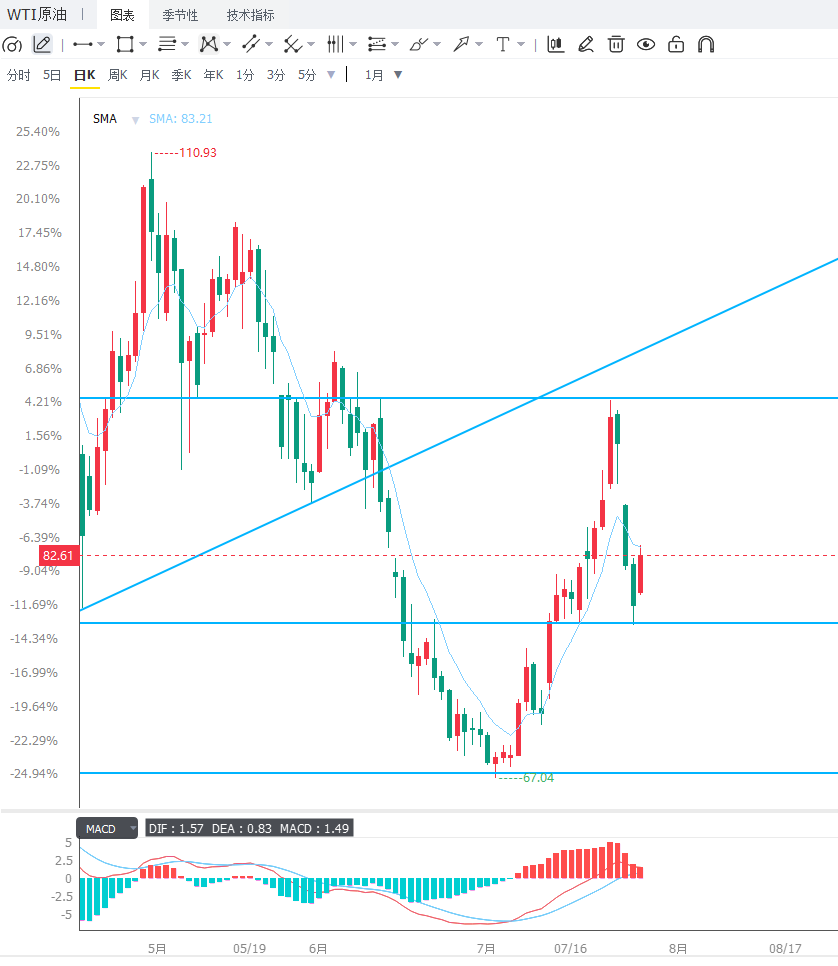 The recent rebound in WTI crude oil prices was primarily driven by renewed escalation of Middle East risks, with the market re-incorporating the possibility of supply disruptions, providing significant short-term support for prices. Current market focus has shifted from simple supply and demand to geopolitical risks, transportation security, and the stability of global energy supplies. Future oil price movements will still depend on the development of US-Iran relations, shipping conditions in the Strait of Hormuz, and changes in global crude oil inventories. If regional tensions continue to escalate, crude oil prices may continue to be driven by risk premiums; however, if the situation eases, the market may refocus on weak demand and supply growth pressures. Overall, WTI crude oil is biased towards a slightly bullish, volatile pattern in the short term, but high volatility risks will persist, and investors need to closely monitor changes in macroeconomic policies and geopolitical events.
The Iranian Islamic Revolutionary Guard Corps recently launched multiple ballistic missiles at US targets in the Middle East, raising market concerns that the previously eased regional tensions could escalate again. Meanwhile, US President Trump stated that the US might resume military action if negotiations with Iran fail to make progress, and warned of potential action against key Iranian infrastructure. The market interprets these statements as increasing the risk of supply disruptions, providing renewed support for oil prices. Furthermore, the US Central Command stated that the US and Saudi Arabian militaries recently conducted joint operations against pro-Iranian armed groups in Iraq, further exacerbating investor concerns about the Middle East security situation. As the Middle East remains a crucial global energy supply region, any potential escalation of conflict could impact oil transportation and supply stability, leading the market to increase risk premiums again. The Strait of Hormuz has become a focal point of market attention. This strait carries a significant portion of global energy transportation, with the market estimating that approximately one-fifth of global seaborne oil shipments pass through this area . Previously, escalating regional tensions affected numerous ships, resulting in a significant decline in shipping activity. Although there has not yet been a large-scale disruption to oil supply, investor concerns about further risk expansion have provided short-term support for oil prices. Meanwhile, the evolving situation in the Red Sea region has increased uncertainty in the energy market. Recently, the Houthi rebels, closely linked to Iran, announced an expansion of their operations and indicated they might take measures against Saudi Arabian maritime transport. Market concerns arise that if both the Red Sea shipping route and Middle Eastern energy transport are affected, the global crude oil supply chain could face new pressure, further pushing up oil price volatility. From a supply and demand perspective, the current rise in oil prices is driven not only by geopolitical factors but also by the weakening US dollar. The recent decline in the US dollar index has lowered the cost of dollar-denominated crude oil for investors in other currencies, thus increasing its attractiveness. Furthermore, the market is awaiting the Federal Reserve's interest rate decision to assess the future trend of the US dollar and the outlook for global economic demand. However, the market still needs to monitor whether the rise in crude oil prices can be sustained. If tensions in the Middle East do not escalate further, and global inventory levels remain stable, oil prices may again be suppressed by expectations of slowing demand growth and ample supply. Investors are currently focusing on changes in US crude oil inventories, global energy transport conditions, and Federal Reserve policy signals, as these factors will collectively determine the next direction of WTI crude oil prices. From a daily chart perspective, WTI crude oil prices found support near a two-week low after a period of decline and have rebounded to the $83 area, forming a short-term technical correction pattern. In terms of trend structure, oil prices are still trading within the previous consolidation range. The current rebound is mainly driven by geopolitical risks, and further gains require stronger fundamental support. Resistance is seen in the $83-$84 area; a break above this area could lead to a test of the $86 resistance level. Support is seen in the $79-$80 area; a break below this area could lead to a return to around $77. Overall, daily momentum has improved, but changes in trading volume and subsequent risk events still need to be observed. The 4-hour chart for WTI crude oil shows a rapid rebound after ending a short-term downtrend, with short-term moving averages turning upwards and buying pressure clearly strengthening. The MACD indicator shows signs of recovery from low levels, and the RSI has risen back into the neutral-to-strong zone, indicating a recovery in short-term bullish momentum. However, oil prices are still close to the previous consolidation resistance area, and if a break above the $83 resistance level is not achieved, there is still a risk of profit-taking. If the price breaks through and holds above $84, it could open up further upside potential; conversely, if it fails to break through, the price may retest the $80 level to find new support. The recent rebound in WTI crude oil prices was primarily driven by renewed escalation of Middle East risks, with the market re-incorporating the possibility of supply disruptions, providing significant short-term support for prices. Current market focus has shifted from simple supply and demand to geopolitical risks, transportation security, and the stability of global energy supplies. Future oil price movements will still depend on the development of US-Iran relations, shipping conditions in the Strait of Hormuz, and changes in global crude oil inventories. If regional tensions continue to escalate, crude oil prices may continue to be driven by risk premiums; however, if the situation eases, the market may refocus on weak demand and supply growth pressures. Overall, WTI crude oil is biased towards a slightly bullish, volatile pattern in the short term, but high volatility risks will persist, and investors need to closely monitor changes in macroeconomic policies and geopolitical events.
- Risk Warning and Disclaimer
- The market involves risk, and trading may not be suitable for all investors. This article is for reference only and does not constitute personal investment advice, nor does it take into account certain users’ specific investment objectives, financial situation, or other needs. Any investment decisions made based on this information are at your own risk.