Ahead of the Fed's decision, a wait-and-see attitude prevailed, and the USD/CAD pair continued its narrowing and consolidating range.
2026-07-29 14:02:49
The US dollar/Canadian dollar pair (USD/CAD) remained range-bound in Asian trading on Wednesday, hovering around 1.4100. Market focus is currently on the outcome of the Federal Reserve's two-day monetary policy meeting, with investors hoping to glean clues about the future path of interest rates from the policy statement and officials' remarks. This will be a crucial factor influencing the dollar's short-term movement.  The US dollar remains in a consolidation phase, having previously touched a one-month high. However, with the risk of a major Federal Reserve event looming, bulls are adopting a cautious approach. The market generally believes that the Fed's policy stance will determine the future direction of the dollar. If policy signals favor maintaining a high-interest-rate environment, the dollar may find support; conversely, a dovish stance could weaken its upward momentum. Meanwhile, the Canadian dollar is supported by rising oil prices. As a typical commodity currency, the Canadian economy is closely linked to the energy market, and rising oil prices typically benefit the Canadian dollar. Recently, WTI crude oil prices have rebounded significantly from near two-week lows, primarily driven by the deteriorating situation in the Middle East, with the market re-incorporating a supply risk premium. Stronger oil prices have improved expectations for Canadian energy exports, becoming a significant factor limiting the rise of the US dollar against the Canadian dollar. However, geopolitical risks continue to provide safe-haven support for the dollar. Recent tensions in the Middle East have escalated again, with the Iranian Islamic Revolutionary Guard Corps launching multiple ballistic missiles at US targets in the region. The US Central Command subsequently stated that the US and Saudi Arabia were conducting joint operations against pro-Iranian militia targets in Iraq. Furthermore, the US has again warned that further action may be taken if diplomatic efforts fail to yield rapid progress. These events have prompted the market to refocus on global energy supply security. Given the Middle East's crucial role in the global energy supply system, any potential supply risks could drive up crude oil prices and intensify market concerns about inflationary pressures. Rising oil prices could increase market expectations of persistently high interest rates , thus providing some support for the US dollar. Currently, there are differing market expectations regarding the monetary policy paths of the US and Canada. Investors believe the Federal Reserve is likely to maintain a cautious stance, while the Bank of Canada continues to face economic growth pressures and is inclined towards a relatively dovish policy. This policy divergence theoretically supports the USD/CAD exchange rate. However, the Canadian dollar's performance remains influenced by the oil market. If oil prices continue to rise due to geopolitical risks, the Canadian dollar may receive further support, putting pressure on the USD/CAD exchange rate. Conversely, if the situation in the Middle East eases and oil prices fall, the market may refocus on the USD/CAD interest rate differential, driving the exchange rate higher. In the short term, the USD/CAD exchange rate remains in a tug-of-war between bulls and bears. Investors need to pay close attention to Federal Reserve policy signals, changes in oil prices, and changes in global risk sentiment. Until a clear direction emerges, the exchange rate may continue to fluctuate around 1.4100. From a daily chart perspective, the USD/CAD pair has entered a consolidation phase after rebounding from a one-month low, currently trading around 1.4100. The overall structure indicates that the short-term rebound trend is not yet fully over, but the upward momentum has weakened. Resistance is seen in the 1.4150-1.4180 area; a break above this area could lead to a further test of the 1.4250 level. Support is seen at 1.4050, the psychological level of 1.4000, and the 1.3950 area. A break below 1.4000 could reconfirm the short-term correction trend. Current daily momentum is being suppressed by rising oil prices, and both bulls and bears are awaiting a new directional signal. The 4-hour chart shows the USD/CAD pair consolidating around 1.4100, with short-term moving averages gradually stabilizing, indicating the market is entering a directional decision phase. The MACD indicator shows a decline in upward momentum, while the RSI remains neutral, suggesting a temporary balance between buying and selling forces in the short term. If the price breaks through 1.4150, upside potential may open up, with a further challenge to the 1.4180-1.4250 area; a break below 1.4050 could increase downward pressure and test support near 1.4000. Short-term price action will still depend on the Fed's decision and volatility in the oil market.
 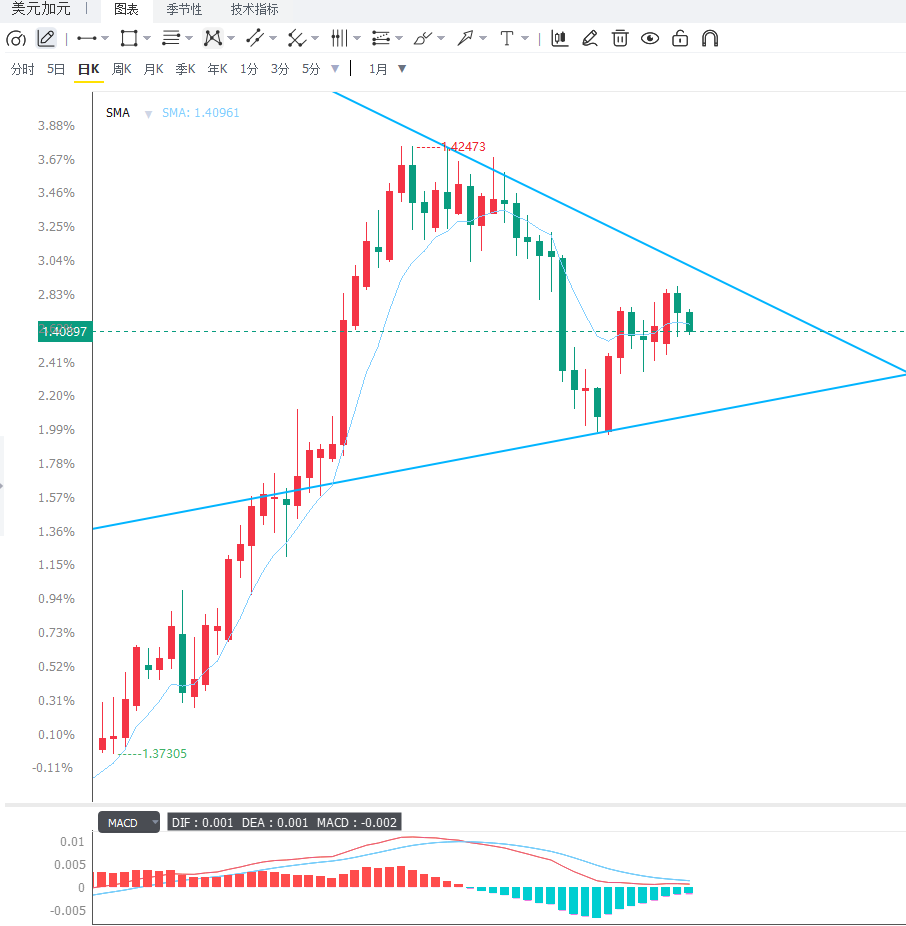 Editor's Summary: The USD/CAD pair is currently influenced by three factors: US interest rate expectations, oil prices, and geopolitical risks. The Federal Reserve's policy outlook is supporting the US dollar, while the rebound in oil prices is strengthening the Canadian dollar, limiting its upside potential. Future market direction depends on whether the Fed releases clearer interest rate signals and whether oil supply risks persist. If the Fed maintains a hawkish stance and risk aversion intensifies, the USD/CAD pair may strengthen again; however, if oil prices continue their upward trend, Canada's energy advantage may continue to support the Canadian dollar. Overall, USD/CAD is likely to remain range-bound in the short term. Investors should pay close attention to the breakout from the 1.4000-1.4200 range to determine the next trend direction.
The US dollar remains in a consolidation phase, having previously touched a one-month high. However, with the risk of a major Federal Reserve event looming, bulls are adopting a cautious approach. The market generally believes that the Fed's policy stance will determine the future direction of the dollar. If policy signals favor maintaining a high-interest-rate environment, the dollar may find support; conversely, a dovish stance could weaken its upward momentum. Meanwhile, the Canadian dollar is supported by rising oil prices. As a typical commodity currency, the Canadian economy is closely linked to the energy market, and rising oil prices typically benefit the Canadian dollar. Recently, WTI crude oil prices have rebounded significantly from near two-week lows, primarily driven by the deteriorating situation in the Middle East, with the market re-incorporating a supply risk premium. Stronger oil prices have improved expectations for Canadian energy exports, becoming a significant factor limiting the rise of the US dollar against the Canadian dollar. However, geopolitical risks continue to provide safe-haven support for the dollar. Recent tensions in the Middle East have escalated again, with the Iranian Islamic Revolutionary Guard Corps launching multiple ballistic missiles at US targets in the region. The US Central Command subsequently stated that the US and Saudi Arabia were conducting joint operations against pro-Iranian militia targets in Iraq. Furthermore, the US has again warned that further action may be taken if diplomatic efforts fail to yield rapid progress. These events have prompted the market to refocus on global energy supply security. Given the Middle East's crucial role in the global energy supply system, any potential supply risks could drive up crude oil prices and intensify market concerns about inflationary pressures. Rising oil prices could increase market expectations of persistently high interest rates , thus providing some support for the US dollar. Currently, there are differing market expectations regarding the monetary policy paths of the US and Canada. Investors believe the Federal Reserve is likely to maintain a cautious stance, while the Bank of Canada continues to face economic growth pressures and is inclined towards a relatively dovish policy. This policy divergence theoretically supports the USD/CAD exchange rate. However, the Canadian dollar's performance remains influenced by the oil market. If oil prices continue to rise due to geopolitical risks, the Canadian dollar may receive further support, putting pressure on the USD/CAD exchange rate. Conversely, if the situation in the Middle East eases and oil prices fall, the market may refocus on the USD/CAD interest rate differential, driving the exchange rate higher. In the short term, the USD/CAD exchange rate remains in a tug-of-war between bulls and bears. Investors need to pay close attention to Federal Reserve policy signals, changes in oil prices, and changes in global risk sentiment. Until a clear direction emerges, the exchange rate may continue to fluctuate around 1.4100. From a daily chart perspective, the USD/CAD pair has entered a consolidation phase after rebounding from a one-month low, currently trading around 1.4100. The overall structure indicates that the short-term rebound trend is not yet fully over, but the upward momentum has weakened. Resistance is seen in the 1.4150-1.4180 area; a break above this area could lead to a further test of the 1.4250 level. Support is seen at 1.4050, the psychological level of 1.4000, and the 1.3950 area. A break below 1.4000 could reconfirm the short-term correction trend. Current daily momentum is being suppressed by rising oil prices, and both bulls and bears are awaiting a new directional signal. The 4-hour chart shows the USD/CAD pair consolidating around 1.4100, with short-term moving averages gradually stabilizing, indicating the market is entering a directional decision phase. The MACD indicator shows a decline in upward momentum, while the RSI remains neutral, suggesting a temporary balance between buying and selling forces in the short term. If the price breaks through 1.4150, upside potential may open up, with a further challenge to the 1.4180-1.4250 area; a break below 1.4050 could increase downward pressure and test support near 1.4000. Short-term price action will still depend on the Fed's decision and volatility in the oil market. Editor's Summary: The USD/CAD pair is currently influenced by three factors: US interest rate expectations, oil prices, and geopolitical risks. The Federal Reserve's policy outlook is supporting the US dollar, while the rebound in oil prices is strengthening the Canadian dollar, limiting its upside potential. Future market direction depends on whether the Fed releases clearer interest rate signals and whether oil supply risks persist. If the Fed maintains a hawkish stance and risk aversion intensifies, the USD/CAD pair may strengthen again; however, if oil prices continue their upward trend, Canada's energy advantage may continue to support the Canadian dollar. Overall, USD/CAD is likely to remain range-bound in the short term. Investors should pay close attention to the breakout from the 1.4000-1.4200 range to determine the next trend direction.
- Risk Warning and Disclaimer
- The market involves risk, and trading may not be suitable for all investors. This article is for reference only and does not constitute personal investment advice, nor does it take into account certain users’ specific investment objectives, financial situation, or other needs. Any investment decisions made based on this information are at your own risk.