Geopolitical tensions escalate, the dollar weakens, and markets are betting on the Federal Reserve holding rates steady.
2026-07-29 17:44:50
Key points: The renewed US-Iran conflict caused oil prices to rebound, but the dollar index fell, reflecting market expectations that the Federal Reserve will maintain interest rates at its meeting at 2 AM on Thursday. Previously, the market had bet that the Warsh-led Fed might unexpectedly raise rates due to escalating inflation risks. However, with recent weakening economic fundamentals, rate hike expectations have quickly reversed, and the Fed is likely to keep rates unchanged tonight. The key point of interest is whether it will release hawkish signals regarding future interest rate arrangements. Furthermore, Warsh plans to push for the termination of the traditional "forward guidance" mechanism at this meeting to increase policy flexibility, making the details of the statement and policy stance of this decision highly uncertain. 
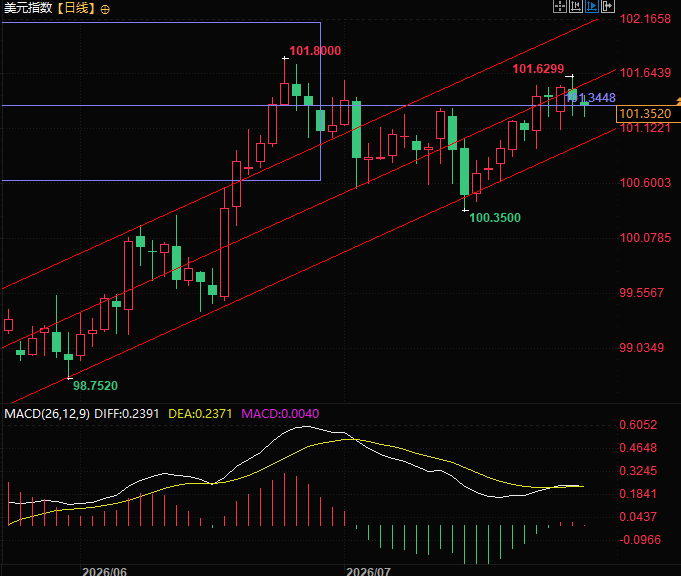 (US Dollar Index Daily Chart, Source: EasyTrade) At 17:42 Beijing time, the US Dollar Index is currently at 101.36.
Key market divergence: Oil prices and the US dollar are exhibiting inverse trading logic.
Ahead of the Federal Reserve's overnight policy meeting, global asset classes exhibited a typical structural divergence, with the focus of the bull-bear battle entirely concentrated on the FOMC policy decision. Driven by the escalating geopolitical conflict in the Middle East and pressure on the Strait of Hormuz and the Red Sea shipping lanes, market risk aversion rapidly intensified, leading to a significant return of the geopolitical risk premium for crude oil and a strong rebound in international oil prices. This fully reflects deep concerns about the uncontrolled situation in the Middle East and disruptions to oil supply. However, in stark contrast to the strong oil prices, the US dollar index weakened ahead of time. The core trading logic was not a decline in risk sentiment, but rather that the market had already priced in the high probability that the Fed would maintain interest rates unchanged tonight. The previously priced-in hawkish rate hike expectations cooled rapidly, leading to a collective cautious wait-and-see approach and early position reduction by dollar bulls, creating a divergence between strong oil and weak US dollar.Fed Policy Moves Ahead: Hawkish Expectations Overdrawn, Policy Framework Under Adjustment
The core reason for this round of market volatility lies in the market's over-inflation of expectations for a Federal Reserve interest rate hike. Previously, Brent crude oil rebounded sharply from $70 to $100, with soaring energy prices coupled with rising inflation concerns driving the market to bet that Fed Chairman Kevin Warsh might deliver more hawkish remarks or even an unexpected rate hike at this second policy meeting. A large amount of trading capital subsequently positioned itself as a long dollar, and US Treasury yields were also supported by hawkish expectations, holding above their highs. However, with recent US economic data continuing to weaken, oil prices retreating from their highs, and US Treasury yields declining slightly, market skepticism regarding the Fed's aggressive tightening has continued to rise. It is worth noting that the Fed under Warsh's leadership is adjusting its policy model, explicitly rejecting the traditional forward guidance mechanism, believing that this mechanism would restrict policy flexibility and bind market expectations that are difficult to implement. The Fed plans to terminate forward guidance at this meeting, while also promising frank and thorough policy discussions with Fed members, which makes the policy direction of this meeting highly uncertain. Although Warsh has consistently adhered to the policy bottom line of bringing inflation back to the 2% target, the market generally believes that inflationary pressures driven solely by energy are unlikely to support the Federal Reserve's interest rate hikes.Institutional Foresight: Limited Probability of Interest Rate Hikes, Global Yield Curve Hints at Structural Market Trends
In response to the upcoming FOMC meeting, major global investment banks have released their forward-looking assessments, generally agreeing on a "stability-oriented" approach, with uncertainty surrounding interest rate hikes and a divergence in interest rate structures. DBS Bank explicitly warned that current long positions in the US dollar carry significant risks. The market has over-priced in the Fed's hawkish stance, and trading logic is highly dependent on volatile energy prices rather than robust US macroeconomic fundamentals, creating clear trading loopholes. If the meeting fails to deliver an unexpectedly hawkish statement, does not result in an immediate rate hike, and does not release a clear signal of a September rate hike, speculative long positions in the US dollar will be forced to reduce their holdings, leading to a period of correction in the dollar. Even though the 10-year US Treasury yield previously held above 4.60%, it is insufficient to offset the expectation of policy easing due to weakening fundamentals. ING further added that the market is currently only pricing in a 30% probability of a rate hike this time, and the Fed maintaining the current interest rate remains the baseline scenario. Looking at the yield curve, if the meeting releases a moderately hawkish signal, short-term interest rates for non-US currencies such as the euro and pound sterling are expected to rise slightly. However, if tighter financial conditions impact market risk sentiment, long-term global interest rates will encounter strong upward resistance and are unlikely to follow short-term rates higher. Coupled with rising uncertainty in the global AI sector and increased stock market volatility, market risk appetite is weak. If the Fed unexpectedly raises interest rates, the tightening financial environment will suppress the valuation of risk assets, ultimately leading to a flattening of the global yield curve and significantly suppressing expectations for global economic recovery.Leading experts collectively warn: Supply-side shock inflation will do more harm than good when raising interest rates.
Several top Wall Street economists and former Federal Reserve officials have publicly stated their opposition to the Fed raising interest rates in response to the current inflation, arguing that this inflation is a typical supply-side shock, not caused by excessive demand. Moody's Analytics chief economist Mark Zandi explicitly stated that the core principle of monetary policy is clear: central banks should not blindly tighten policy in the face of supply-side shocks causing inflation. The current US labor market is already weak, and raising interest rates to suppress demand and cool inflation carries extremely high risks, easily dragging down the job market and triggering an economic recession—a dangerous operation that would be counterproductive. Former Fed Chair Janet Yellen also provided an authoritative assessment, reiterating that the Fed's default strategy should be to ignore supply-side inflation shocks, rather than passively raising interest rates. She emphasized that monetary policy cannot effectively curb supply-driven inflation without incurring extremely high unemployment costs; blindly raising interest rates will only sacrifice economic and employment stability and cannot fundamentally solve the price increases caused by Middle East geopolitical conflicts and energy and shipping disruptions. Market institutions also corroborate this view. David Kelly, chief global strategist at JPMorgan Asset Management, stated that current inflation lacks persistence and is a short-term, impulsive phenomenon that will eventually subside. Forcibly suppressing prices through interest rate hikes will only trigger an economic recession, and the market's focus on restoring purchasing power can only be achieved through income increases, not by suppressing prices. Goldman Sachs and Wolf Research also agree that interest rate hikes cannot solve supply-side problems such as energy shortages and geopolitical conflicts, and this round of limited interest rate hikes has little substantial help in cooling inflation.Summary of Key Outlook and Market Logic from the Meeting
Considering current policy expectations and market dynamics, this FOMC meeting will be a key watershed moment for the short-term dollar, crude oil, and global interest rates. The market has already priced in expectations of price stabilization, with dollar bulls taking profits and weakening prices; while oil prices remain strong due to rigid support from geopolitical risks, clearly demonstrating asset divergence. In the short term, under a supply-driven inflationary environment, the Fed is likely to maintain a wait-and-see approach, refusing aggressive rate hikes, and the previously priced-in hawkish expectations will be further corrected. If the meeting results in a stable stance and releases dovish language, the dollar will continue its weak adjustment, and the geopolitical premium for crude oil will be further consolidated; if it unexpectedly releases hawkish signals, rising short-term interest rates and tightening financial conditions may suppress risk assets, and the global market will experience a structural repricing. (US Dollar Index Daily Chart, Source: EasyTrade) At 17:42 Beijing time, the US Dollar Index is currently at 101.36.
- Risk Warning and Disclaimer
- The market involves risk, and trading may not be suitable for all investors. This article is for reference only and does not constitute personal investment advice, nor does it take into account certain users’ specific investment objectives, financial situation, or other needs. Any investment decisions made based on this information are at your own risk.