The real suspense surrounding the Federal Reserve isn't interest rates; could the 10-2 vote rewrite the dollar's pricing?
2026-07-29 17:54:51
On Wednesday, July 29th, the Federal Reserve's July interest rate meeting entered its final window before the decision announcement (to be released at 2:00 AM the following day). The target range for the federal funds rate has remained between 3.50% and 3.75% since the beginning of the year. This meeting will not update economic projections, so market attention is highly focused on the voting structure, the wording of the policy statement, and Chairman Kevin Warsh's comments on inflation at the press conference. The currency market has already entered a highly sensitive state, with the dollar index currently trading around 101.30, awaiting the decision. Some interest rate market pricing indicates an implied probability of a 25 basis point rate hike at this meeting of about 30%, meaning that while the market is still pricing in a no-deal scenario, a protective pricing of policy surprises remains. 
 This pattern closely resembles the market structure preceding major policy events: the direction remains intact, but the willingness to continue chasing prices weakens, awaiting new interest rate information to reset pricing. More importantly, the recent rise in the US dollar index does not entirely correspond to improved growth expectations. Repeated conflicts in the Middle East have pushed up energy risk premiums while simultaneously increasing uncertainty about the inflation path, making the dollar supported by both interest rate differential expectations and safe-haven demand.
The real core issue is not interest rate determination, but the voting structure.
Simply maintaining the interest rate range of 3.50% to 3.75% is unlikely to provide any significant information increment. The June meeting unanimously voted 12-0 to keep rates unchanged; therefore, if members like Logan or Hammark support a rate hike in July, the market will need to reassess the committee's tolerance for inflation risks. The June meeting minutes show that all 12 voting members supported keeping rates unchanged, meaning any dissenting vote represents a marginal crack in policy consensus. Market benchmark expectations are concentrated at or near a 10-2 vote. This does not mean the Fed has decided to enter a rate hike cycle, but rather that internal risk weights may be shifting further from employment and growth to inflation. If only Logan votes for a rate hike, while Hammark continues to support maintaining rates, an 11-1 vote is still acceptable. What could truly change the pricing of interest rate paths is more than two dissenting votes, especially if members not previously considered significantly tightening turn to support a rate hike. This is because the current policy issue has shifted from "whether interest rates are high enough" to "whether the energy shock is translating into more sustained price pressures." The Federal Reserve's July monetary policy report explicitly stated that inflation remains above the 2% long-term target, partly due to supply shocks in sectors such as energy. In other words, policymakers' observation of energy prices is no longer merely about short-term market fluctuations, but rather involves the risk of a second round of inflation.Inflation data appears to be easing, but policy constraints have not actually been lifted.
The U.S. Consumer Price Index (CPI) fell 0.4% month-over-month in June, the largest monthly decline since April 2020, but still rose 3.5% year-over-year. The core CPI, excluding food and energy, was flat month-over-month but rose 2.6% year-over-year. The energy index fell 5.7% month-over-month in June, the main reason for the overall index decline. This data presents a clear structural contradiction for the interest rate market. The month-over-month decline in total inflation mainly stemmed from a drop in energy prices, rather than a comprehensive cooling of demand. More notably, the personal consumption expenditures (PCE) price index, which the Federal Reserve prioritizes, remained high. In May, the overall PCE price index rose 4.1% year-over-year, and the core index rose 3.4% year-over-year, both significantly above the 2% target. The latest June data will not be released until July 30th, meaning this meeting is effectively the day before the release of important inflation data. This implies that if the Federal Reserve raises interest rates before the data is fully confirmed, it needs a very high degree of policy confidence; therefore, a direct rate hike remains a low-probability tail scenario. Conversely, if statements and votes indicate that a growing number of committee members believe current interest rates are insufficient to control inflation, the market will increase the probability of further policy tightening at the September meetings and subsequent ones. Warsh has also consistently emphasized price stability recently. During his congressional hearing on July 14, he stated that the committee has "no room for tolerance" for persistently high inflation and stressed that restoring price stability remains a policy priority. The July monetary policy framework also reaffirmed that the long-term inflation target remains 2%.The US dollar index is trading on tail risk in interest rates.
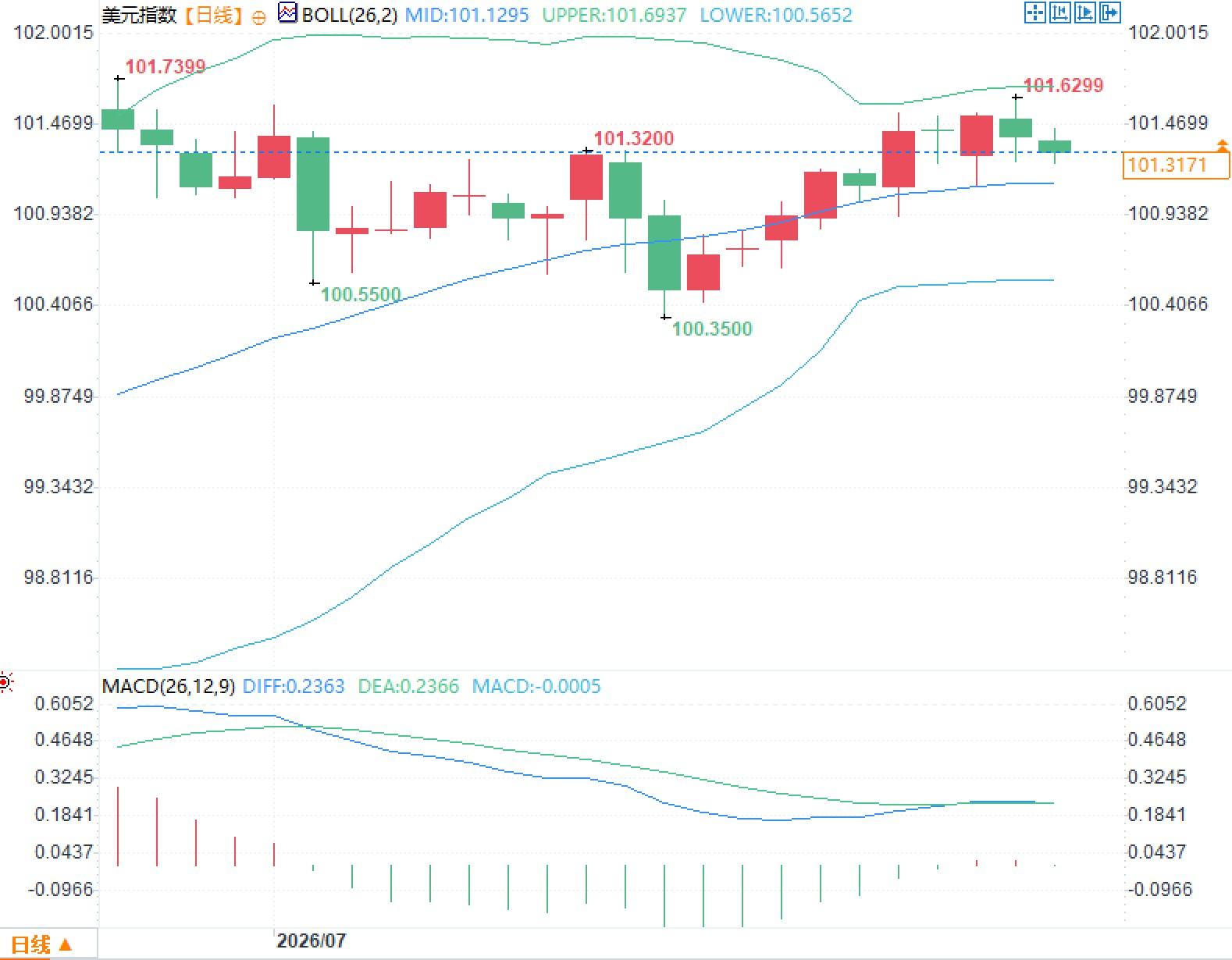
The US dollar index is currently trading above 101, with a strong correlation between technical structure and fundamentals. The Bollinger Band middle line is around 101.13, and the upper line is around 101.69. The current price is above the middle line but has not yet broken through the upper line; the 101.63 to 101.74 area previously formed significant short-term resistance. The MACD fast and slow lines are converging around 0.23, indicating that the upward trend remains, but marginal momentum has clearly declined. This pattern closely resembles the market structure preceding major policy events: the direction remains intact, but the willingness to continue chasing prices weakens, awaiting new interest rate information to reset pricing. More importantly, the recent rise in the US dollar index does not entirely correspond to improved growth expectations. Repeated conflicts in the Middle East have pushed up energy risk premiums while simultaneously increasing uncertainty about the inflation path, making the dollar supported by both interest rate differential expectations and safe-haven demand.
- Risk Warning and Disclaimer
- The market involves risk, and trading may not be suitable for all investors. This article is for reference only and does not constitute personal investment advice, nor does it take into account certain users’ specific investment objectives, financial situation, or other needs. Any investment decisions made based on this information are at your own risk.