Oil prices rose 6%, while gold prices bucked the trend and remained firm, suggesting that tonight's interest rate direction is already set.
2026-07-29 21:06:51
On Wednesday (July 29th) during the European and American trading sessions, an interesting scene unfolded: international oil prices fluctuated upwards, rising by over 6%, while gold prices also performed strongly, maintaining positive territory until recently, when they turned slightly lower, trading around 4020, down 0.23%. Typically, when oil prices rise by more than 4%, the market associates this with rising inflation and increased expectations of interest rate hikes, leading to a decline in gold prices. The main point is that today's strong performance in gold prices suggests that, ahead of the release of the results of the Federal Reserve's two-day key interest rate meeting, funds are leaning towards a more aggressive bullish bet on gold. Currently, there are also voices predicting an interest rate hike in the market. According to data from the CME FedWatch Tool, last week the market priced in a 25 basis point rate hike by the Fed at only 25.77%, while the current probability has climbed to 35.8%. However, compared to June 17th, both US inflation and labor force data have weakened simultaneously, while oil price increases have been limited. This is because the Federal Reserve unanimously voted to maintain interest rates on June 17th, making a rate hike less likely. Therefore, I believe a rate hike is improbable. Furthermore, the five new departments established by Warsh were specifically designed to clarify and define the factors influencing inflation and employment, as well as related benchmark indicators. Currently, there are no published benchmarks, meaning there is no reason to raise or lower rates. Of course, even if a black swan event occurs and a rate hike occurs, there's no need to panic. Forcibly proving independence might actually lower Treasury yields, as the market believes the Fed has the ability to control inflation, thus reducing the interest rate premium needed to compensate for inflation on bonds. 
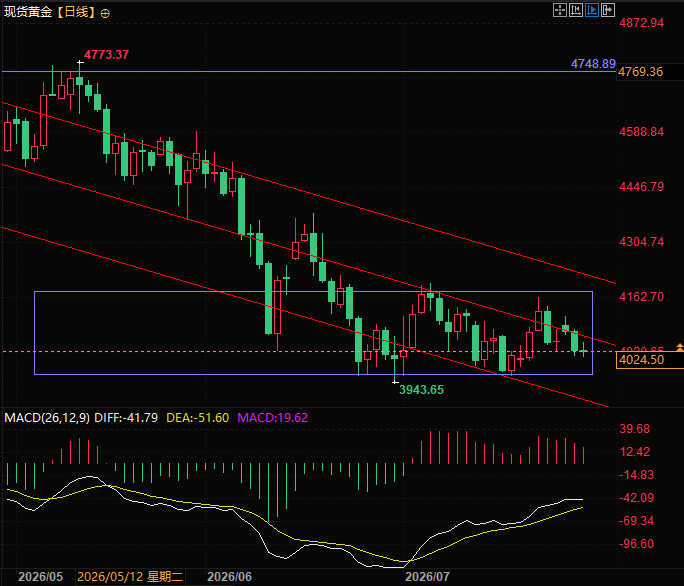 (Spot gold daily chart, source: FX678) At 21:02 Beijing time, spot gold is currently trading at $4,021 per ounce.
Middle East geopolitical tug-of-war, interest rate changes affect gold prices
In the geopolitical market, news of peace talks in the Middle East last night led to a temporary easing of the conflict, causing oil prices to plummet by 4%. However, today, Iran denied seeking negotiations with the US in the near future, stating it would not relinquish control of the Strait of Hormuz. Hours later, it launched a missile attack on US troops stationed in Jordan, shattering expectations of peace talks and increasing the risk premium for the US dollar and US Treasury bonds. Gold, being a non-interest-bearing asset, is highly sensitive to interest rate changes. Rising expectations of interest rate hikes will push up US Treasury yields and strengthen the US dollar, continuously compressing the upside potential of gold prices and becoming the core negative factor limiting the recent rebound in gold prices.Institutional Trading Alerts and Risk Warnings:
Although gold prices have seen a significant pullback, they remain at historically high levels, highlighting the continued risks of chasing the rally at these high levels. Darrell Fletcher, Managing Director of Commodities at Bannockburn Capital Markets, warns that as gold prices approach historical highs, blindly betting on short-term gains is extremely unprofitable. The uncertainty and risk of pullbacks for long positions at these high levels have increased dramatically, and chasing the rally in the short term can easily lead to being trapped. Despite short-term market pressure and increased risks, the medium- to long-term investment logic for gold has not collapsed and it still possesses solid investment value. Fletcher further analyzes that gold is breaking free from its long-term low-price consolidation pattern, and the value reassessment is continuing. Meanwhile, the demand for gold is continuously increasing, whether in terms of central bank foreign exchange reserve allocations or global individual investors' asset diversification, providing a solid foundation for the medium- to long-term trend of gold prices. Regarding the trading and allocation logic for gold, Alex Tsepaev, Chief Strategist of B2PRIME Group, provides a clear positioning: investors need to establish reasonable return expectations, extend the investment period, and properly allocate positions to hedge against short-term gold price volatility. Gold is not a speculative asset for seeking excess returns; its core value lies in its role as a stabilizer for asset portfolios, hedging against systemic risks such as inflation, geopolitics, and financial markets, thus ensuring overall asset stability. At the same time, the risks of speculative trading in gold should not be ignored. Thomas Wimmell, portfolio manager at Midas Asset Management, reminds market participants that spot gold, physical gold coins, and gold ETFs are all typical speculative investment options. As a commodity, gold prices are influenced by multiple complex variables, including macroeconomics, geopolitics, industrial demand, and financial liquidity, making its price movements highly unpredictable, with some price fluctuations even lacking clear fundamental support.Summary and Technical Analysis:
Overall, gold is currently exhibiting a divergence between concentrated short-term negative factors and a solid medium-to-long-term fundamental outlook. In the short term, gold prices are pressured by three factors: the upcoming Fed interest rate decision, easing Middle East geopolitical tensions, and falling oil prices, resulting in a continued narrow range of pressure and a persistently high-level consolidation pattern. However, from a medium-to-long-term perspective, global demand for safe-haven assets and hedging of currency credit continue to provide bottom support for gold prices. Investors should abandon rigid bullish thinking in their trading decisions, be wary of unexpected market fluctuations, strictly control positions and risks, and rationally respond to the directional market movements brought about by the Fed decision. Technically, gold prices are still in a downtrend, but if they do not break below the lower edge of the trading range at 3965 in the near term, they may transition from a downtrend to a range-bound consolidation pattern with the trading range as the central point. (Spot gold daily chart, source: FX678) At 21:02 Beijing time, spot gold is currently trading at $4,021 per ounce.
- Risk Warning and Disclaimer
- The market involves risk, and trading may not be suitable for all investors. This article is for reference only and does not constitute personal investment advice, nor does it take into account certain users’ specific investment objectives, financial situation, or other needs. Any investment decisions made based on this information are at your own risk.