Gold Trading Alert: Fed Holds Rates Steady, "Wash's Wording Too Complex"? Gold Prices Rise Immediately! Tonight's Focus: PCE Data
2026-07-30 07:20:49
On Wednesday (July 29), spot gold staged an unexpected reversal for many investors. Before the Federal Reserve announced it would maintain interest rates, gold prices had weakened, even dipping below the $4,000 mark during the session. However, after the Fed finally confirmed that it would keep the target range for the federal funds rate unchanged at 3.50% to 3.75%, spot gold quickly surged, briefly reaching $4,116 per ounce, its highest level since July 23. At the close of trading that day, spot gold rose 0.94%, settling at $4,066.13 per ounce. On Thursday (July 30) in early Asian trading, gold prices continued their upward trend, briefly touching the $4,100 mark, a gain of approximately 0.84%. This movement was noteworthy because of its "anomaly" with market expectations—Fed Chairman Warsh released rather hawkish signals at the press conference, and three FOMC members even voted for an immediate rate hike, but gold not only did not fall, but instead led a rebound in assets. Independent precious metals trader Tai Wong pinpointed this contradiction: "Despite Chairman Warsh's overall hawkish stance, precious metals are leading a modest asset rally—it feels like a relief rally following the Fed's decision to keep interest rates unchanged. It's unclear how long this rally will last. Warsh's wording is subtle and quite complex, so the market may change its mind after deeper reflection." 
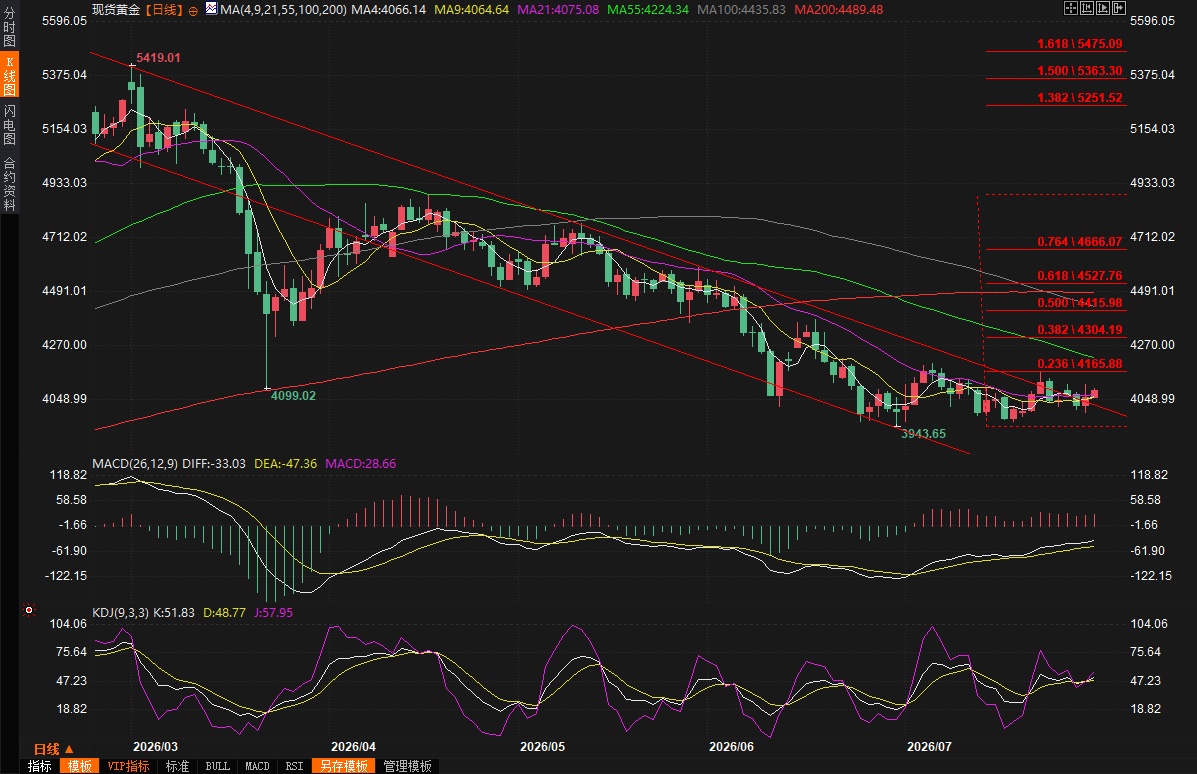 (Spot gold daily chart, source: FX678) At 07:15 Beijing time, spot gold is currently trading at $4090.66 per ounce.
The Fed's "hawkish pause": A rare internal division of 9 to 3.
This FOMC meeting was Warsh's second interest rate decision since succeeding Powell as Federal Reserve Chairman in May. The meeting decided to maintain the current interest rate by a 9-3 vote, but three dissenters—the presidents of the Cleveland, Dallas, and Minneapolis Fed branches—clearly advocated for an immediate 25-basis-point rate hike. These three officials had also voted against the rate hike at Powell's last meeting in late April. Such a large internal division is quite rare in the history of the Federal Reserve. Nationwide chief economist Kathy Bostjancic bluntly stated, "The large number of dissenting votes highlights that policymakers are becoming increasingly hawkish." Meanwhile, the market had already priced in about one-third of the probability of a rate hike before the decision was announced, with traders at one point betting on a near 30% chance of a rate hike. However, Warsh chose to remain on hold. He stated at the press conference, "I wanted to see a family debate, and I did. That's the purpose, and it's part of the system's design." He characterized this internal debate as an inherent part of the system's design, but also sent a clear message to the market: the Fed "will not waver" on the issue of combating inflation. Warsh emphasized that inflation has been above the Fed's 2% target for more than five consecutive years, a problem that "cannot be solved in nine weeks, nor can it be solved by a single month of modest price declines." He made it clear that the Fed does not have a higher "soft inflation target" and is determined to bring the inflation rate back to the long-term target of 2%.Why did the market rise instead of fall? Three forces combined to drive up gold prices.
Gold's surge against the trend in the face of such hawkish signals was primarily due to the convergence of three forces. The first force was the relief of seeing expectations of a rate hike dashed . Before the decision was announced, market expectations for a rate hike at this meeting rose rapidly, with some traders even betting on an unexpected rate hike. When the Fed ultimately chose to hold rates steady, pent-up buying was released, causing gold prices to jump by about $40 in a short period. CME FedWatch showed that after the decision, traders' expectations of a September rate hike fell from about 81% to 64%. The second force was the decline in the dollar and US Treasury yields . After the decision, the dollar weakened against the euro, making dollar-denominated gold cheaper for overseas buyers. The dollar index fell 0.58% on Wednesday, its largest single-day drop since April 30, closing at 100.81, after hitting a more than one-week low of 100.76 during the session. Meanwhile, the two-year US Treasury yield, after rising to 4.339% intraday, fell sharply by 5 basis points to 4.227%. The decline in short-term yields, which typically fluctuate in tandem with the Federal Reserve's interest rate expectations, provided direct support for gold. The third force —perhaps the most crucial—was the market's deep concern about long-term inflation and long-term interest rates. Despite the decline in short-term yields, the 30-year US Treasury yield surged 7.1 basis points to 5.167% after the Warsh press conference, even briefly exceeding 5.2% during the session, reaching its highest level since 2007. Tai Wong interpreted this as: "Panic in the long-term bond market dragged down the stock market before the close. Concerns about inflation helped gold outperform." This steepening yield curve, with "short-term declines and long-term rises," conveys a contradictory yet profound signal: the market has breathed a sigh of relief regarding interest rate hikes in the short term, but concerns about long-term inflation and the fiscal outlook are intensifying. It is precisely in this context that gold's appeal as a traditional inflation hedge has been reactivated.Geopolitical Storm: The Dual Force of Soaring Oil Prices and Safe-Haven Demand
If the Federal Reserve's decision ignited the gold price rebound, then the sharp escalation of the situation in the Middle East has provided sustained fuel for this rally. On July 29, the United States and Saudi Arabia jointly launched airstrikes against Iranian-backed armed groups in Iraq. This was the first major US military operation in the Middle East since President Trump suspended airstrikes against Iran the previous week. The airstrikes killed at least 20 members of the Iraqi Popular Mobilization Forces and wounded 32 others. Simultaneously, Iran fired on US military bases in Jordan and ships in the Strait of Hormuz, prompting Trump to vow retaliatory strikes. More worryingly, a floating liquefied natural gas storage vessel owned by a US company was attacked by a drone in the Egyptian port of Damieta. This incident signifies that the Middle East conflict is spreading from the main battlefield to a wider geographical area. Sources revealed that Trump is reassessing whether to launch a new large-scale military operation against Iran, and the US Central Command has drafted an operational plan to launch a high-intensity air offensive lasting 10 to 14 days. As a result, international oil prices surged by approximately 7%, with US crude oil futures closing up 6.56% at $84.46 per barrel and Brent crude oil futures jumping 7.91% to close at $90.74 per barrel. The surge in oil prices directly exacerbated market concerns about inflation—the Middle East wars are driving up global fuel and food prices. For gold, geopolitical risks provided dual support: on the one hand, safe-haven demand directly boosted gold buying; on the other hand, the inflationary pressures from rising oil prices strengthened gold's value as an inflation hedge.Market Outlook
In the short term, changes in expectations for a September rate hike will be a key variable. Following the decision, the probability of the Fed maintaining interest rates unchanged until September surged from 23.4% to 42.6%, while the probability of a rate hike of at least 25 basis points fell from 76.6% to 57.4%. The market will see the release of US June Personal Consumption Expenditures (PCE) data on Thursday—the Fed's preferred inflation indicator, the results of which could directly impact expectations for a September rate hike. From a broader perspective, gold is being pulled by two opposing forces. On one hand, the Fed under Warsh's leadership has demonstrated a strong commitment to combating inflation, and the high-interest-rate environment will continue to suppress non-interest-bearing gold assets. Some analysts believe that before the Fed's policy shift becomes clearer, gold prices will likely remain range-bound between $3960 and $4170. On the other hand, geopolitical risks show no signs of abating; Trump is assessing a new round of large-scale military strikes against Iran; the long-term inflation concerns reflected in the 30-year US Treasury yield exceeding 5.2% are still brewing; and continued gold purchases by global central banks provide long-term structural support. These factors together constitute the underlying logic of the gold bull market. (Spot gold daily chart, source: FX678) At 07:15 Beijing time, spot gold is currently trading at $4090.66 per ounce.
- Risk Warning and Disclaimer
- The market involves risk, and trading may not be suitable for all investors. This article is for reference only and does not constitute personal investment advice, nor does it take into account certain users’ specific investment objectives, financial situation, or other needs. Any investment decisions made based on this information are at your own risk.