A shocking "three-person defection" has emerged from the Federal Reserve; is Warsh facing a credibility crisis? The decision focuses on 5 key points.
2026-07-30 08:42:51
As expected, the Federal Reserve kept interest rates unchanged on Wednesday, with Chairman Kevin Warsh offering little direction in his press conference. A highlight of the meeting was the significant increase in dissenting votes, while Warsh attempted to clarify the committee's decision-making process. 
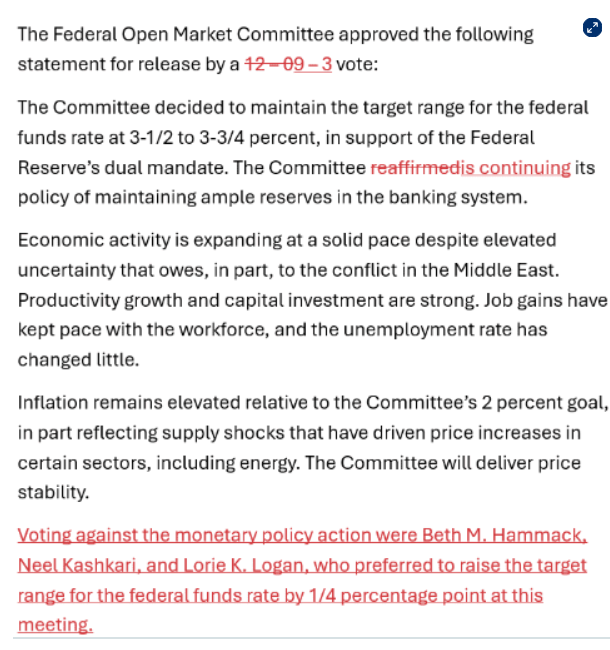 The statement released Wednesday is the second of its kind under Chairman Kevin Warsh, who pledged significant changes to how the Federal Reserve communicates its monetary policy expectations to the public. The previous statement in June already hinted at a shift in communication under Warsh's leadership. Analysis of past statements shows the June statement was about 130 words long, far fewer than the 300+ words found in recent meetings. It lacked forward guidance and voting information from FOMC members —both standard features of statements made under former Chairman Jerome Powell. Warsh acknowledged the “difference” early on in his first press conference as chairman in June, stating that forward guidance “is not appropriate for the current policy situation.” “It’s shorter, simpler, and has removed some old phrasing,” Warsh said in June. “That statement just told you the facts as best it could.” Previously, investors were accustomed to scrutinizing changes in the wording of such formulaic statements to gauge shifts in the central bank’s internal policy stance. But since last month's statement, traders have been speculating whether the Fed will now adopt a new, shorter template—or whether each statement will be substantially different. Some on Wall Street have begun using AI tools to analyze the central bank's communications under Warsh's leadership. Warsh announced in June the formation of several task forces to review key aspects of the Fed's operations. Earlier this month, he stated that University of Washington professor Peter Fisher and former Bank of England Governor Mervyn King, among others, are members of these communications-related task forces.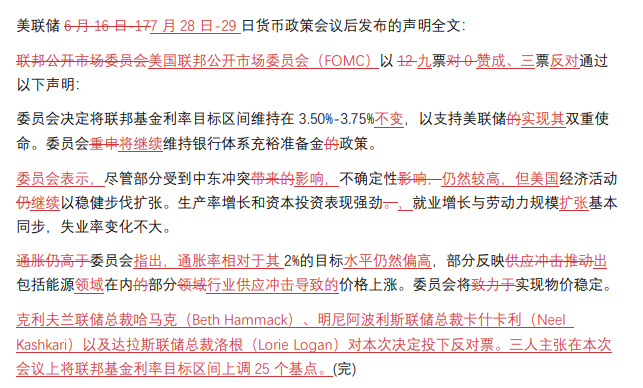
Here are the five key takeaways from the Fed's actions this week.
1. “Family Debate” Reappears Three members of the Federal Open Market Committee (FOMC) voted against keeping interest rates unchanged, advocating for a 25-basis-point hike. Warsh stated, “I asked for a heated family debate, and it came to fruition. That’s the point, and that’s part of the design.” “There was a noticeable increase in interaction among colleagues; it was a genuine family debate.” All the dissenting votes came from regional Fed presidents: Lorie Logan of the Dallas Fed, Neel Kashkari of the Minneapolis Fed, and Beth Hammack of the Cleveland Fed. Given their previous statements, this result was not unexpected. 2. Statement Remains Brief Aside from detailing the dissenting votes, the statement remained largely unchanged and was still much shorter than previous Fed statements. Warsh stated, "As before, the policy statement only states facts and deliberately avoids predictions. In the current period of high uncertainty, we believe this is a prudent approach." "Uncertainty does not equate to a lack of clarity." 3. A resolute fight against inflation, but… Warsh reiterated the Fed's determination to control inflation, but also reminded the market and the public that this battle will not be easy, nor will it end quickly. He said, "We don't have a magic wand." "This is not something that can be accomplished in days or weeks." 4. Market "rebellion" Despite the chairman's tough stance on inflation, the market did not buy it. Long-term Treasury yields rose sharply, while the policy-sensitive 2-year Treasury yield fell somewhat. The market's interpretation was: We believe you will continue to control short-term policy rates, but this will trigger significant inflation in the future. The 30-year Treasury yield saw the largest increase, rising 11.5 basis points to 5.211%, the highest level since 2007, seemingly undermining Warsh's credibility as an "inflation fighter." 5. No Hints at the September Meeting Investors tried to glean clues about whether the Fed would raise interest rates at the September 15-16 FOMC meeting, but found little to no answer. The statement offered neither forward guidance nor a hint of a reaction function, and Warsh's remarks were rather vague. He said, "I take seriously the transition period needed to reduce forward guidance. Reforms are not easy, but our overall assessment will help us make better decisions to fulfill our responsibilities."What did they say?
Commenting on the atmosphere of the two meetings he has chaired so far, Warsh said, “Undoubtedly, some of your comments today will talk about a split within the Fed. But that’s not how I’ve felt in the last few days and the days before. What I’ve felt is a group of professionals with different perspectives, different opinions, different judgments, but all willing to roll up their sleeves and have a family debate, and eager to reform the way the Fed makes policy.” Krishna Guha, Global Head of Policy and Central Bank Strategy at Evercore ISI, noted, “We’ve always believed that the real credibility test/trap for Warsh is in September, not July. If summer inflation and/or the war and energy situation are relatively hot, he will have to raise rates to maintain credibility. The key difference is that September is broadly data-dependent, while July is more dependent on Warsh’s preferences.” Chris Rupkey, Chief Economist at Fwdbonds, said, “The Fed under Warsh seems to be ignoring the inflation risk signals conveyed by higher yields in the bond market. Keep watching. The reform-oriented Fed looks like it has failed under Chairman Warsh. The bond market wants answers but gets none.”Comparison of Fed Decision Red Lines: What Changes Were Made in Warsh's Second Statement?
Economists and investors gleaned a glimpse into a new era of Federal Reserve communication from Wednesday's Federal Open Market Committee (FOMC) statement. Below is a comparison between Wednesday's FOMC statement and the statement from the previous policy meeting in June. Text removed from the June statement is marked in red with a strikethrough. Text appearing for the first time in the new statement is marked in red with an underline. Black text appears in both statements. The statement released Wednesday is the second of its kind under Chairman Kevin Warsh, who pledged significant changes to how the Federal Reserve communicates its monetary policy expectations to the public. The previous statement in June already hinted at a shift in communication under Warsh's leadership. Analysis of past statements shows the June statement was about 130 words long, far fewer than the 300+ words found in recent meetings. It lacked forward guidance and voting information from FOMC members —both standard features of statements made under former Chairman Jerome Powell. Warsh acknowledged the “difference” early on in his first press conference as chairman in June, stating that forward guidance “is not appropriate for the current policy situation.” “It’s shorter, simpler, and has removed some old phrasing,” Warsh said in June. “That statement just told you the facts as best it could.” Previously, investors were accustomed to scrutinizing changes in the wording of such formulaic statements to gauge shifts in the central bank’s internal policy stance. But since last month's statement, traders have been speculating whether the Fed will now adopt a new, shorter template—or whether each statement will be substantially different. Some on Wall Street have begun using AI tools to analyze the central bank's communications under Warsh's leadership. Warsh announced in June the formation of several task forces to review key aspects of the Fed's operations. Earlier this month, he stated that University of Washington professor Peter Fisher and former Bank of England Governor Mervyn King, among others, are members of these communications-related task forces.
- Risk Warning and Disclaimer
- The market involves risk, and trading may not be suitable for all investors. This article is for reference only and does not constitute personal investment advice, nor does it take into account certain users’ specific investment objectives, financial situation, or other needs. Any investment decisions made based on this information are at your own risk.