Attack on a US LNG ship in Egypt triggers geopolitical risks; what will be the future of oil prices?
2026-07-30 08:22:50
Brent crude futures opened lower in early Asian trading on Thursday (July 30), currently trading around $87.30 per barrel. Oil prices rebounded yesterday after a brief pullback following expectations of a ceasefire, with geopolitical risk premiums returning at a faster pace. On Wednesday, a US-owned floating liquefied natural gas (LNG) storage vessel was attacked by a drone in the Egyptian Mediterranean port of Damieta, marking a shift in the Middle East conflict from the main battlefield outwards. British maritime security firm Ambrey released a preliminary assessment stating that a drone struck the "Energos Winter," and the fire subsequently spread to another vessel. The Egyptian Ministry of Oil confirmed the fire at the port but did not mention a drone attack, stating that the fire was quickly extinguished and there were no casualties. 
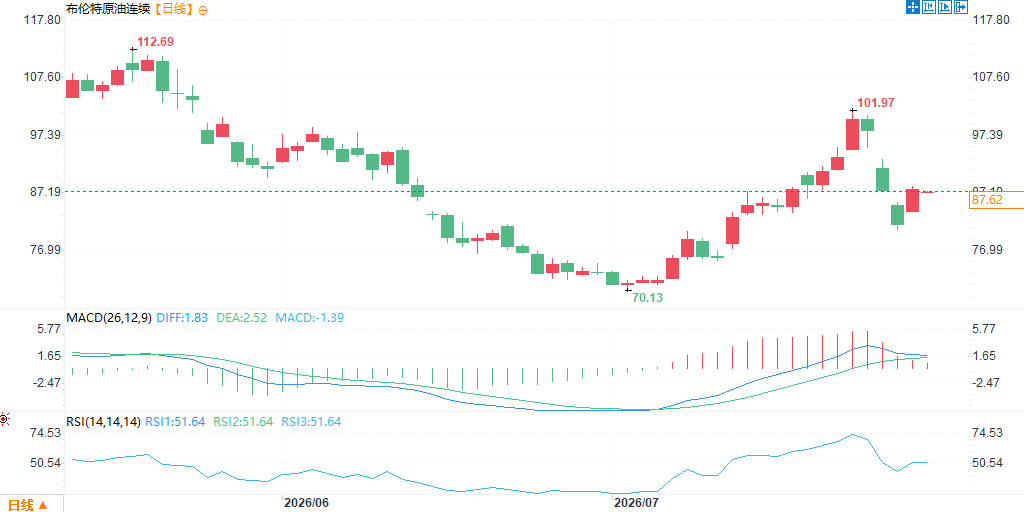 (Brent crude oil futures daily chart, source: EasyTrade) At 8:14 AM Beijing time on July 30, Brent crude oil futures were trading at $87.39 per barrel.
US-Saudi joint airstrikes on Iraq
This joint US-Saudi airstrike marks the first time Saudi Arabia has publicly joined Washington in striking Iranian-backed targets in Iraq. The Iraqi Popular Mobilization Forces (PMF)—a coalition of Iranian-backed paramilitary groups integrated into Iraqi security forces—reported that the airstrike killed at least 20 members and wounded 32. Iraqi men chanted Shiite slogans and "Death to America" as they carried the bodies of the victims. Washington and Riyadh stated that the strike was in retaliation for drone attacks launched from inside Iraq against Saudi oil facilities. This is the first major US military operation in the Middle East since pausing airstrikes last Friday. Iran's Hamshahriya newspaper reported that four advisors to the Iranian Revolutionary Guard were killed in the airstrike.dangerous rifts in Iraq
The attacks on Iraq have highlighted dangerous divisions within the country. The Iraqi government is one of the few countries globally that maintains close military and diplomatic ties with both Tehran and Washington, but this dual connection has long been a source of tension. Iraqi Prime Minister Muammar Zaidi, who took office two months ago, urged all parties to avoid escalation and expressed his desire to keep Iraq out of the conflict. The Iraqi presidential palace condemned the airstrikes as "unacceptable attacks and a blatant violation of Iraqi sovereignty," while calling on armed groups to cease attacks on neighboring countries. The presence of hundreds of thousands of Iranian religious pilgrims traveling to Iraqi holy sites for annual commemorations further underscores the close ties between the two nations.The diplomatic window opened briefly and then closed again.
After pausing airstrikes for several days, Trump vowed retaliation for Iranian attacks on U.S. forces. "Now it's our turn," he said at the White House. He added that Washington might reach an agreement with Iran at some point in the future, but "we're going to hit them hard." This comes after Iran rejected Oman's proposal for joint management of the Strait of Hormuz. Iran confirmed Tuesday evening that it had attacked U.S. military bases in Jordan and ships in the Strait of Hormuz. When Trump launched the attack on Iran in February, he stated that the military action would only last a few weeks, but the conflict has now lasted five months with no end in sight.Geopolitical premium re-included
The oil market reacted swiftly to the escalation. Brent crude futures rose more than 7% on Wednesday, essentially recovering losses from earlier in the week caused by Trump's unexpected weekend halt to airstrikes. U.S. officials privately warned that resuming large-scale military action against Iran carries risks, given the impact on ammunition stockpiles—the Center for Strategic and International Studies estimates that the U.S. military has fewer than 1,000 Patriot interceptor missiles and fewer than 250 THAAD interceptor missiles in its inventory.Institutional Views
A Citigroup report released on July 30th predicted that Brent crude oil could fall to $60-65 per barrel by the end of the year. Previously, in June, the bank had already lowered its Q3 average price forecast to $75, Q4 to $70, and 2027 to $65 (a significant downward revision from higher levels), reverting to a bearish scenario. The core logic is that the US-Iran Memorandum of Understanding (MOU) will essentially normalize traffic in the Strait of Hormuz by mid-to-late July, with fundamentals quickly returning to dominance: shipping recovery, absence of Asian buyers, a significant weakening of the physical market, and inventory reduction far below expectations. The bank believes the MOU may continue due to the lack of incentive for either side to disrupt it, and the market is currently only pricing in the agreement itself rather than sustained medium-term traffic flow; otherwise, prices should fall another $10-15. Even temporary frictions are unlikely to change the trend of oversupply and weak demand. Goldman Sachs recently stated that it predicts an average Brent crude oil price of $80 per barrel in Q4 2026 and an average price of $75 in 2027 (assuming the Strait of Hormuz remains open). The baseline scenario is supported by declining Middle Eastern production in the second half of the year, while offsetting downward pressure from higher-than-expected June production and weak demand from China, South Korea, and the Middle East. The bank expects oil prices to hold onto recent gains in July and August, driven by continued depletion of global and OECD commercial inventories, coupled with Middle Eastern production cuts and summer demand. However, the risks are clearly skewed to the upside: if the Strait of Hormuz disruption continues into 2027, Brent crude could break through $120 in the fourth quarter of 2026 and average around $100 in 2027.With five months of conflict showing no signs of abating, the Middle East is sliding into broader regional confrontation.
The attack on a US LNG carrier in Egypt, the joint US-Saudi airstrikes in Iraq, and the Houthi blockade of Saudi Red Sea ports—five months of Middle Eastern conflict are evolving from a bilateral confrontation between the US and Iran into a multi-front regional conflict encompassing the Mediterranean, the Red Sea, Iraq, Jordan, and the Strait of Hormuz. Trump's diplomatic window closed after only a few days, Iran rejected the Oman proposal, and both sides returned to the path of military confrontation. Oil prices have rebounded above $90 per barrel, reflecting the market's pricing in the escalation of the conflict. For the market, the core question now is: where is the next "red line" in this conflict? Whether the answer is the Mediterranean, Iraq, the Red Sea, or the Strait of Hormuz, the trend of expanding conflict is undeniable. The five-month war shows no signs of ending. (Brent crude oil futures daily chart, source: EasyTrade) At 8:14 AM Beijing time on July 30, Brent crude oil futures were trading at $87.39 per barrel.- Risk Warning and Disclaimer
- The market involves risk, and trading may not be suitable for all investors. This article is for reference only and does not constitute personal investment advice, nor does it take into account certain users’ specific investment objectives, financial situation, or other needs. Any investment decisions made based on this information are at your own risk.