Cooling expectations for a rate hike by the Reserve Bank of Australia vs. hawkish signals from the Federal Reserve: The Australian dollar awaits direction from the August meeting.
2026-07-30 10:40:52
On Thursday (July 30) during Asian trading hours, the Australian dollar traded in a narrow range against the US dollar, hovering around 0.6960 after three consecutive days of decline. Domestically, Australian inflation unexpectedly slowed to 3.8% in June (previous value 4.0%, expected 4.0%), a four-month low. Market expectations for another rate hike by the Reserve Bank of Australia this year plummeted from over 90% before the data release to about 50%, and the 10-year government bond yield fell back to 4.9%. Externally, the Federal Reserve voted 9-3 to keep interest rates unchanged, with three hawkish members dissenting. Warsh made a clear commitment at the press conference that he would "never waver in achieving the 2% inflation target." With these two forces intertwined, the Australian dollar sought short-term equilibrium around 0.6960. 
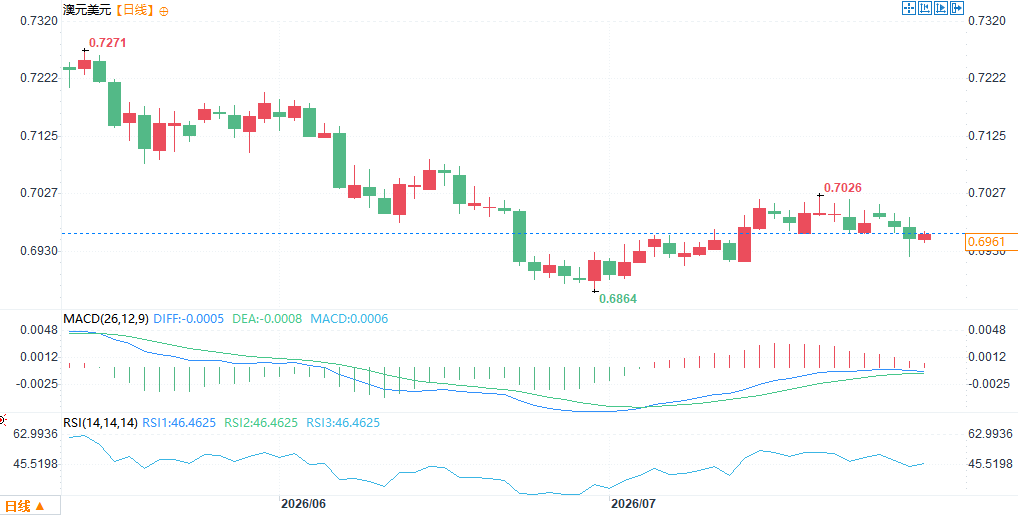 (Australian dollar/US dollar daily chart, source: EasyForex) At 10:38 Beijing time on July 30, the Australian dollar was trading at 0.6959/60 against the US dollar.
Cooling inflation has weakened expectations of a rate hike by the Reserve Bank of Australia, but a stable cutoff mean limits downside potential.
Australia's overall inflation unexpectedly slowed to 3.8% in June, lower than the previous reading and market expectations of 4.0%, marking the lowest level since the outbreak of the Iraq War in February. Following this data release, market expectations for an August rate hike by the Reserve Bank of Australia (RBA) have largely dissipated, with the probability of another rate hike this year plummeting from over 90% to around 50%. The 10-year government bond yield subsequently fell to 4.9%, further weakening interest rate support for the Australian dollar. However, the cooling inflation has not changed the entire picture. Strategists at BNY Mellon pointed out that Australia's overall CPI rose 3.8% year-on-year in June, unchanged from the previous month, while core inflation (cut-off mean) remained stable at 3.6%, also unchanged from the previous month. The lack of easing in both overall and core inflation indicates that underlying price pressures remain stubborn. RBA Governor Bullock had previously warned that further rate hikes could not be completely ruled out if necessary. This assessment suggests that even if rates remain unchanged in August, it is too early to conclude that the tightening cycle has ended, providing some floor support for the Australian dollar.Three committee members objected, but Warsh's statement was stronger than expected.
The Federal Reserve's July meeting saw a 9-3 vote to keep interest rates unchanged at 3.50%-3.75%, but three hawkish members—Dallas Fed President Logan, Cleveland Fed President Hammark, and Minneapolis Fed President Kashkari—voted against a 25-basis-point rate hike. This was the most public dissent within the FOMC in recent years. Chairman Warsh stated clearly at the post-meeting press conference that there would be "no wavering on achieving the 2% inflation target," and pointed out that "inflation cannot be cured in nine weeks." The Fed Sentiment Index, constructed by a well-known institution, jumped 18.94 points to 147.58, firmly in hawkish territory, indicating that the market should continue to price in the Fed's persistent anti-inflationary stance. This signal suggests that upside risks for the US dollar remain, putting medium-term pressure on the Australian dollar.RBA rate hike expectations cooling vs. Fed hawkish signals
The Australian dollar is currently in a typical tug-of-war between bulls and bears. Factors weighing on the Australian dollar include: cooling inflation in Australia weakens expectations of a Reserve Bank of Australia (RBA) rate hike, with the probability of a rate hike this year dropping to 50%; the 10-year government bond yield has fallen to 4.9%, reducing interest rate differential support; the Federal Reserve's hawkish stance and Warsh's hawkish comments have supported the US dollar. Factors supporting the Australian dollar include: cutoff mean inflation remaining stable at 3.6%, with underlying pressures not yet eliminated, and the RBA still potentially raising rates in the future; Chairman Bullock warned that "further rate hikes cannot be completely ruled out." The Australian dollar has recently fallen for several days, and there is a short-term need for technical correction. The RBA will hold a meeting on August 11, and the market generally expects it to keep interest rates unchanged at 4.35%. However, with core inflation still high at 3.6%, the wording of the RBA's policy statement will be crucial—if it maintains a hawkish stance (emphasizing upside risks to inflation and not ruling out further rate hikes), the Australian dollar may receive support; if it turns dovish, the Australian dollar will face greater downward pressure.The three-way game in the short term for the Australian dollar
The current focus in the foreign exchange market is on three key variables. The Reserve Bank of Australia's (RBA) August meeting is crucial. If the statement maintains a hawkish stance and hints at further tightening, it will strengthen support for Australian dollar interest rates and drive a short-term rebound. Meanwhile, expectations of further Fed rate hikes continue to dominate the US dollar's performance. If the market continues to price in a September rate hike, the US dollar index is expected to strengthen further, directly suppressing the Australian dollar. Furthermore, the Middle East geopolitical situation remains a significant source of uncertainty. If the conflict escalates, risk aversion will rise significantly, providing buying support for the US dollar as a traditional safe-haven currency and exacerbating pressure on non-US currencies, including the Australian dollar. In summary, the short-term trend of the Australian dollar will depend on the interplay between the RBA's statement and the Fed's expectations, as well as the pace of geopolitical risk developments, potentially leading to significantly increased volatility.Institutional Views
Westpac's latest forecast at the end of July shows the Australian dollar to reach 0.71 against the US dollar in September 2026 and 0.72 in December 2026, before remaining in the 0.72-0.73 range in 2027. The bank has adjusted its view on the Australian economic and interest rate path, expecting the cash rate to remain at a relatively high level for some time before gradually declining. The Australian dollar benefits from Australia's AAA sovereign rating, higher yields, and its advantage in commodity exports, but in the short term, it remains dominated by expectations of Federal Reserve policy and the US dollar's performance. Westpac points out that if the Reserve Bank of Australia maintains a relatively hawkish communication stance, it will provide support for the Australian dollar; conversely, if expectations of a Fed rate hike strengthen or escalating conflicts in the Middle East boost safe-haven demand, the Australian dollar may come under pressure. Scotiabank expects the Australian dollar to gradually move towards the 0.72-0.73 range against the US dollar in the second half of 2026, and then rise moderately further in 2027. The bank believes that Australia's fundamentals remain supportive, higher yields are attractive from a carry trade perspective, and improved commodity exports and global growth expectations are expected to provide additional support. Scotiabank emphasizes that the Reserve Bank of Australia (RBA) is expected to maintain its policy rate unchanged for an extended period, and the interest rate advantage is likely to persist. The main risks stem from a hawkish shift by the Federal Reserve or increased risk aversion due to escalating conflicts in the Middle East, with the overall trend expected to be a moderate upward movement.The Australian dollar seeks a balance between cooling inflation and a hawkish Federal Reserve.
The Australian dollar found some respite near 0.6960 against the US dollar, as cooling inflation weakened expectations of a Reserve Bank of Australia (RBA) rate hike, but the truncated mean inflation holding steady at 3.6% suggests underlying pressure remains. The Federal Reserve's hawkish vote of 9:3 to hold rates steady, with Warsh's firm commitment at the press conference to "remain steadfast in achieving the 2% inflation target," provided medium-term support for the US dollar. The RBA will hold its meeting on August 11, with the market widely expecting no change, but the wording of the policy statement will be a key variable. In the short term, the Australian dollar is likely to consolidate within the 0.6930-0.7000 range. If the RBA releases an unexpectedly hawkish signal, the Australian dollar may rebound above 0.7020; if the Fed continues to price in a September rate hike, the Australian dollar may fall below 0.6930 and accelerate its decline. Until then, the tug-of-war between bullish and bearish factors is unlikely to break. (Australian dollar/US dollar daily chart, source: EasyForex) At 10:38 Beijing time on July 30, the Australian dollar was trading at 0.6959/60 against the US dollar.
- Risk Warning and Disclaimer
- The market involves risk, and trading may not be suitable for all investors. This article is for reference only and does not constitute personal investment advice, nor does it take into account certain users’ specific investment objectives, financial situation, or other needs. Any investment decisions made based on this information are at your own risk.