10-year yields surge, gold shows resilience! Term premium reveals key information.
2026-07-30 16:20:52
On Thursday (July 30th) during the Asian and European sessions, spot gold experienced a slight rise followed by a decline, currently down 0.56%. The US-Iran conflict shows no signs of easing, with Iran launching five more rockets, and Trump threatening retaliation against Iran. Meanwhile, the Federal Reserve's decision to maintain interest rates has very limited impact on potential rate cuts. Key points: The Federal Reserve announced it would maintain interest rates, but the bond market reacted with unusual volatility and divergence: the yield on 2-year US Treasury bonds fell sharply, while the yield on 10-year Treasury bonds surged. As the anchor for global asset pricing and interest rate levels, the surge in the 10-year Treasury yield should theoretically directly raise the risk-free rate, significantly increasing the opportunity cost of holding gold. However, the gold market did not experience the sharp decline predicted by traditional models, instead demonstrating remarkable resilience. This seemingly contradictory phenomenon is underpinned by the rapid widening of the 2/10-year Treasury yield spread—that is, the rapid increase in the term premium and the sharp steepening of the yield curve. This phenomenon is clearly positive for gold prices, but for the capital markets, it represents a clear risk. 
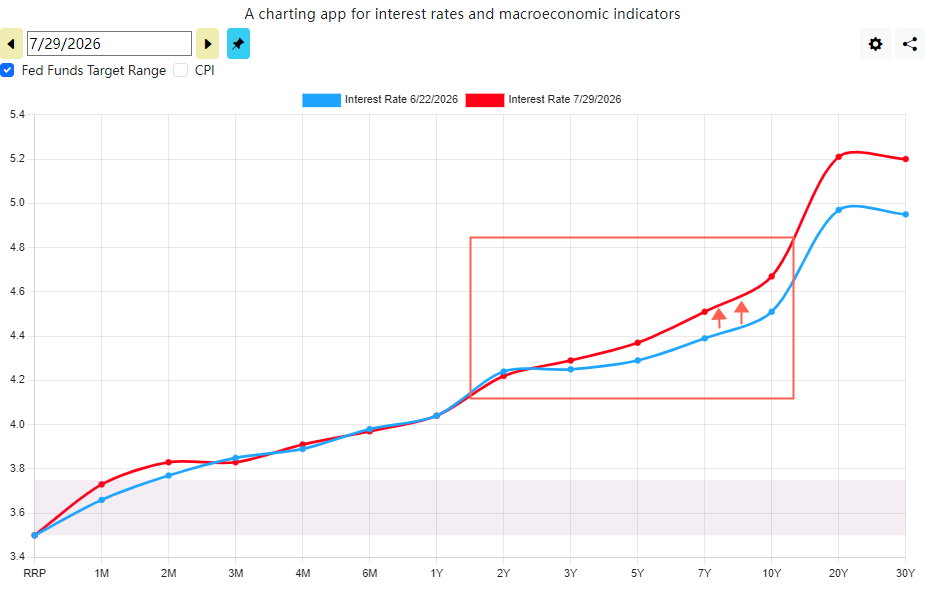 (Although interest rates have risen, the term premium has continued to widen recently, causing the downward trend in gold prices to begin to slow down.)
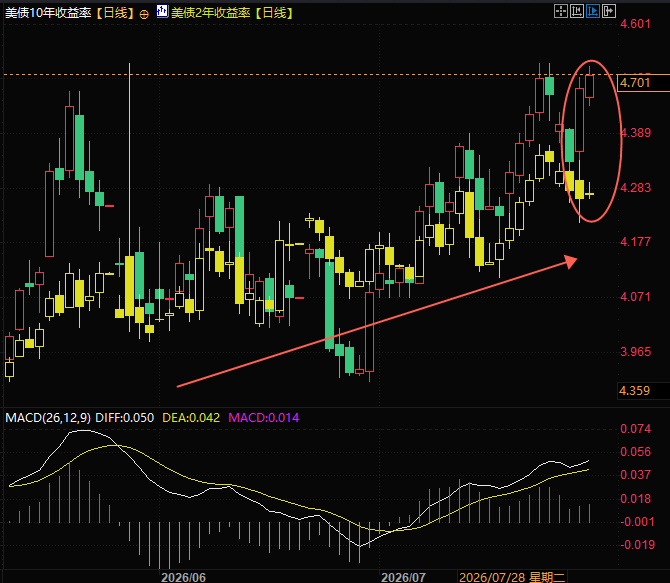 (Overlay chart of 2-year and 10-year US Treasury yields, source: EasyTrade)
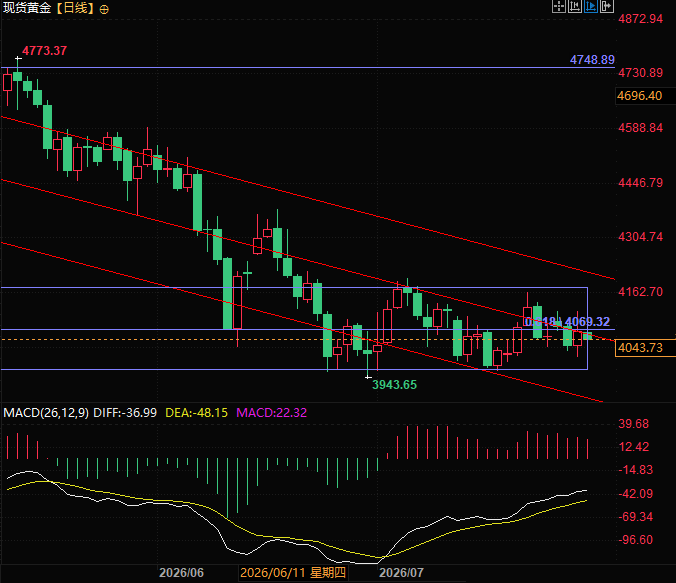 (Spot gold daily chart, source: EasyTrade) At 16:06 Beijing time, spot gold is currently trading at $4050 per ounce.
Short-term plunge and long-term surge: A clash of logics amid macroeconomic turmoil
The severe divergence between the short and long ends of the yield curve essentially reflects the market's extremely contradictory pricing of the near- and long-term macroeconomic outlook: The short end (2-year) is declining: a "warning signal" of a K-shaped economy and shrinking demand. The lagged effects of the Fed maintaining high interest rates are accelerating in the real economy. Supply-side economics suggests that current inflation is not due to excessive demand, but rather to supply-side constraints (the Fed cannot directly influence tanker passage through the Strait of Hormuz). Faced with high borrowing costs, the consumption capacity of low- and middle-income groups in the latter half of the US K-shaped economy is exhausted, leading to rising credit card default rates; simultaneously, the stock market decline has brought a significant negative wealth effect. The cooling demand is forcing the market to pre-price "the Fed will eventually have to cut interest rates to save the economy," thus pushing down the 2-year yield, which is most sensitive to policy rates. The long end (10-year) is surging: protests from "interest rate police" and a credibility crisis for the Fed. The surge in long-term yields is a powerful punishment imposed on policymakers by "interest rate police" (Bond Vigilantes). Increased policy uncertainty: The Federal Reserve has abandoned clear forward guidance, turning policy communication into a "blind box." Empty rhetoric: Chairman Warsh outwardly proclaims responsibility for inflation but has repeatedly failed to take concrete policy action, even claiming that "the market has already done the tightening for the Fed." This disconnect between words and actions severely damages the central bank's policy credibility. Supply imbalances and geopolitical shocks: Trump's threat to restart military action against Iran and the escalation of geopolitical conflict could reignite supply-side inflation in sectors such as energy; simultaneously, the US Treasury is issuing long-term bonds without restraint. The interest rate police, by initiating a sell-off at the long end, widening the term premium, are sending a clear warning to the market: the central bank may lose its ability to anchor long-term inflation, and government debt expansion is unsustainable. (Although interest rates have risen, the term premium has continued to widen recently, causing the downward trend in gold prices to begin to slow down.)How can a widening term premium become a "hidden bulletproof vest" for gold?
Why didn't the rise in 10-year yields devastate gold prices? In traditional financial modeling, the real interest rate (nominal interest rate minus inflation expectations) is gold's biggest adversarial variable. Logically, when the 10-year nominal yield surges, gold valuations should be squeezed. However, the current rise in long-term yields is not due to an endogenous increase in interest rates caused by "strong economic fundamentals," but rather an exogenous risk premium driven by a widening term premium. When the interest rate "police" punishes governments and central banks by pushing up 10-year yields, it actually exposes the unsustainability of the fiat currency system and sovereign debt: Sovereign credit risk hedging: The surge in volatility and risk compensation of government bonds as traditional "risk-free assets" forces funds to flow into gold, which has no counterparty default risk. De-dollarization and central bank gold purchases: The sharp fluctuations in long-term bond prices have worsened the risk-reward ratio of holding US Treasury assets, accelerating the trend of global central banks adjusting foreign exchange reserves and allocating funds to increase gold holdings. Forcing central banks to ultimately compromise: The disorderly surge in long-term interest rates will eventually trigger the debt-bearing limits of the real economy. The market anticipates that the Federal Reserve will eventually be forced to intervene in the long term by printing money or implementing Operation Twist, and this expectation that "central banks will eventually compromise" has translated into buying of gold in advance. (Overlay chart of 2-year and 10-year US Treasury yields, source: EasyTrade)The widening term premium has placed a heavy "iron shackle" on the entire capital market.
The sharp rise in asset pricing anchors: The 10-year Treasury yield is the benchmark for the discount rate of global risky assets. Driven by the term premium, long-term yields have been forcibly pushed up, which is tantamount to directly increasing the "gravity" of overvalued assets such as US stocks, triggering a deep valuation squeeze on overvalued technology and growth stocks. The "pseudo-easing" trap in the real economy and credit market: Even if the Federal Reserve chooses to cut interest rates in response to the sharp drop in short-term (2-year) rates, the real economy will not benefit from the liquidity dividend at all. This is because corporate long-term bond issuance rates, commercial real estate loan rates, and mortgage rates are all anchored to long-term yields. The long-term rate being firmly fixed at a high level by the term premium means that the cost of financing for the real economy remains high, and the chain of credit tightening is accelerating, forcing downward pressure on corporate earnings (EPS). A warning of "smart money" withdrawal: The narrowing of long-term yields reveals that large funds representing "smart money" are strategically withdrawing from the dollar debt system. If short-term funds remain immersed in the single-minded illusion that "interest rate cuts will lead to a surge in prices," they will inevitably run into the double whammy of long-term high interest rates on fundamentals and valuations, triggering a second round of declines and significant volatility in risky assets such as the stock market.Viewpoints and Technical Analysis:
Behind the Federal Reserve's decision to maintain interest rates lies a complex interplay of supply-side inflation, the looming threat of a K-shaped recession, uncontrolled fiscal policy, and a crisis of central bank credibility. The decline in 2-year yields reflects anxieties about a recession, while the surge in 10-year yields underscores concerns about sovereign credit and runaway inflation. The sharp steepening of the yield curve and the widening term premium have shattered the outdated formula that "rising interest rates inevitably suppress gold." As markets begin to doubt fiat currencies and the capabilities of policymakers, gold's safe-haven and de-crediting properties have been fully activated, making it the most solid asset in this macroeconomic upheaval. Traders need to pay close attention to the term premium. If the 2-year Treasury yield continues to rise recently, and at a faster rate than the 10-year Treasury yield, it will weaken the term premium logic and suppress gold prices. Simultaneously, the recent widening of the term premium also indicates that long-term funds, representing large capital, are still withdrawing from the dollar system, while short-term funds have not yet noticed, suggesting that US stocks may need further adjustments. From a technical perspective, spot gold is still trading within a range, but if it continues to fail to break through the price center of 4069, there is a risk of a downward breakout. Currently, we continue to monitor the performance of gold prices within the range. (Spot gold daily chart, source: EasyTrade) At 16:06 Beijing time, spot gold is currently trading at $4050 per ounce.
- Risk Warning and Disclaimer
- The market involves risk, and trading may not be suitable for all investors. This article is for reference only and does not constitute personal investment advice, nor does it take into account certain users’ specific investment objectives, financial situation, or other needs. Any investment decisions made based on this information are at your own risk.