Eurozone economic recovery expectations boosted the euro, with EUR/GBP nearing a four-week high pending the Bank of England's decision.
2026-07-30 15:16:49
The euro edged lower against the pound (EUR/GBP) in Asian trading on Thursday, but the overall upward trend remains intact. The pair previously touched a four-week high of 0.8585 and is currently trading around 0.8577, remaining above the previous breakout zone, indicating that the euro's bullish structure remains stable. The market is currently focused on Eurozone economic data and the Bank of England's monetary policy decision. Expectations of a Eurozone economic recovery are a key factor supporting the euro, with investors awaiting the preliminary second-quarter GDP data to determine whether regional economic growth is improving.  The market expects Eurozone GDP to grow by 0.2% quarter-on-quarter in the second quarter, recovering from the 0.2% contraction in the first quarter. Meanwhile, the market anticipates year-on-year GDP growth to rise to around 0.5% from 0.3% in the first quarter, indicating a gradual improvement in economic activity. In addition to GDP data, the market is also focused on Eurozone employment and consumer confidence. Data shows that the Eurozone unemployment rate is expected to remain at 6.2% in June, with the overall labor market remaining stable. Furthermore, the European Commission's consumer confidence data is expected to show that the consumer confidence index may improve to -15.9 in July, higher than June's -17.7, reflecting a recovery in market confidence. In contrast, the pound is currently facing pressure from changes in expectations regarding the Bank of England's policy. The market widely expects the Bank of England to maintain its interest rate at 3.75% at this meeting. However, investors are not focusing on the interest rate outcome itself, but rather on the internal voting divisions within the Monetary Policy Committee and the comments made by Bank of England Governor Bailey regarding the future policy path. If the Bank of England releases a cautious signal, the market may lower its expectations for further tightening, thereby weakening the pound's performance. Recent pressures on UK economic growth, inflation trends, and fiscal policy uncertainty have made investors cautious about the future performance of the pound. Some analysts believe that the pound may face pressure in the coming months as market expectations for further interest rate hikes by the Bank of England gradually weaken. If the Bank of England fails to meet market expectations for higher interest rates, and domestic fiscal policy disputes increase, EUR/GBP may rise further. From the perspective of monetary policy differences, the current trends of the euro and the pound are driven by different factors. The euro mainly benefits from expectations of improved economic conditions in the Eurozone, while the pound is affected by adjustments in the Bank of England's policy path. If Eurozone economic data continues to improve, and the Bank of England maintains a cautious stance, the European monetary landscape outside of the Eurozone and EUR/GBP may further tilt towards the euro. Currently, the market is awaiting two key factors: whether Eurozone GDP data meets recovery expectations; and whether the Bank of England signals future policy tightening. These two factors will determine the short-term direction of EUR/GBP. From the daily chart, EUR/GBP has recently maintained an upward trend, breaking through previous highs and continuing to trade above 0.8570, indicating that the euro has a short-term advantage. The key resistance level to watch is 0.8600. A break above this level could lead to further testing of the 0.8650-0.8700 area. On the downside, 0.8550 is a crucial short-term support level. A break below this level could lead to a pullback to around 0.8500. The overall trend remains bullish, but the Bank of England's policy decision should be monitored for potential volatility. Looking at the 4-hour chart, EUR/GBP has entered a consolidation phase after a rapid rise, with short-term momentum slowing, but the price remains above the previous breakout area. Technical indicators suggest the bullish structure remains intact. A break above 0.8600 could extend the upward trend and challenge 0.8650; a break below 0.8550 could trigger a short-term correction. Future price action will focus on Eurozone GDP data, the Bank of England's policy statement, and the market's repricing of sterling interest rate expectations.
 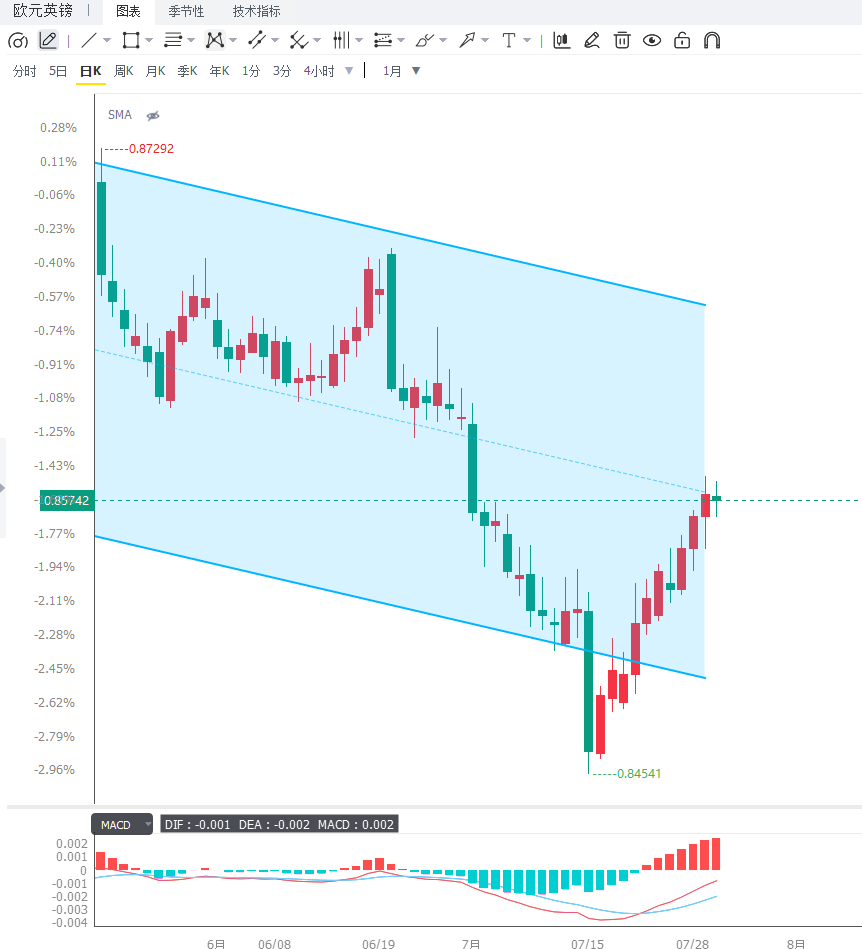 The current EUR/GBP exchange rate movement reflects the divergence between improving Eurozone economic expectations and uncertainty surrounding UK monetary policy. The euro is supported by expectations of economic recovery, while the pound is pressured by market expectations of reduced room for further tightening by the Bank of England. Looking ahead, if Eurozone GDP performance is stronger than expected, and the Bank of England maintains a cautious stance, EUR/GBP may continue its upward trend. Conversely, if the Bank of England signals a more hawkish policy stance, the pound may see a short-term rebound. Overall, EUR/GBP is still biased towards a volatile upward trend in the short term. The market will focus on whether the key resistance level of 0.8600 is broken, and the impact of the Bank of England's policy signals on the pound's movement. Investors should be wary of rapid fluctuations caused by central bank decisions.
The market expects Eurozone GDP to grow by 0.2% quarter-on-quarter in the second quarter, recovering from the 0.2% contraction in the first quarter. Meanwhile, the market anticipates year-on-year GDP growth to rise to around 0.5% from 0.3% in the first quarter, indicating a gradual improvement in economic activity. In addition to GDP data, the market is also focused on Eurozone employment and consumer confidence. Data shows that the Eurozone unemployment rate is expected to remain at 6.2% in June, with the overall labor market remaining stable. Furthermore, the European Commission's consumer confidence data is expected to show that the consumer confidence index may improve to -15.9 in July, higher than June's -17.7, reflecting a recovery in market confidence. In contrast, the pound is currently facing pressure from changes in expectations regarding the Bank of England's policy. The market widely expects the Bank of England to maintain its interest rate at 3.75% at this meeting. However, investors are not focusing on the interest rate outcome itself, but rather on the internal voting divisions within the Monetary Policy Committee and the comments made by Bank of England Governor Bailey regarding the future policy path. If the Bank of England releases a cautious signal, the market may lower its expectations for further tightening, thereby weakening the pound's performance. Recent pressures on UK economic growth, inflation trends, and fiscal policy uncertainty have made investors cautious about the future performance of the pound. Some analysts believe that the pound may face pressure in the coming months as market expectations for further interest rate hikes by the Bank of England gradually weaken. If the Bank of England fails to meet market expectations for higher interest rates, and domestic fiscal policy disputes increase, EUR/GBP may rise further. From the perspective of monetary policy differences, the current trends of the euro and the pound are driven by different factors. The euro mainly benefits from expectations of improved economic conditions in the Eurozone, while the pound is affected by adjustments in the Bank of England's policy path. If Eurozone economic data continues to improve, and the Bank of England maintains a cautious stance, the European monetary landscape outside of the Eurozone and EUR/GBP may further tilt towards the euro. Currently, the market is awaiting two key factors: whether Eurozone GDP data meets recovery expectations; and whether the Bank of England signals future policy tightening. These two factors will determine the short-term direction of EUR/GBP. From the daily chart, EUR/GBP has recently maintained an upward trend, breaking through previous highs and continuing to trade above 0.8570, indicating that the euro has a short-term advantage. The key resistance level to watch is 0.8600. A break above this level could lead to further testing of the 0.8650-0.8700 area. On the downside, 0.8550 is a crucial short-term support level. A break below this level could lead to a pullback to around 0.8500. The overall trend remains bullish, but the Bank of England's policy decision should be monitored for potential volatility. Looking at the 4-hour chart, EUR/GBP has entered a consolidation phase after a rapid rise, with short-term momentum slowing, but the price remains above the previous breakout area. Technical indicators suggest the bullish structure remains intact. A break above 0.8600 could extend the upward trend and challenge 0.8650; a break below 0.8550 could trigger a short-term correction. Future price action will focus on Eurozone GDP data, the Bank of England's policy statement, and the market's repricing of sterling interest rate expectations. The current EUR/GBP exchange rate movement reflects the divergence between improving Eurozone economic expectations and uncertainty surrounding UK monetary policy. The euro is supported by expectations of economic recovery, while the pound is pressured by market expectations of reduced room for further tightening by the Bank of England. Looking ahead, if Eurozone GDP performance is stronger than expected, and the Bank of England maintains a cautious stance, EUR/GBP may continue its upward trend. Conversely, if the Bank of England signals a more hawkish policy stance, the pound may see a short-term rebound. Overall, EUR/GBP is still biased towards a volatile upward trend in the short term. The market will focus on whether the key resistance level of 0.8600 is broken, and the impact of the Bank of England's policy signals on the pound's movement. Investors should be wary of rapid fluctuations caused by central bank decisions.
- Risk Warning and Disclaimer
- The market involves risk, and trading may not be suitable for all investors. This article is for reference only and does not constitute personal investment advice, nor does it take into account certain users’ specific investment objectives, financial situation, or other needs. Any investment decisions made based on this information are at your own risk.