Multiple fronts of conflict, coupled with sanctions and blockades, have driven up the geopolitical premium for crude oil to its maximum.
2026-07-30 18:12:49
Main content: The Middle East situation has recently deteriorated further. The Revolutionary Guard's X account was banned, and the US military adopted higher clearance standards. However, Israel is promoting new oil pipelines, and the Bab el-Mandeb Strait remains relatively open, suggesting a potential marginal improvement in oil supply. Stimulated by major geopolitical events such as the US-Saudi joint airstrikes, disruptions to energy shipping routes, and pressure on oil production facilities, international oil prices surged 7%-8% in the previous trading day. On Thursday, the market priced in some risk premiums, and oil prices slightly retreated. However, due to the previous day's surge, gold prices maintained a strong consolidation pattern. Overall, the oil market has entered a high-volatility pattern characterized by "surges due to escalating conflicts, declines due to easing tensions, and continued risk-anchored premiums," with geopolitical news becoming the core driver of short-term market movements. 
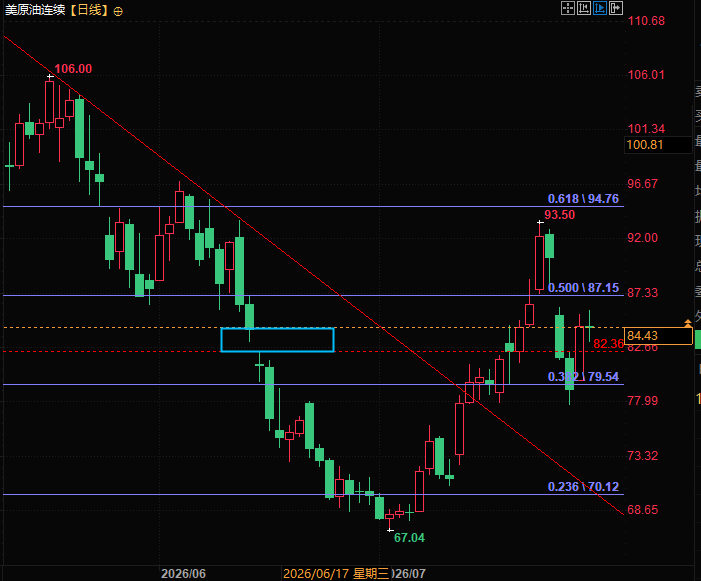 (WTI crude oil futures daily chart, source: FX678) At 18:08 Beijing time, the WTI futures contract was trading at $84.45 per barrel.
The direct confrontation between the US and Iran continues to escalate, with precision airstrikes breaking the brief ceasefire.
The core trigger for this round of conflict was the escalation of direct military confrontation between the US and Iran, with the US officially ending the previous brief ceasefire and launching a new round of precision strikes. The US Central Command officially announced that it launched a high-intensity airstrike against Iran at 8:00 PM Eastern Time on Thursday, Thursday morning. The operation lasted two hours, precisely striking dozens of key targets of the Iranian Islamic Revolutionary Guard Corps, including military command centers, drone combat facilities, and coastal defense points. The US clearly stated that this airstrike was a strong response to Iran's previous ballistic missile launches at US bases in the Middle East, with the core objective of weakening the military threat posed by Iran and its proxy forces to US military bases, international commercial shipping, and Gulf oil-producing countries. Iran launched a simultaneous and strong counterattack, creating a two-way offensive. Iran not only launched missile strikes against US bases in Jordan but also attacked three oil tankers traveling on unauthorized routes in the Strait of Hormuz. Jordanian armed forces successfully intercepted five incoming Iranian missiles, causing no casualties on the Jordanian side. Iranian state media confirmed that the US airstrike on Iran's Qeshm Island resulted in three deaths and multiple injuries, and that the region surrounding the country's energy hub suffered a substantial impact. The ongoing direct confrontation has completely eliminated any room for de-escalation in the US-Iran standoff, and the bottom of geopolitical risks in the crude oil market continues to rise.The joint US-Saudi airstrikes have opened a new chapter in the regional proxy war, escalating the conflict.
This round of conflict has seen a significant escalation: Saudi Arabia has publicly collaborated with the US military in cross-border military operations for the first time, fundamentally altering the Middle East power dynamics. On Wednesday, the US-Saudi coalition launched joint airstrikes against pro-Iranian militant positions in eastern Iraq, precisely targeting the Iranian-backed Popular Mobilization Forces (PMF), resulting in the deaths of at least 20 militants. Four Iranian Revolutionary Guard advisors were also confirmed dead in the airstrikes, significantly escalating the intensity of the proxy war in the region. This escalation has simultaneously triggered regional sovereignty disputes and diplomatic confrontations. The Iraqi presidential palace publicly condemned the US-Saudi cross-border airstrikes as a blatant violation of national sovereignty and explicitly called on all parties to immediately cease all cross-border military operations. Iran, on the other hand, denies directly commanding the attacks within Iraq, attempting to avoid further loss of control. This multi-party maneuvering has further exacerbated the uncertainty in the Middle East, indirectly supporting the risk premium for crude oil.The conflict has spilled over into North Africa, drawing shipping hubs into conflict for the first time.
The conflict has spilled over from the Persian Gulf and the Red Sea, traditional conflict zones, to a key energy shipping hub in North Africa, putting global oil and gas transportation security under immense pressure. On Wednesday, Egypt's port of Damieta was attacked by a drone, hitting and igniting a fire on a wholly US-owned liquefied natural gas (LNG) floating storage vessel. Egyptian official reports only confirmed the fire at the port, without mentioning the method of attack, while the British maritime security agency Ambry confirmed that the incident was indeed caused by a drone strike. As of now, no armed group has claimed responsibility for the attack, and the uncertainty continues to escalate. As a key mediator in the Middle East and a stable energy transshipment port, Egypt had previously remained uninvolved in direct military conflict. This attack signifies a complete expansion of the spillover effects of Middle Eastern geopolitical conflict, extending risks from major oil-producing regions and core shipping routes to North African oil and gas storage and transportation hubs, further exposing weaknesses in the global energy supply chain and providing long-term support for oil prices.Unilateral sanctions have been implemented, restricting the flow of crude oil shipping and trade.
Beyond military strikes, the US has simultaneously escalated financial and trade sanctions, restricting Iran's energy trade from the distribution end. The US Treasury Department officially announced a new round of sanctions targeting Iran's shipping system, imposing sanctions on a total of eight oil tankers and ten related entities. By locking down shipping capacity and freezing related trade channels, the sanctions further compress Iran's crude oil export space. The combination of sanctions and military conflict creates a dual pressure of "military blockade + trade restrictions," disrupting the global crude oil distribution pattern and exacerbating market concerns about supply contraction.The divergent operation of the two major energy shipping routes has highlighted structural risks in navigation.
As two vital arteries for global crude oil transportation, the Strait of Hormuz and the Bab el-Mandeb Strait are currently exhibiting a structural divergence, with shipping risks directly influencing crude oil supply and demand expectations. The Strait of Hormuz, affected by the US-Iran standoff, tanker attacks, and US sanctions, has seen a persistently low number of vessels navigating it, significantly reducing channel efficiency and disrupting nearly 30% of global seaborne crude oil transport, resulting in persistent supply-side pressure. In contrast, the Bab el-Mandeb Strait has seen a short-term rebound, with 39 commodity carriers passing through on Tuesday into the Red Sea, marking the highest number of passages since July 19th. However, market risks remain. The Houthi rebels in Yemen announced a maritime blockade of Saudi Arabia on July 20th, continuously targeting Red Sea shipping and Saudi crude oil export routes, aiming to disrupt transport in the Bab el-Mandeb Strait. Simultaneously, Saudi Arabia is actively seeking to form a regional shipping protection coalition to counter the Houthi threat, leaving significant uncertainty regarding the stability of the shipping lanes. IG analysts point out that the supply of Middle Eastern crude oil is not completely cut off, and multiple alternative transportation options and detours have emerged in the market. The short-term recovery in shipping traffic has alleviated the panic of extreme supply disruptions to some extent, which is also the core reason for the recent surge and fall in oil prices. However, in the long run, the ongoing conflict and blockade will continue to weaken Iran's control over the Strait of Hormuz, reshape the Middle East's oil transportation landscape, and structural supply risks will continue to disrupt the market.Diplomatic maneuvering has repeatedly strained the situation, leading to a continued cooling of expectations.
Regional diplomatic mediation has stalled, and the market's hopes for a ceasefire and negotiation process continue to fall short. The reconciliation plan proposed by Oman for "joint management of the Strait of Hormuz by regional parties" has been explicitly rejected by senior Iranian officials, rendering the strait control dispute completely unresolved and significantly reducing the probability of a resumption of US-Iran negotiations. Meanwhile, the Saudi Defense Minister traveled to Washington to meet with high-ranking US officials, aiming to coordinate with the US in combating pro-Iranian armed groups and taking a firm stance against the risk of attacks on energy facilities. He also proactively signaled de-escalation, urging the US to exercise restraint and avoid further escalation of military strikes against the Houthis, striving to stabilize the regional situation. The conflicting positions and divergent demands of various parties make it difficult for the situation in the Middle East to cool down quickly, and the high volatility in the oil market is expected to continue for a long time.Damage to core production facilities exacerbates the risk of long-term supply-demand mismatch.
Besides shipping risks, damage to core refining and export facilities in oil-producing countries provides fundamental support for a medium- to long-term strengthening of oil prices. The Houthi rebels in Yemen continue their targeted attacks on Saudi Arabia's oil export lifeline, assaulting Saudi oil transshipment facilities and disrupting the oil transport route from Saudi Arabia to the Red Sea port of Yanbu. As a key alternative export node after the Strait of Hormuz was blocked, the damage to Yanbu port directly weakens Saudi Arabia's ability to withstand disruptions in oil exports. Satellite imagery confirms clear signs of damage to Saudi Aramco's Abqaiq Gigafactory, which has a daily oil processing capacity of 7 million barrels. This damage directly impacts the total volume of Middle Eastern oil refining and exports, further exacerbating the global oil supply-demand mismatch.Overall Market Outlook: High volatility and high premiums continue to dominate.
In summary, the current situation in the Middle East is characterized by "normalized military confrontation, prolonged sanctions and blockades, structured risks in shipping lanes, and ineffective diplomatic mediation." Short-term oil prices have seen a slight pullback due to the restoration of air traffic and the realization of risk premiums, but the core bullish factors—the ongoing US-Iran standoff, the vulnerability of energy facilities, the unresolved risks in the two major shipping lanes, and the continued escalation of unilateral sanctions—have not subsided. The oil market will continue to be anchored to Middle East geopolitical news, maintaining a pattern of high volatility and high geopolitical premiums. Any escalation of conflict, shipping disruptions, or attacks on facilities will trigger a new round of price rebounds. Technically, oil prices have broken upwards within a consolidation range of support and gaps, and are currently consolidating at the previous upward gap. Current resistance levels are at the downward gap above and the 0.500 Fibonacci retracement level of 87, while support is at 82.36, which is the upward gap level. (WTI crude oil futures daily chart, source: FX678) At 18:08 Beijing time, the WTI futures contract was trading at $84.45 per barrel.
- Risk Warning and Disclaimer
- The market involves risk, and trading may not be suitable for all investors. This article is for reference only and does not constitute personal investment advice, nor does it take into account certain users’ specific investment objectives, financial situation, or other needs. Any investment decisions made based on this information are at your own risk.