With inflation falling to 2.6%, what exactly is the Bank of England worried about?
2026-07-30 20:14:49
On Thursday, July 30, the Bank of England decided by a vote of 6 to 3 to keep the benchmark interest rate at 3.75%, in line with approximately 92% of market pricing before the meeting. Compared to the 7-2 vote at the June meeting, the number of members supporting a 25 basis point rate hike to 4% increased to 3, indicating that concerns about the persistence of inflation are spreading within the committee, rather than simply repeating the previous wait-and-see stance. The Bank of England also confirmed that the next interest rate decision will be announced on September 17. 
 Momentum indicators are also biased towards neutral. The MACD fast line in the chart is around -0.0002, the slow line is around 0.0003, and the histogram value is around -0.0011, still in the weak zone near the zero axis. The recent narrowing of the negative bars suggests weakening downward momentum, but it is not enough to prove that upward momentum has been established. The market is waiting for a clearer directional change in interest rate expectations, rather than simply repricing based on a single hawkish decision to maintain interest rates. The UK labor market provides another layer of constraint. The unemployment rate from March to May was 4.9%, 0.2 percentage points higher than the same period last year; during the same period, the degree of slack in the labor market increased, weakening the basis for continued wage acceleration. Therefore, the pound currently faces two forces: energy inflation and a hawkish voting pattern support short-term interest rate expectations, while slower growth and easing employment limit long-term interest rates and exchange rate valuations. Before the September meeting, service inflation, wage growth, energy prices, and inflation expectations will have more pricing weight than overall monthly inflation.
The 6-to-3 vote with no change in interest rates is noteworthy.
On the surface, the 3.75% interest rate has remained unchanged for several consecutive periods, with no surprises in policy outcomes. However, for traders, changes in the voting pattern often reflect the committee's reaction function more accurately than static interest rate levels. In June, only Megan Green and Hugh Peele supported a rate hike, while this month, Catherine Mann joined the rate hike camp, bringing the number of members supporting precautionary tightening to one-third. The core logic of these three members is not that current inflation is out of control, but rather that waiting for a clear secondary effect in wages and service prices before taking action could result in higher policy costs. The Bank of England's meeting documents indicate that inflation has been above the 2% target for more than five years. If energy prices remain high for an extended period, businesses may pass on costs through price increases, and workers may strengthen their wage compensation demands. Once such behaviors reinforce each other, a short-term energy shock could transform into more persistent endogenous inflation. The majority of members are still choosing to wait because current data has not yet shown a clear wage-price spiral, and the labor market has already shown signs of loosening. In other words, the 6-to-3 vote is not a direct signal of an imminent rate hike, but it does indicate that the future policy threshold has changed. Subsequent data only need to show that inflation stickiness has increased again, rather than reaching a state of full-blown overheating, and the balance of votes within the committee may shift further.The energy shock altered the inflation path, but it has not changed the baseline scenario.
The UK's Consumer Price Index (CPI) rose 2.6% year-on-year in June, down from 2.8% in May; core inflation, excluding energy, food, alcohol, and tobacco, was 2.6%, unchanged from May. While commodity price inflation cooled significantly, the core indicator stopped declining, indicating that the main contributor to the inflation decline remained the volatile energy and some commodity items, and the stickiness of services has not completely disappeared. The Bank of England expects overall inflation to rise to around 3.2% in the fourth quarter of 2026 after energy costs continue to be passed on to end-user prices, before gradually declining to around 1.7% by the first quarter of 2028. In a stress scenario, if oil and gas prices are significantly higher than the baseline assumption, triggering stronger inflation expectations and secondary effects, inflation could rise to 4.1% in the third quarter of 2027, while economic growth could slow to 0.9% during the same period. This forecast reveals the current policy dilemma. Raising interest rates cannot increase energy supply, but it can suppress demand, credit expansion, and wage bargaining power, thereby preventing the spread of external cost shocks. Tightening too early would amplify economic weakness, while acting too late could cause inflation expectations to decouple. Therefore, the Bank of England chose to retain the option of raising interest rates, while requiring that the secondary effects be further verified in forward data.The core of pound sterling pricing has shifted to interest rate differential expectations and growth constraints.
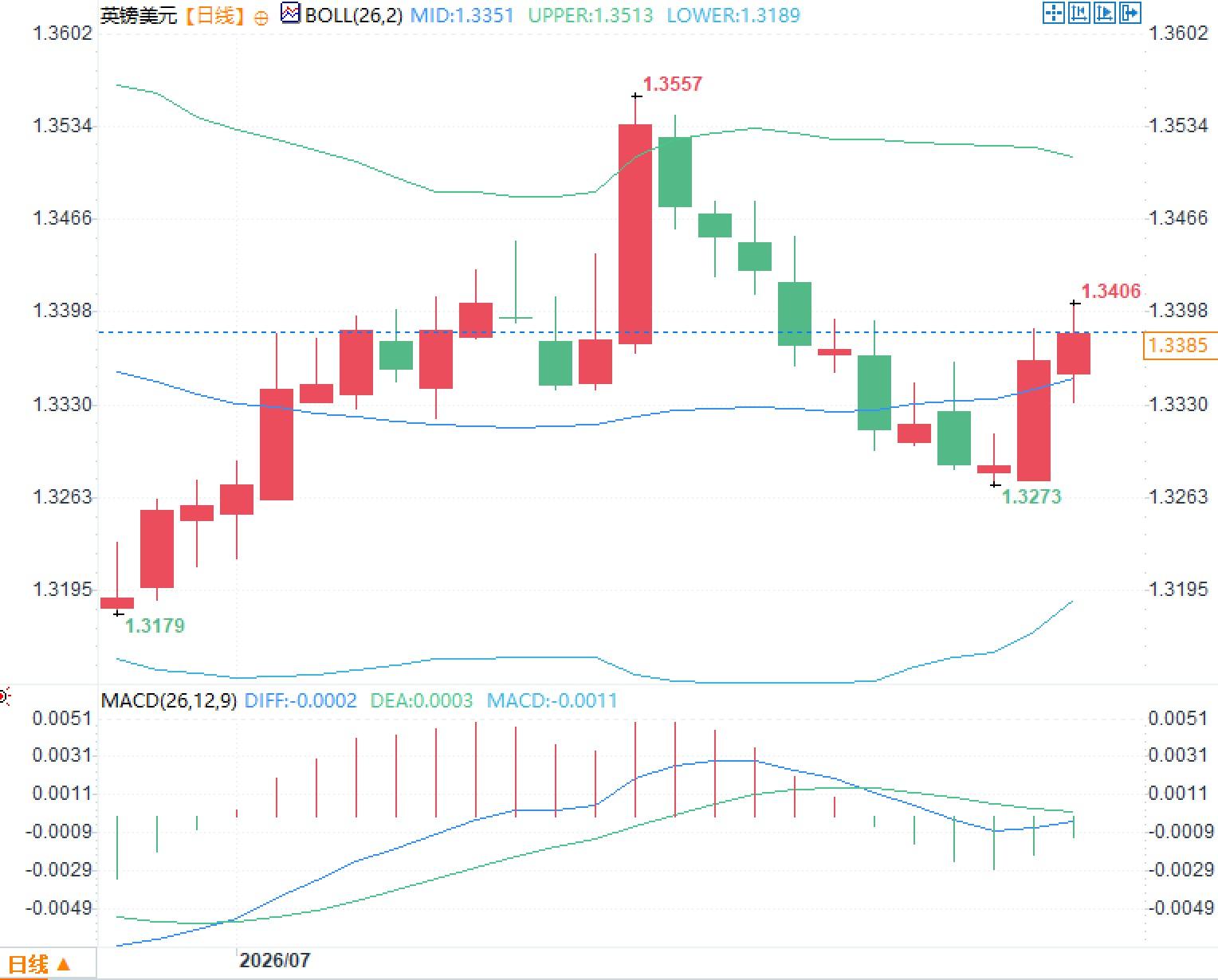
The daily Bollinger Bands for GBP/USD are as follows: middle band at approximately 1.3351, upper band at approximately 1.3513, and lower band at approximately 1.3189. The current price has rebounded above the middle band, but there is still significant room before reaching the upper band, indicating that the short-term correction has not yet confirmed a reversal of the medium-term trend. After falling from 1.3557 to 1.3273, the price rebounded, but the 1.3400-1.3460 area still contains considerable resistance from previous trading activity and trapped investors. Momentum indicators are also biased towards neutral. The MACD fast line in the chart is around -0.0002, the slow line is around 0.0003, and the histogram value is around -0.0011, still in the weak zone near the zero axis. The recent narrowing of the negative bars suggests weakening downward momentum, but it is not enough to prove that upward momentum has been established. The market is waiting for a clearer directional change in interest rate expectations, rather than simply repricing based on a single hawkish decision to maintain interest rates. The UK labor market provides another layer of constraint. The unemployment rate from March to May was 4.9%, 0.2 percentage points higher than the same period last year; during the same period, the degree of slack in the labor market increased, weakening the basis for continued wage acceleration. Therefore, the pound currently faces two forces: energy inflation and a hawkish voting pattern support short-term interest rate expectations, while slower growth and easing employment limit long-term interest rates and exchange rate valuations. Before the September meeting, service inflation, wage growth, energy prices, and inflation expectations will have more pricing weight than overall monthly inflation.
- Risk Warning and Disclaimer
- The market involves risk, and trading may not be suitable for all investors. This article is for reference only and does not constitute personal investment advice, nor does it take into account certain users’ specific investment objectives, financial situation, or other needs. Any investment decisions made based on this information are at your own risk.