Gold Trading Alert: Gold Prices Break Through the $4,100 Mark! Four "Hidden Drivers" Emerge, Will Things Get Even More Frenzied?
2026-07-31 07:40:50
On Friday (July 31) in early Asian trading, spot gold fluctuated narrowly above the $4100 mark, currently trading around $4105 per ounce, holding onto most of its overnight gains. On Thursday (July 30), spot gold broke strongly above the $4100 per ounce mark, catalyzed by the Fed's interest rate decision, reaching a high of $4120.08 during the session, a new one-week high, before closing at $4103.42 per ounce, a gain of approximately 0.9%. This breakout, seemingly sudden, was actually the inevitable result of the convergence of four forces: a weakening dollar, cooling inflation data, escalating geopolitical conflicts, and uncertainty surrounding Fed policy. After weeks of back-and-forth around the $4000 mark, the bulls have finally found a breakthrough. However, is this the start of a new round of upward movement, or merely the calm before the storm? This article will analyze the core driving logic of the current gold market from four dimensions. 
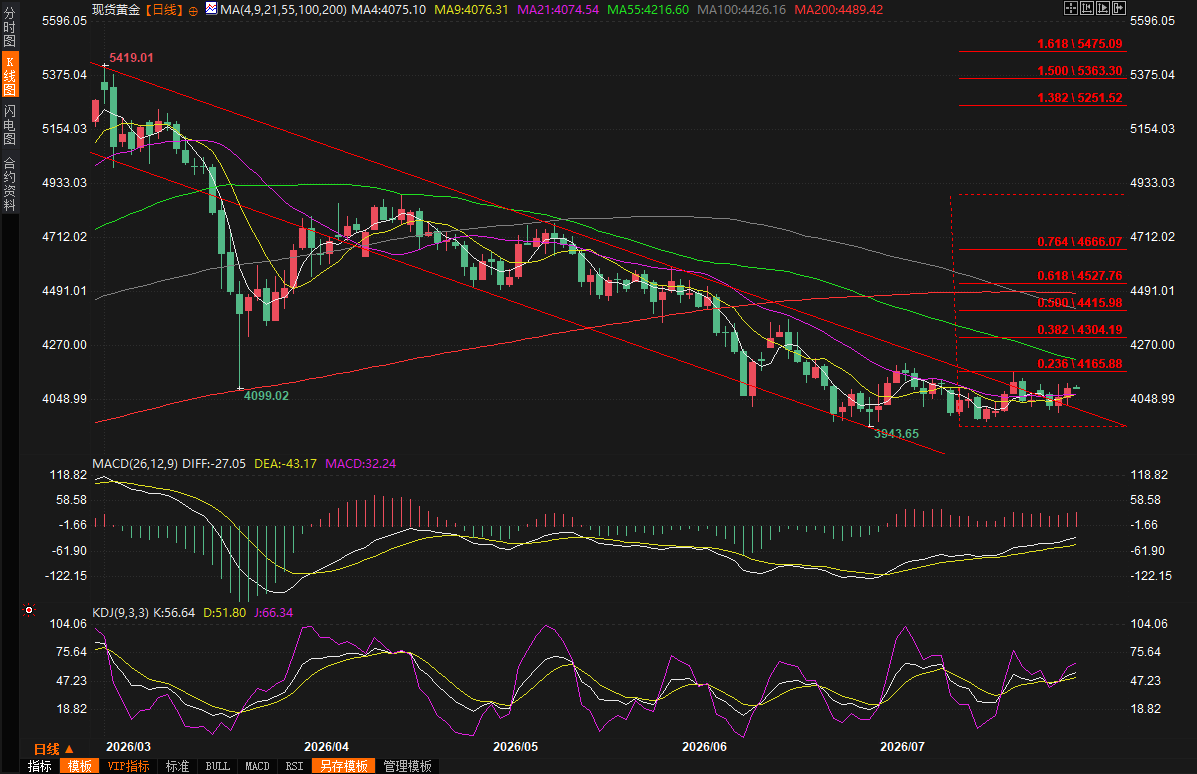 (Spot gold daily chart, source: FX678) At 07:36 Beijing time, spot gold is currently trading at $4103.70 per ounce.
I. Dollar Collapse: How the Surge in the Yen and Suspicions of Intervention Impacted Gold Prices
The seesaw effect between gold and the US dollar was vividly demonstrated in the market on July 30th. On that day, the US dollar index fell sharply by nearly 0.90%, briefly dipping below the 100 mark to 99.90. The direct consequence of a weaker dollar is that dollar-denominated gold becomes cheaper for overseas buyers, providing the most direct monetary support for rising gold prices. However, behind this round of dollar depreciation lies a more dramatic story—the violent surge in the yen's exchange rate. During the US trading session on July 30th, the dollar plummeted nearly 500 points against the yen in less than an hour, with a maximum daily drop of 3.3%, the largest single-day decline since December 2023. The yen-dollar exchange rate rose to 157.80 yen to 1 dollar, hitting a near two-month high. The general market interpretation is that Japanese authorities intervened in the foreign exchange market. According to Nikkei, the Japanese government and the Bank of Japan intervened in the currency market by buying yen and selling dollars, while US monetary authorities also conducted a "currency check" as a pre-intervention phase—meaning that Japan and the US jointly took action to curb the yen's depreciation. TS Lombard economist Rory Green pointed out that Federal Reserve Chairman Warsh's remarks after maintaining interest rates were interpreted by the market as dovish, which may have created a favorable opportunity for the Bank of Japan to intervene and support the yen. This sharp fluctuation in exchange rates has created a double benefit for gold: on the one hand, the overall weakening of the dollar directly reduces the cost of holding gold; on the other hand, the market uncertainty caused by the soaring yen further strengthens gold's safe-haven attributes. Juan Perez, senior trading director at Monex USA, bluntly stated: "Is it possible that the Fed might have to worry more about economic growth than inflation? This is also very, very bad for the dollar."II. The Inflation Conundrum: PCE Turns Negative for the First Time in Six Years
Inflation data was another key driver of the recent gold price surge. Data released Thursday by the U.S. Bureau of Economic Analysis showed that the Personal Consumption Expenditures (PCE) price index fell 0.1% month-over-month in June, marking the first monthly decline since the COVID-19 pandemic began in 2020. The year-over-year increase narrowed significantly to 3.7% from 4.1% in May. Excluding the volatile energy and food items, the core PCE price index rose only 0.1% month-over-month, below the market consensus of 0.2%, and the year-over-year growth rate fell slightly to 3.3% from 3.4%. This temporary cooling of inflation data directly prompted traders to reduce their bets on a September rate hike by the Federal Reserve. The CME Group's FedWatch tool showed that the probability of a September rate hike by the Fed fell from approximately 77% before the meeting to 61%. The expectation of higher interest rates for a longer period has eased, which is undoubtedly good news for non-interest-bearing gold—the opportunity cost of holding gold has decreased. However, market anxiety has not dissipated, as the true extent of this inflation slowdown remains questionable. The core driver of the negative month-on-month PCE growth in June was the decline in energy prices, which in turn stemmed from the temporary ceasefire agreement reached between the US and Iran. However, the fragility of this temporary ceasefire agreement is already a market consensus – and this was quickly proven by reality. Bart Melek, Global Head of Commodity Strategy at TD Securities, pointed out incisively: "The Middle East wars seem unlikely to end in the short term, so the inflationary pressures that eased in the past few months may return." More alarming is that although the PCE data cooled in the short term, the core PCE year-on-year growth rate of 3.3% is still far above the Fed's long-term inflation target of 2%, and has remained above the target value for several consecutive years. This means that the structural endogenous pressure of US inflation has not completely subsided. Market analysis points out that this decline in inflation is highly sporadic; the core differences between the US and Iran have not been resolved, and international oil prices remain at historically high levels, posing a potential risk of a subsequent rebound in inflation, which may limit the upside potential for gold prices.III. The Growth Paradox: Why does a slower-than-expected GDP growth rate and booming domestic demand become a double-edged sword for gold prices?
The US second-quarter GDP data released on Thursday provided another important macroeconomic backdrop for the market. Preliminary data from the US Bureau of Economic Analysis showed that the annualized quarterly GDP growth rate for the second quarter of 2026 was only 1.5%, far below economists' expectations of 2.1%. The first quarter's growth rate was 2.1%. The main drag on GDP growth was the widening trade deficit—net exports dragged down GDP growth by 1.01 percentage points, the largest drag since the first quarter of 2025. However, beneath these seemingly weak overall figures lies a striking contradiction: exceptionally strong domestic demand in the US. Consumer spending, which accounts for more than two-thirds of US economic activity, grew by 3.2% in the second quarter, compared to only 0.5% in the first quarter. Even more noteworthy is the surge in business equipment investment, which jumped 15.2%, marking the second consecutive quarter of double-digit growth. The core driver of this investment boom is artificial intelligence—leading technology companies such as Meta and Microsoft continue to increase their investment in the AI sector, massively deploying data center construction and expanding computing power capital expenditures. Federal Reserve Chairman Warsh stated frankly after the policy meeting that the current resilience of the US economy is "impressive," with continued strong business investment being the most striking feature of the current US economy. However, this "booming domestic demand" precisely constitutes a deep contradiction in the gold market. On the one hand, strong consumption and investment mean the economy has not fallen into recession, which to some extent weakens the safe-haven demand for gold. On the other hand, strong domestic demand is accompanied by persistent inflationary pressures—the "General Purchase Price Index," which measures the overall price level of the US economy, rose at an annualized rate of 5.7% in the second quarter, the fastest pace in four years. Oliver Allen, senior economist at Pantheon Macroeconomics, pointed out the core of the problem: "Underlying growth remains robust, but it is unlikely to be sustainable." With the savings rate falling to a four-year low and gasoline prices rising again, consumers are unlikely to continue relying on using savings to maintain spending. Once this "growth illusion" shatters, the safe-haven logic of gold will fully return.IV. Bond Market Panic: 30-Year US Treasury Yield Surges to 19-Year High, Federal Reserve's Credibility Under Question
If the dollar, inflation, and GDP data are the "visible lines" driving gold price increases, then the turmoil in the bond market constitutes a more subtle yet equally important "hidden line." On July 30, the yield on the 30-year US Treasury note surged to 5.244%, a 19-year high since July 13, 2007. The yield on the 10-year US Treasury note also rose above 4.67%. The root cause of this bond market storm was precisely the Federal Reserve's interest rate decision on July 29. The Fed decided by a 9-3 vote to maintain the benchmark interest rate at 3.50%-3.75%. Maintaining the interest rate was in line with market expectations—what truly triggered market turmoil was the statement made by Fed Chairman Warsh after the meeting. While promising to remain "unwavering" in its commitment to suppressing inflation, Warsh refused to provide any clear guidance on the future policy path. He even explicitly abandoned the traditional practice of providing forward guidance. In a report, Bank of America economist Aditya Bhave bluntly stated that the market's reaction to Warsh's press conference indicated that investors were "questioning the credibility of the Federal Reserve," and that "the need to rebuild credibility increases the likelihood of a September rate hike." Morgan Stanley's chief U.S. economist, Michael Gapen, summarized it more bluntly: Warsh's remarks "suggested that the threshold for a rate hike may be higher than some people expected," and that financial markets "may be more confused after the meeting than at its start." Wolfe Research's chief economist, Stephanie Roth, offered a harsher assessment: "The press conference damaged his credibility to some extent. His communication style seems counterproductive, and the market is exposing his bluff." The impact of this bond market turmoil on gold is complex. In the short term, soaring long-term bond yields typically put pressure on gold—because higher long-term interest rates mean a higher opportunity cost of holding non-interest-bearing assets. However, the deeper impact lies in the deepening market skepticism regarding the Federal Reserve's ability to control inflation. As Easterly EAB Global Macro Strategist Arnim Holzer stated, "Investors are demanding higher compensation for holding longer-duration bonds." When market confidence in central bank credibility falters, gold's appeal as a means of final payment and a store of value actually increases.V. Ongoing Conflict: Drone Attacks Along the Suez Canal and the Battle of the Strait of Hormuz
On July 30, two gas tankers at the Egyptian port of Damieta were attacked by drones. The port is located near the Suez Canal—a waterway connecting the Mediterranean and Red Seas—and is one of Saudi Arabia's few remaining oil export routes. Trade sources familiar with the incident revealed that the drone struck the US-owned gas storage ship Energos Winter, and the fire subsequently spread to another vessel. This attack occurred against the backdrop of the escalating US-Iran conflict. The US military stated Wednesday night that it had struck a military command center and drone facilities of the Iranian Revolutionary Guard after Tehran opened fire on US forces in the Middle East. Iranian state media reported that the US airstrikes caused civilian casualties. In retaliation, the Iranian Revolutionary Guard claimed to have attacked US assets at the Azraq military base in Jordan and US assets at the Ali Salem airbase in Kuwait. More worrying is the expansion of the conflict. In the five-month-long war, Saudi Arabia publicly launched its first joint airstrikes with the US against pro-Iranian armed groups in eastern Iraq. The Houthi rebels in Yemen launched attacks on Saudi Arabia from within Iraq. Iran claims control of the Strait of Hormuz, a crucial waterway. The sharp escalation of these geopolitical risks has had a dual impact on the gold market. The most direct effect is a surge in safe-haven demand—gold's status as the ultimate safe-haven asset is irreplaceable when investors face escalating Middle East conflicts, potentially disrupted energy supply routes, and the unpredictability of great power rivalry. Simultaneously, geopolitical conflicts are pushing up oil prices, exacerbating inflationary pressures and supporting expectations of a Federal Reserve rate hike, which could potentially drag down gold price gains.VI. Gold's Prospects Amidst the Battle Between Bulls and Bears: Breakout or Trap?
Standing above the $4,100 mark, the gold market is facing its most complex battle between bulls and bears in recent years. From the bulls' perspective, the supporting logic is undeniably solid: the weakening dollar trend has not reversed, and yen intervention may only be the beginning; inflation is cooling in the short term; the uncertainty surrounding the Fed's policies is shaking market confidence in central banks; and the trend of global central banks continuously increasing their gold reserves remains unchanged. However, the bears' forces should not be underestimated. The 30-year US Treasury yield hitting a 19-year high means that long-term funding costs are rising, which continues to put downward pressure on gold. The Middle East conflict could push oil prices and inflation up again at any time, and while market expectations for a Fed rate hike in September have decreased, they still exceed 60%. Bart Melek of TD Securities points out that the resistance zone for gold is around $4,150 to $4,200—the current price is approaching this area. From a technical perspective, gold prices surged above $4,120 after breaking through $4,100, but subsequently retreated. While the Relative Strength Index (RSI) broke through the 50 neutral level, indicating buying pressure, it faces multiple resistance levels at $4,165 and $4,194. The World Gold Council's assessment provides a more macro perspective: supported by asset diversification and inflation hedging needs, investment demand will remain the core engine of global gold demand growth this year. In the medium to long term, rising global geopolitical risks, the restructuring of the political and economic order, and the continued progress of de-dollarization will all provide structural support for gold prices. Gold's rise above $4,100 is the result of multiple forces converging, not a single factor. The collapse of the dollar, the uncertainty of inflation, the contrast in growth rates, the panic in the bond market, and the spread of war collectively constitute the complete narrative of this round of gold price increases. However, this is far from the end of the story. The ambiguity of the Federal Reserve's policy path, the unpredictability of the Middle East conflict, and the fragile balance of the global economy in a high-interest-rate environment all mean that the gold market will continue to face significant volatility. (Spot gold daily chart, source: FX678) At 07:36 Beijing time, spot gold is currently trading at $4103.70 per ounce.
- Risk Warning and Disclaimer
- The market involves risk, and trading may not be suitable for all investors. This article is for reference only and does not constitute personal investment advice, nor does it take into account certain users’ specific investment objectives, financial situation, or other needs. Any investment decisions made based on this information are at your own risk.