Canadian GDP data is about to be released, and the Canadian dollar faces a crucial test.
2026-07-31 11:38:51
On Friday (July 31), the USD/CAD pair rebounded slightly during Asian trading hours after three consecutive days of decline. The pair had previously dipped to 1.3990, a new low since July 21, and was currently trading around 1.4020. The pair found some respite before the data release, but the upcoming Canadian GDP report will be crucial in determining whether the Canadian dollar can strengthen further. The May GDP report is one of the most important events for Canadian dollar traders this week. The market expects a monthly growth rate of 0.2%, compared to 0.5% previously. While this appears to be a routine growth data release, it carries more weight for the Canadian dollar, the Bank of Canada, and the USD/CAD pair. The Canadian economy is facing a difficult period – weak growth at the beginning of the year and recession fears fueled by quarterly data. The Bank of Canada has been balancing two very different risks: weak growth and sticky inflation. This GDP data will confirm whether the Canadian economy is recovering or prove that the strong rebound in April was only temporary. 
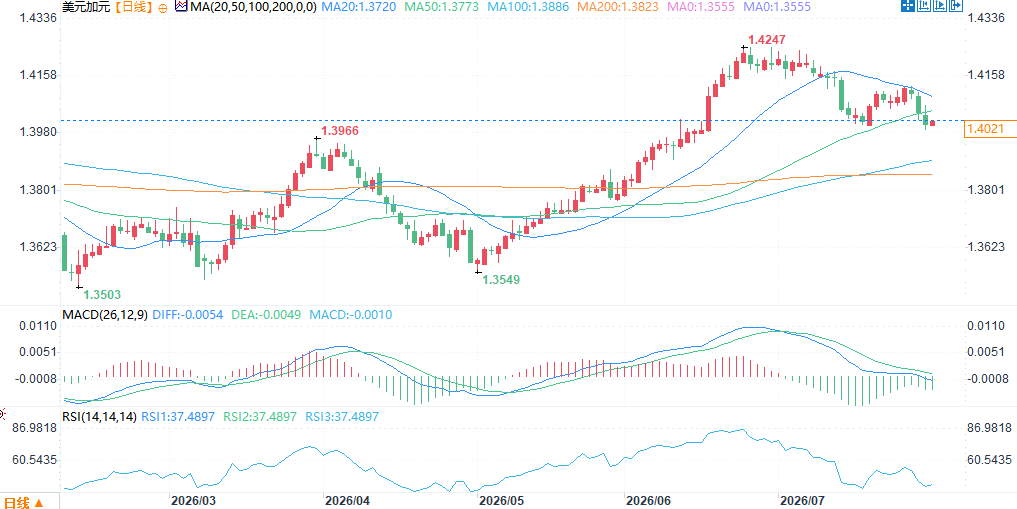 (USD/CAD daily chart, source: EasyForex) At 11:36 Beijing time on July 31, the USD/CAD exchange rate was 1.4020/21.
Canada's economy had a weak start, but a strong rebound in April still needs to be verified.
Canada's economic momentum is expected to weaken as we enter 2026. Recent monthly GDP data has been volatile: December -0.3%, January near zero, February +0.2%, March -0.1%, and April +0.5%. April's 0.5% growth exceeded expectations, reversing the weakness of March and marking Canada's strongest monthly growth in recent times. The breadth of growth is noteworthy—goods-producing sectors (mining, oil and gas extraction) saw strong growth, while the service sector (public sector, transportation, finance, and real estate) also expanded. However, an important caveat is that April's strength does not automatically guarantee strength in May and June. Some growth stemmed from a rebound after previous weakness; if these sectors slow again, GDP could quickly lose momentum.Market Expectations and Key Points
The market expects May GDP growth to be around 0.2%, slower than April's 0.5% but still positive. However, Statistics Canada's previous estimate showed May growth of only about 0.1%, making this release more noteworthy. If the actual figure is 0.2% or higher, it will exceed the previously weak forecast; if it's close to 0.1%, it still indicates growth, but the market may be less excited; if it's flat or negative, it will reignite concerns that the Canadian economy is still struggling. The June estimate is equally important—it will help the market estimate overall Q2 growth. If April is strong, May is positive, and June is also good, Q2 GDP will show a clear rebound, which is beneficial for the Canadian dollar.The Bank of Canada's Dilemma
The Bank of Canada recently kept its interest rate unchanged at 2.25%, signaling a shift away from aggressive dovishness and a view that while the economy is weak, it is improving. However, the situation is not so simple—overall inflation is above 3% (partly due to pressure on energy and refining margins), while inflation excluding gasoline is closer to 2%. If GDP is strong and inflation is firm, the central bank's case for cutting rates weakens; if GDP is weak and inflation is cooling, the central bank may be more inclined to ease; if GDP is weak but inflation is high, the central bank faces the worst-case scenario—slow growth coupled with inflationary pressures. This GDP report will help define the Bank of Canada's next policy narrative.Additive reactions in different scenarios
Strong GDP (above 0.2% and a positive June flash estimate): Positive for the Canadian dollar. The market may begin pricing in a stronger Canadian recovery, potentially leading to a weaker USD/CAD pair, a stronger CAD/JPY pair, higher Canadian yields, and reduced expectations of a central bank rate cut. In line with expectations (0.2%): The market reaction may be more balanced, confirming growth but not enough to change the Bank of Canada's outlook. The Canadian dollar may strengthen briefly, but the rally is likely to fade. Weak GDP (flat or negative): Negative for the Canadian dollar. The April rebound will appear unreliable, reigniting concerns about the continued fragility of the Canadian economy, and potentially leading to a stronger USD/CAD pair.Industries and variables that traders should pay attention to
While overall GDP figures are important, sector breakdowns will determine the true nature of the report: energy and mining were the main drivers of the April rebound; manufacturing will reflect global demand and trade conditions; the housing market has begun to recover and is sensitive to interest rates; the financial and insurance sectors have supported recent growth; and wholesale and retail trade reflect domestic demand. Traders should also pay attention to: Canadian bond yields, oil price movements, and the overall strength of the US dollar—the USD/CAD exchange rate is driven not only by Canada but also by Federal Reserve expectations and global risk appetite. (USD/CAD daily chart, source: EasyForex) At 11:36 Beijing time on July 31, the USD/CAD exchange rate was 1.4020/21.
- Risk Warning and Disclaimer
- The market involves risk, and trading may not be suitable for all investors. This article is for reference only and does not constitute personal investment advice, nor does it take into account certain users’ specific investment objectives, financial situation, or other needs. Any investment decisions made based on this information are at your own risk.