A World Gold Council report shows that despite the largest quarterly drop in a decade, gold remains a bull market favorite, demonstrating its remarkable resilience.
2026-07-31 11:54:49
The gold market experienced its largest quarterly decline in a decade in the second quarter of 2026, with prices continuing to fluctuate and weaken, putting significant pressure on the overall market. However, the latest industry report from the World Gold Council shows that the short-term pullback in gold prices has not broken through the core market fundamentals. Supported by strong physical buying in Asia and substantial increases in central bank holdings, the gold market has demonstrated strong resilience, and its long-term upward trend remains solid. Its investment value in the second half of the year is still worth paying attention to.
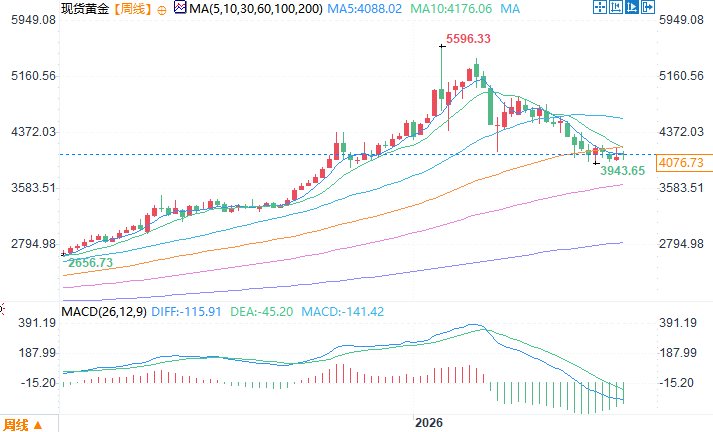 Spot gold weekly chart source: FX678. At 11:52 AM Beijing time on July 31, spot gold was trading at $4076.33 per ounce.
Despite a significant market correction, core fundamentals remain resilient.
Gold prices fell in the second quarter due to multiple negative factors. The Iranian situation triggered a global energy crisis, pushing up inflation expectations and forcing central banks worldwide to tighten monetary policy. This, coupled with rising expectations of US interest rate hikes, stronger US Treasury yields, and a stronger dollar, significantly increased the holding cost of gold as a non-interest-bearing asset, triggering a market sell-off. Data shows that the average gold price in the second quarter was $4056.59 per ounce, down 8% quarter-on-quarter, but still up 37% year-on-year, maintaining its long-term upward trend. Despite the market correction, overall demand for gold remained stable. Global gold demand totaled 1269 tons in the second quarter, flat year-on-year, and 2522 tons in the first half of the year, a slight increase of 2% year-on-year. Benefiting from higher gold prices, total gold demand in the first half of the year reached a record high of $380 billion, fully demonstrating gold's asset resilience. Institutions predict that Asian investment funds and OTC trading demand will continue to be the core supporting forces for the gold market in the second half of the year.Market liquidity is diverging: European and American ETFs are seeing reduced holdings, while Asian physical demand remains strong.
Global gold investment exhibited a clear regional divergence. In the second quarter, risk aversion cooled in European and American markets, with gold ETFs experiencing a net outflow of 45 tons. North American holdings saw their worst first-half performance since 2013, primarily driven by rising real interest rates and expectations of a Federal Reserve rate hike, leading investors to take profits. However, the market did not experience widespread panic, with multiple instances of bargain hunting during the quarter, indicating that gold's strategic allocation value remained recognized. In stark contrast to Europe and America, physical gold demand in Asia remained robust. Global demand for gold bars and coins remained stable at 307 tons in the second quarter, roughly the same as the same period last year. Major Asian countries performed particularly well, with retail gold investment demand reaching 314 tons in the first half of the year, a record high for the same period. Sluggish domestic asset returns, a weak housing market, and geopolitical uncertainties continued to drive residents to allocate gold. Meanwhile, over-the-counter (OTC) trading demand surged, reaching 327 tons in the second quarter, with the majority of the incremental funds coming from the Asian market. Indian gold investment demand also increased by 9% year-on-year, reflecting strong bargain-hunting sentiment.Central bank gold purchases rebound strongly, solidifying long-term support logic.
The strong recovery in official gold demand is a key factor in stabilizing the gold market. After a brief lull in gold purchases in the first quarter, global central bank gold purchases rebounded sharply in the second quarter to 289 tons, more than five times that of the first quarter, setting a new record for the highest second-quarter gold purchases in history. Poland and major Asian central banks led the way in increasing their holdings, with the major Asian central bank adding 33 tons of gold in a single quarter, the largest increase since the end of 2023. Looking at the long-term trend, the central bank gold-buying spree is expected to continue. Related surveys show that 89% of surveyed central banks predict that global official gold reserves will continue to grow, and 45% plan to continue increasing their gold holdings. The core needs of de-dollarization and diversification of reserve risks continue to highlight the official allocation value of gold.Jewelry demand is under pressure, but the market supply and demand structure remains balanced.
High gold prices continue to suppress consumer demand, becoming the only weakness in the market. Global gold jewelry consumption in the second quarter was 278 tons, a 17% year-on-year decline, the lowest quarterly level since the pandemic, with significant drops in demand in both of Asia's two major consumer markets. Consumer demand is showing new trends towards lighter, lower-purity gold and trade-in programs, with ordinary consumer demand shifting towards investment-grade gold bars and coins. On the supply side, overall supply remained stable. Mined gold production in the second quarter increased slightly by 2% year-on-year, reaching a new high for the same period; however, the short-term decline in gold prices dampened consumers' willingness to sell gold, resulting in a 6% year-on-year decrease in recycled gold supply. Coupled with strong market expectations of rising gold prices and the absence of systemic financial risks globally, the supply of recycled gold is unlikely to increase significantly, maintaining an overall stable supply and demand balance.Summarize
In conclusion, the sharp correction in gold prices in the second quarter was a short-term market fluctuation, not a fundamental reversal. While the exit of speculative funds from Europe and the US brought short-term pressure, the two core supporting forces—physical investment in Asia and continued central bank purchases—remained solid, resulting in a healthy overall supply and demand structure. Gold prices may continue to consolidate in the short term, but as market expectations for monetary policy gradually materialize, gold, supported by strong fundamentals, still has room to resume its upward trend. Spot gold weekly chart source: FX678. At 11:52 AM Beijing time on July 31, spot gold was trading at $4076.33 per ounce.
- Risk Warning and Disclaimer
- The market involves risk, and trading may not be suitable for all investors. This article is for reference only and does not constitute personal investment advice, nor does it take into account certain users’ specific investment objectives, financial situation, or other needs. Any investment decisions made based on this information are at your own risk.