Escalating conflict in the Middle East weighed on the euro, but the European Central Bank's interest rate guidance limited the decline.
2026-07-31 11:14:57
On Friday (July 31) during Asian trading hours, the euro weakened against the US dollar, retreating slightly from its June 18 high of around 1.1530 and currently trading around 1.1510, as escalating tensions between the US and Iran triggered risk aversion in the market. An Iranian parliamentary spokesperson stated that the US would "pay the price for killing Iranian civilians," and Saudi Arabia and 13 other countries announced the formation of an international coalition to guarantee freedom of navigation in the Red Sea and the Gulf of Aden. The expanding scope of geopolitical conflict is putting pressure on the risk currency, the euro. However, the Federal Reserve's decision to hold rates steady and Warsh's refusal to provide clues about future policy adjustments, coupled with the European Central Bank's clear guidance on a September rate hike, provided a floor for the euro. 
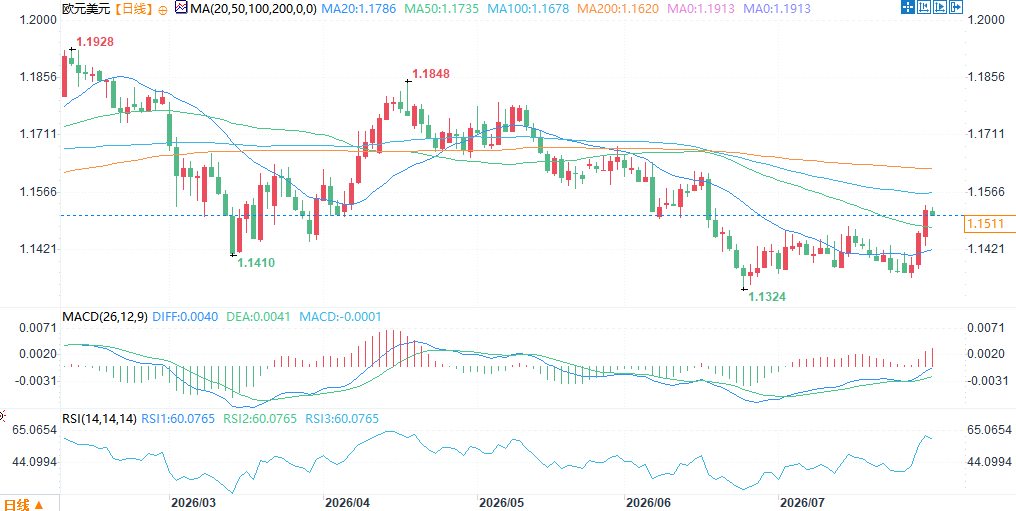 (Euro/USD daily chart, source: FX678) At 11:12 Beijing time on July 31, the euro was trading at 1.1510/11 against the US dollar.
The escalating conflict in the Middle East is putting pressure on the euro.
The euro's weakness is directly driven by the escalating geopolitical risks in the Middle East. An Iranian parliamentary spokesperson stated that the US would "pay the price for killing Iranian civilians," hinting at potential further retaliatory action from Tehran. Meanwhile, Saudi Arabia and 13 other countries announced the formation of an international coalition to ensure freedom of navigation in the Bab el-Mandeb Strait, the Red Sea, and the Gulf of Aden—a move reflecting the region's serious concerns about threats to shipping security. The expanding scope of the conflict is fueling risk aversion in markets, putting pressure on risk currencies such as the euro.The Federal Reserve held rates steady and Warsh refused to provide guidance, raising market doubts about the Fed's commitment to combating inflation.
The Federal Reserve kept interest rates unchanged on Wednesday, but Fed Chairman Warsh explicitly refused to provide clues about future policy adjustments during the press conference, raising questions about whether the new chairman is "seriously committed to curbing inflation." This uncertainty weakened the dollar and provided support for the euro. The CME FedWatch tool showed that market pricing in a September rate hike had fallen from about 77% before the meeting to 63.4%, reflecting market doubts about the Fed's policy path.The European Central Bank's clear guidance provides the euro with a "comparative advantage".
DBS strategists point out that the euro is receiving support from clearer policy guidance in Europe compared to the US. They stated, "While Warsh left US markets groping in the dark, the ECB is more unified in its hints of a September rate hike," a stance that "is giving the euro a clear comparative advantage over the dollar." The clear expectation of a September rate hike by the ECB provides a floor for the euro, even with short-term pressure from geopolitical risks.The euro faces a choice of direction.
The current foreign exchange market remains dominated by multiple key variables. Further escalation of the Middle East situation will fuel global risk aversion, potentially putting significant pressure on the euro as a risk-sensitive currency. Expanding conflict could disrupt energy supplies and trade routes, exacerbating uncertainty about the European economic outlook. Investors will likely sell euro assets and shift to safe-haven currencies like the US dollar, thus exerting sustained downward pressure on the euro exchange rate. Eurozone HICP data is also crucial. Stronger-than-expected inflation figures will reinforce market expectations that the European Central Bank will maintain or accelerate its rate hike path. Inflation stickiness will limit policy easing, supporting the euro's interest rate advantage and attracting capital inflows, thus offsetting some of the negative impact of geopolitical risks and providing temporary support for the euro. Federal Reserve policy expectations constitute another important variable. If the market continues to price in a slower rate hike in September, the US dollar will face significant pressure. Earlier rate cut expectations or a decreased probability of a rate hike will weaken the dollar's interest rate advantage, prompting capital flows to other currencies, including the euro. Against this backdrop, the euro/dollar exchange rate will depend on the dynamic interplay of Middle East risks, European inflation data, and Federal Reserve expectations.The euro seeks a balance between geopolitical risks and ECB guidance.
The euro retreated from recent highs to around 1.1510 against the dollar amid escalating tensions between the US and Iran. Rising geopolitical risks are putting pressure on risk currencies, but the ECB's clear guidance on a September rate hike provides a floor for the euro. The Fed's inaction and Warsh's refusal to provide clues about future policy adjustments have weakened the dollar, while the ECB's relatively unified hawkish stance is giving the euro a comparative advantage. In the short term, the euro is likely to consolidate within the 1.1480-1.1570 range. If the situation in the Middle East deteriorates further, the euro may test the 1.1480 support level; if geopolitical risks ease and expectations of an ECB rate hike continue to strengthen, the euro is expected to break through the 1.1570 resistance level and head towards 1.1600. The euro's medium-term direction still depends on the relative strength of the ECB's and the Fed's policy paths. (Euro/USD daily chart, source: FX678) At 11:12 Beijing time on July 31, the euro was trading at 1.1510/11 against the US dollar.
- Risk Warning and Disclaimer
- The market involves risk, and trading may not be suitable for all investors. This article is for reference only and does not constitute personal investment advice, nor does it take into account certain users’ specific investment objectives, financial situation, or other needs. Any investment decisions made based on this information are at your own risk.