US crude oil futures fell by about 2% at one point, pressured by the resumption of shipping activity in the Hormuz, with the OPEC+ meeting becoming a key short-term variable.
2026-07-31 15:11:10
On Friday (July 31), during Asian trading hours, US crude oil futures fell by about 2% at one point, currently trading around $82 per barrel. Profit-taking by traders after Thursday's strong rebound, coupled with a recovery in shipping volume in the Strait of Hormuz, put downward pressure on oil prices. However, ongoing geopolitical conflicts in the Middle East continue to provide support for oil prices – the Iranian parliamentary speaker warned the US would "pay a price," the Iranian Revolutionary Guard claimed to have launched strikes against US military bases in Kuwait, Jordan, and Bahrain, and reiterated that the Strait of Hormuz will remain closed. 
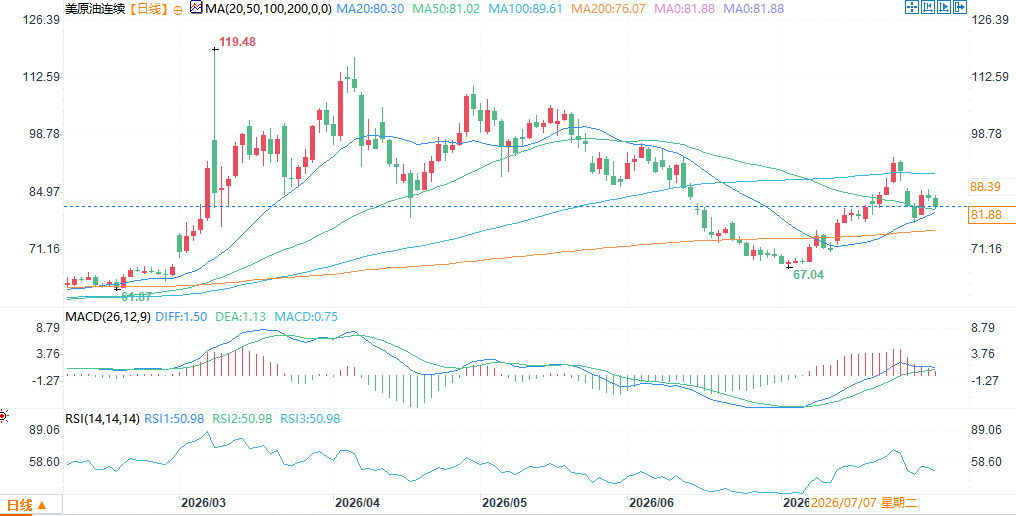 (US crude oil futures daily chart, source: FX678) At 15:08 Beijing time on July 31, US crude oil futures were trading at $82.27 per barrel.
Profit-taking and the resumption of shipping in the Hormuz region put pressure on oil prices.
The main driver of the oil price decline was profit-taking by traders after Thursday's strong rebound. Additionally, shipping activity in the Strait of Hormuz has recently picked up – the US Navy escorted some oil tankers through the waterway, and 14 merchant ships passed through on Wednesday, up from single digits last week. This resumption of shipping has eased immediate concerns about supply disruptions, putting downward pressure on oil prices in the short term.Escalating geopolitical risks provide a floor for oil prices.
Despite short-term pressure, the ongoing geopolitical conflict in the Middle East has provided a floor for oil prices. The Iranian parliamentary spokesperson stated that the US will "pay the price for killing Iranian civilians"; the Iranian Revolutionary Guard claimed to have launched strikes against US military bases in Kuwait, Jordan, and Bahrain, and reiterated that the Strait of Hormuz will remain closed, stating that "aggressors will be punished." These developments indicate that the US-Iran conflict is far from over, and the geopolitical risk premium on the supply side persists.US-Iran negotiations focus on the Hormuz region, putting the geopolitical premium for oil prices to the test.
Currently, the United States and Iran are communicating on restoring regional stability. The Pakistani Foreign Ministry disclosed that the negotiations focus on easing tensions, with a key issue being the security of the Strait of Hormuz, a crucial global energy transport route. This strait handles approximately one-fifth of global crude oil trade, and its stability directly impacts supply security expectations. If diplomatic efforts make substantial progress, market concerns about crude oil supply disruptions will significantly ease. Geopolitical risk premiums are expected to recede rapidly, weakening the safe-haven buying that recently supported oil prices. Investors will reassess the reliability of Middle Eastern supplies, and oil prices may face downward pressure in the short term. However, the outcome of the negotiations remains highly uncertain. If communication stalls or signs of escalation reappear, safe-haven demand will quickly return, potentially providing renewed support for oil prices. The market is currently closely monitoring the statements and actions of both sides, and diplomatic progress will be one of the core variables influencing short-term oil price direction.Shipping security cooperation accelerates
Regional shipping security measures are rapidly expanding towards the Red Sea. As a crucial waterway connecting Asia, Europe, and Africa, the Red Sea route has long faced the risk of attack and interference, directly impacting the efficiency of global trade and energy transportation. Recently, relevant parties have been further extending the scope of existing regional security cooperation to build a more comprehensive maritime protection network. Saudi Arabia recently held discussions with representatives from 43 countries, focusing on exploring the establishment of a regular maritime security cooperation mechanism. The meeting focused on information sharing, joint patrols, emergency response, and combating asymmetric threats, aiming to reduce the probability of attacks on important shipping routes. The participation of multiple parties demonstrates the international community's high regard for the security of the Red Sea route and reflects the difficulty for any single country to independently address the current complex security challenges. If the relevant cooperation mechanism is implemented and operates effectively, it will help improve navigation stability in the Red Sea and surrounding waters, reduce shipping insurance costs and detour requirements. In the long run, this will not only ensure the smooth flow of energy and commodity trade but also provide a positive signal for easing regional tensions and reduce the impact of geopolitical risks on global supply chains.US crude oil inventories fell more than expected.
Data from the U.S. Energy Information Administration showed that U.S. crude oil inventories fell by 7.167 million barrels in the week ending July 24 (previous week +2.011 million barrels, expected -2.5 million barrels), a larger-than-expected decline, providing fundamental support for oil prices. ING analysts expect OPEC+ to confirm a further production increase of 188,000 barrels per day in September at its August 2 meeting, which would completely undo the voluntary production cut of 1.65 million barrels per day announced in 2023. However, the agency noted reports that the alliance "may pause further supply increases after the September increase," indicating a more cautious approach to subsequent production increases.With the OPEC+ meeting approaching, oil prices await direction.
Current oil price movements remain driven by multiple key variables. If shipping in the Strait of Hormuz continues to recover, it will significantly alleviate market concerns about disruptions to Middle Eastern crude oil exports. As a crucial passage for approximately one-fifth of global crude oil trade, its efficiency directly determines the smoothness of supply. If traffic order further improves and insurance rates and detour costs decrease, the geopolitical premium previously priced in due to shipping risks will be rapidly reversed, putting downward pressure on oil prices. The Middle East geopolitical situation is equally critical. If the conflict escalates again, concerns about global energy supply security will rapidly intensify, potentially leading to a rapid rebound in oil prices. Increased military tensions will disrupt export routes and production facilities, pushing up market risk premiums and attracting safe-haven buying back into the crude oil market, thus supporting or even pushing up oil prices in the short term. The OPEC+ meeting constitutes an important variable on the supply side. If the meeting signals a halt to production increases or the maintenance of production cuts, it will strengthen expectations of tighter supply, providing a floor for oil prices. Any tightening of production policies will boost market confidence, offsetting some of the negative impact from demand concerns and the recovery of shipping, allowing oil prices to trade with a slightly upward bias amidst fluctuations. Investors need to closely monitor the dynamic interplay of these three factors.Supply and demand game under multiple intertwined variables
On Friday during Asian trading hours, US crude oil futures fell about 2% to below $82 per barrel, influenced by profit-taking and the resumption of shipping through the Strait of Hormuz. The short-term pressure factors are clear: concentrated profit-taking, coupled with a rebound in shipping volume through the Strait of Hormuz—14 merchant ships passed through on Wednesday, higher than the single-digit level last week—meaning the previously priced geopolitical premium is being rapidly eroded. However, supply-side risks are far from dissipated. Iran vowed retaliation, with the Revolutionary Guard claiming to have struck US military bases in Kuwait, Jordan, and Bahrain, reiterating that the Strait of Hormuz will remain closed. US-Iran negotiations are progressing simultaneously, but the outcome is highly uncertain—if they break down or escalate, oil prices will rebound rapidly. Fundamentals also provide support: US crude oil inventories fell more than expected by 7.167 million barrels, OPEC+ production increases after September are facing a pause, and Saudi Arabia is leading 43 countries in discussions on a Red Sea maritime security coalition. Overall, oil prices are likely to consolidate within the current range in the short term. The resumption of Hormuz passage and profit-taking exert downward pressure, while geopolitical conflict, declining inventories, and OPEC+ policy provide support. The direction of the next stage depends on the interplay of three factors: the passage of the Hormuz, the evolution of the situation in the Middle East, and the signals from the OPEC+ meeting. (US crude oil futures daily chart, source: FX678) At 15:08 Beijing time on July 31, US crude oil futures were trading at $82.27 per barrel.
- Risk Warning and Disclaimer
- The market involves risk, and trading may not be suitable for all investors. This article is for reference only and does not constitute personal investment advice, nor does it take into account certain users’ specific investment objectives, financial situation, or other needs. Any investment decisions made based on this information are at your own risk.