Gold is nearing the upper limit of its trading range, awaiting a breakout?
2026-07-31 14:20:50
Spot gold (XAU/USD) continued its weak performance in Asian trading on Friday, failing to extend its gains after breaking through $4,100 and now facing renewed downward pressure. The decline in gold prices was mainly due to a rebound in the US dollar. The dollar index ended its previous decline to its lowest level since June 17th, regaining some buying support and putting pressure on dollar-denominated gold.  Previously released US economic data briefly boosted gold prices. Data from the US Bureau of Economic Analysis showed that the US GDP grew at an annualized rate of 1.5% in the second quarter, lower than the previous quarter's 2.1% and below market expectations, indicating a slowdown in economic growth momentum. Meanwhile, US inflation data continued to show signs of cooling. The personal consumption expenditures (PCE) price index fell 0.1% month-on-month in June, the first monthly decline since April 2020. Year-on-year, the overall PCE inflation rate fell from 4.1% to 3.7%, in line with market expectations; the core PCE, which the Federal Reserve focuses on, also saw its year-on-year growth rate fall from 3.4% to 3.3%, with the month-on-month increase slowing to 0.1% from 0.3% in May. These data briefly reduced market bets on further tightening of policy by the Federal Reserve in the short term and pushed the dollar weaker overnight, providing upward momentum for gold. However, market concerns about inflation risks have not completely subsided, especially with oil prices remaining highly volatile due to geopolitical factors, potentially pushing up inflationary pressures again due to energy costs. The recent situation in the Middle East remains a significant factor influencing gold's price movements. The US announced the completion of a new round of military operations targeting Iranian objectives, while regional shipping security continues to be a focus of market attention. Iran rejected proposals for joint management of the Strait of Hormuz, while Saudi Arabia is pushing for an international cooperation mechanism to protect vital shipping routes in the Bab el-Mandeb Strait, the Red Sea, and the Gulf of Aden. Market concerns exist that further escalation of regional tensions could disrupt global energy supplies and drive up oil prices. In this scenario, inflationary pressures could resurface, prompting the Federal Reserve to maintain a tight policy stance, thus limiting upside potential for gold. Investors currently still expect an over 85% probability of at least one Fed rate hike by the end of the year. Higher rate hike expectations support a rise in US Treasury yields and drive some funds back into dollar assets, putting pressure on non-interest-bearing gold. However, gold still has some downside support. Due to slowing US economic growth and continued decline in inflation, market opinions remain divided on the future direction of monetary policy. If subsequent economic data continues to be weak, it could reinforce expectations of further easing and provide new upward momentum for gold. Currently, XAU/USD remains within the trading range established in recent weeks, with the market awaiting new fundamental catalysts. Investors are focusing on US consumer confidence data, changes in inflation expectations, the trend of US Treasury yields, and the development of geopolitical risks, as these factors will determine the direction of gold's next breakout. From a daily chart perspective, gold is currently maintaining a slightly weak, oscillating structure. The price encountered resistance near $4100 and has since retreated, remaining in a high-level consolidation phase. The technical pressure formed after breaking below the 200-day moving average has not been completely relieved, and the current oscillating trend is more of a post-decline correction phase. In terms of technical indicators, while the MACD histogram is still in positive territory, the momentum has weakened; the RSI indicator is near 50, indicating that the market's bullish and bearish forces are approaching equilibrium, but upward momentum is insufficient. The upper resistance level to watch is the upper edge of the range around $4175. A successful break above this level could lead to a further challenge of the $4200 mark, followed by stronger resistance near the 200-day moving average. On the downside, the first support levels to watch are the psychological level of $4000 and the recent low near $3976. A break below this area could open up further downside potential. From a 4-hour chart perspective, gold's short-term trend has weakened. After repeatedly encountering resistance above $4100, prices have pulled back, with short-term moving average pressure gradually increasing. The market is currently in a consolidation phase. If gold can hold the $4000 area, there is still a chance for a short-term rebound and a retest of the $4100-$4175 resistance zone. A break below the $3976 support level could accelerate the correction towards $3900. Technical indicators show increased short-term selling pressure, but no clear downtrend signal has yet appeared. Future price movements will depend on the strength of the US dollar and changes in expectations regarding Federal Reserve policy.
 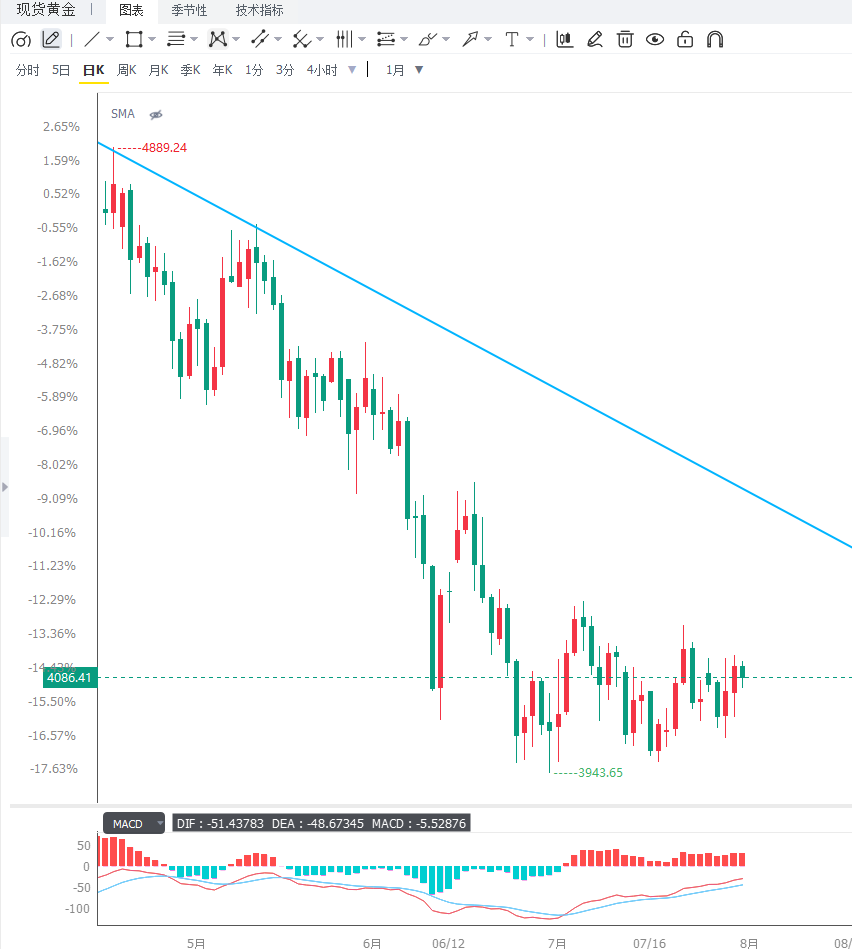 Editor's Summary: Recent gold price movements reflect the market's ongoing struggle between economic slowdown, declining inflation, and the risk of policy tightening. Weak US economic data and falling inflation have provided support for gold, but energy price volatility and expectations of a Fed rate hike continue to limit further upward movement. In the short term, the dollar's performance and US Treasury yields remain the core factors determining gold's direction. If the market continues to lower its expectations for rate hikes, gold may regain upward momentum; however, if geopolitical risks drive up oil prices and intensify inflation concerns, leading to an extension of the Fed's high interest rate policy, gold may continue to face pressure. Overall, gold remains in a key trading range, with support around $4,000 and resistance above $4,175 becoming the focus of short-term battles between bulls and bears. Investors need to closely monitor changes in macroeconomic data and developments in global risk events to determine the direction of the next trend breakout.
Previously released US economic data briefly boosted gold prices. Data from the US Bureau of Economic Analysis showed that the US GDP grew at an annualized rate of 1.5% in the second quarter, lower than the previous quarter's 2.1% and below market expectations, indicating a slowdown in economic growth momentum. Meanwhile, US inflation data continued to show signs of cooling. The personal consumption expenditures (PCE) price index fell 0.1% month-on-month in June, the first monthly decline since April 2020. Year-on-year, the overall PCE inflation rate fell from 4.1% to 3.7%, in line with market expectations; the core PCE, which the Federal Reserve focuses on, also saw its year-on-year growth rate fall from 3.4% to 3.3%, with the month-on-month increase slowing to 0.1% from 0.3% in May. These data briefly reduced market bets on further tightening of policy by the Federal Reserve in the short term and pushed the dollar weaker overnight, providing upward momentum for gold. However, market concerns about inflation risks have not completely subsided, especially with oil prices remaining highly volatile due to geopolitical factors, potentially pushing up inflationary pressures again due to energy costs. The recent situation in the Middle East remains a significant factor influencing gold's price movements. The US announced the completion of a new round of military operations targeting Iranian objectives, while regional shipping security continues to be a focus of market attention. Iran rejected proposals for joint management of the Strait of Hormuz, while Saudi Arabia is pushing for an international cooperation mechanism to protect vital shipping routes in the Bab el-Mandeb Strait, the Red Sea, and the Gulf of Aden. Market concerns exist that further escalation of regional tensions could disrupt global energy supplies and drive up oil prices. In this scenario, inflationary pressures could resurface, prompting the Federal Reserve to maintain a tight policy stance, thus limiting upside potential for gold. Investors currently still expect an over 85% probability of at least one Fed rate hike by the end of the year. Higher rate hike expectations support a rise in US Treasury yields and drive some funds back into dollar assets, putting pressure on non-interest-bearing gold. However, gold still has some downside support. Due to slowing US economic growth and continued decline in inflation, market opinions remain divided on the future direction of monetary policy. If subsequent economic data continues to be weak, it could reinforce expectations of further easing and provide new upward momentum for gold. Currently, XAU/USD remains within the trading range established in recent weeks, with the market awaiting new fundamental catalysts. Investors are focusing on US consumer confidence data, changes in inflation expectations, the trend of US Treasury yields, and the development of geopolitical risks, as these factors will determine the direction of gold's next breakout. From a daily chart perspective, gold is currently maintaining a slightly weak, oscillating structure. The price encountered resistance near $4100 and has since retreated, remaining in a high-level consolidation phase. The technical pressure formed after breaking below the 200-day moving average has not been completely relieved, and the current oscillating trend is more of a post-decline correction phase. In terms of technical indicators, while the MACD histogram is still in positive territory, the momentum has weakened; the RSI indicator is near 50, indicating that the market's bullish and bearish forces are approaching equilibrium, but upward momentum is insufficient. The upper resistance level to watch is the upper edge of the range around $4175. A successful break above this level could lead to a further challenge of the $4200 mark, followed by stronger resistance near the 200-day moving average. On the downside, the first support levels to watch are the psychological level of $4000 and the recent low near $3976. A break below this area could open up further downside potential. From a 4-hour chart perspective, gold's short-term trend has weakened. After repeatedly encountering resistance above $4100, prices have pulled back, with short-term moving average pressure gradually increasing. The market is currently in a consolidation phase. If gold can hold the $4000 area, there is still a chance for a short-term rebound and a retest of the $4100-$4175 resistance zone. A break below the $3976 support level could accelerate the correction towards $3900. Technical indicators show increased short-term selling pressure, but no clear downtrend signal has yet appeared. Future price movements will depend on the strength of the US dollar and changes in expectations regarding Federal Reserve policy. Editor's Summary: Recent gold price movements reflect the market's ongoing struggle between economic slowdown, declining inflation, and the risk of policy tightening. Weak US economic data and falling inflation have provided support for gold, but energy price volatility and expectations of a Fed rate hike continue to limit further upward movement. In the short term, the dollar's performance and US Treasury yields remain the core factors determining gold's direction. If the market continues to lower its expectations for rate hikes, gold may regain upward momentum; however, if geopolitical risks drive up oil prices and intensify inflation concerns, leading to an extension of the Fed's high interest rate policy, gold may continue to face pressure. Overall, gold remains in a key trading range, with support around $4,000 and resistance above $4,175 becoming the focus of short-term battles between bulls and bears. Investors need to closely monitor changes in macroeconomic data and developments in global risk events to determine the direction of the next trend breakout.
- Risk Warning and Disclaimer
- The market involves risk, and trading may not be suitable for all investors. This article is for reference only and does not constitute personal investment advice, nor does it take into account certain users’ specific investment objectives, financial situation, or other needs. Any investment decisions made based on this information are at your own risk.