Foreign exchange market intervention has failed to reverse the yen's weakness; Deutsche Bank analysts predict continued downward pressure on the yen.
2026-07-31 15:14:51
Amidst a continued weakening of the yen, Japan's Ministry of Finance intervened in the foreign exchange market, an action supported by the US Treasury Department. Tokyo's inflation has stabilized around 2%, but the risk of upward inflation has not yet been eliminated. However, the Bank of Japan chose to remain on hold, only releasing a slightly hawkish signal. Volkmar Baur, an analyst at Commerzbank, pointed out that the central bank's policy力度 (strength/intensity) is clearly insufficient and unlikely to reverse market expectations; the yen will still face the risk of further depreciation in the short term. Japan's Ministry of Finance intervened directly in the foreign exchange market yesterday, clearly conveying the government's inability to tolerate a continued weak yen. Meanwhile, the US Treasury Department expressed support, suggesting that this intervention will receive favorable external support. The latest inflation data from Tokyo shows that local inflation is gradually stabilizing at around 2%, and considering recent trends, there is a possibility of further upward movement in inflation, theoretically creating conditions for a tightening of monetary policy.
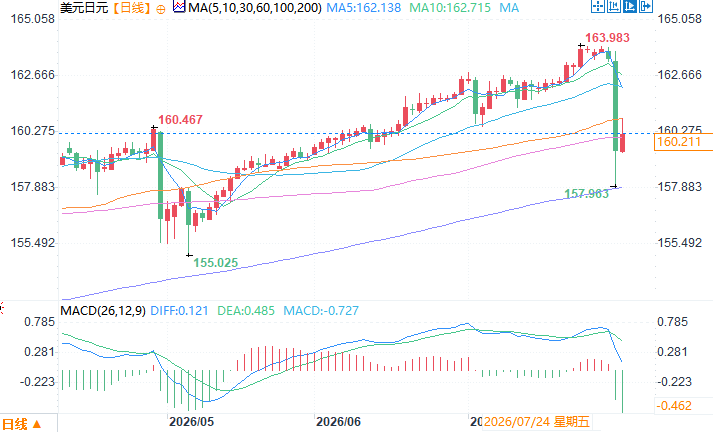 USD/JPY daily chart source: FX678. At 15:11 Beijing time on July 31, USD/JPY was trading at 160.37/38.
Official intervention in the foreign exchange market has been implemented, and external factors have provided support.
The market environment had already laid the groundwork for intervention. Japan's Ministry of Finance intervened directly in the foreign exchange market yesterday, clearly conveying the government's inability to tolerate a continued weak yen. Meanwhile, the US Treasury Department expressed support, suggesting that this intervention will receive favorable external support. The latest inflation data from Tokyo shows that local inflation is gradually stabilizing at around 2%, and considering recent trends, there is a possibility of further upward movement in inflation, theoretically creating conditions for a tightening of monetary policy.The Bank of Japan's policy leans towards conservatism, with limited hawkish pronouncements.
Despite multiple positive factors, the Bank of Japan's policy choices fell short of market expectations. The central bank maintained its benchmark interest rate, largely in line with market expectations, and the policy document only subtly hinted at a future tightening of monetary policy. Such vague statements are unlikely to change investors' trading strategies. A review of recent market movements reveals a clear pattern: while the Ministry of Finance has the willingness to actively intervene in the foreign exchange market, the exchange rate threshold triggering intervention has been continuously lowering, and the range within which the government can tolerate sustained yen depreciation is widening. Historical experience suggests that this pattern is unlikely to fundamentally change in the short term.Summarize
Overall, foreign exchange intervention can provide a temporary boost to the yen, but the Bank of Japan's cautious and conservative monetary policy weakens the long-term effectiveness of such interventions. As long as the central bank does not dare to decisively tighten monetary policy, relying solely on the Ministry of Finance's occasional market interventions will hardly fundamentally reverse the yen's downward trend. In the coming period, the yen is likely to return to a depreciation trajectory, and investors need to continue to monitor exchange rate volatility risks. USD/JPY daily chart source: FX678. At 15:11 Beijing time on July 31, USD/JPY was trading at 160.37/38.
- Risk Warning and Disclaimer
- The market involves risk, and trading may not be suitable for all investors. This article is for reference only and does not constitute personal investment advice, nor does it take into account certain users’ specific investment objectives, financial situation, or other needs. Any investment decisions made based on this information are at your own risk.