Despite a multitude of positive factors, gold continues to weaken and is consolidating within a range, awaiting a breakout.
2026-07-31 17:44:49
On Friday (July 31), spot gold weakened throughout the Asian and European sessions, showing signs of failing to rise despite recent bullish news. It is currently trading around 4055, down 1%. The Fed's hawkish stance and decision to maintain the benchmark interest rate for the fifth consecutive time provided limited short-term support for gold and silver prices. However, market policy uncertainty has not subsided and has been postponed to the September decision window. Coupled with the oil inflation disturbance caused by the Iran war, internal policy disagreements within the Fed, and low market liquidity constraints during the summer, gold and silver are unlikely to break out of their recent trend and are more likely to remain range-bound, awaiting a breakout after the market returns to activity in September and the release of key data. 
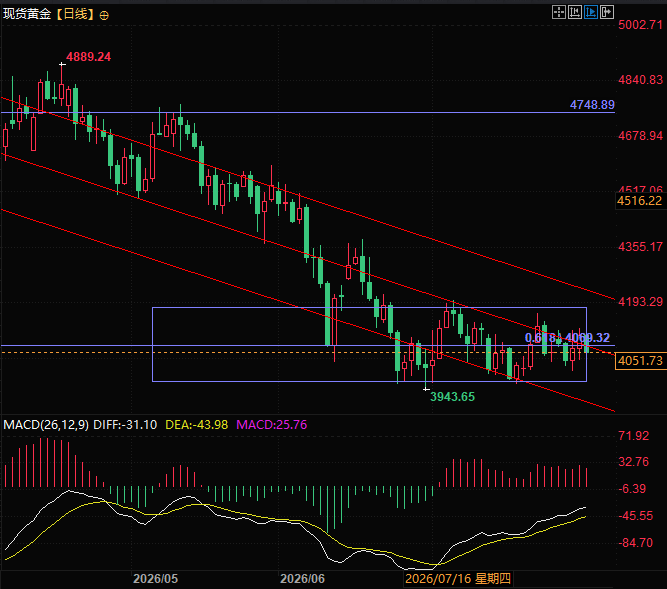 (Spot gold daily chart, source: EasyTrade) At 17:41 Beijing time, spot gold is currently trading at $4051 per ounce.
Internal divisions within the Federal Reserve have intensified, but the core policy stance remains stable.
The biggest highlight of this Federal Reserve interest rate decision was the significantly increased internal policy divergence, resulting in a rare and fiercely contested vote since 2016. Three regional Fed presidents voted against raising rates, advocating for an immediate tightening of policy, highlighting the rise of hawkish forces within the Fed. However, all Fed governors and New York Fed President Williams unanimously supported maintaining the current interest rate, meaning that the core policymakers have no immediate plans for a rate hike, and the market need not panic excessively about the risk of aggressive tightening. The policy statement showed minimal changes compared to the June version, with only minor adjustments to the wording related to reserve policies, updating the original "reaffirming the ample reserve policy" to "continuing to implement the ample reserve policy," maintaining an overall stable policy tone.Walsh's hawkish stance is clear, and his policies face multiple pressures from political maneuvering.
Federal Reserve Chairman Warsh delivered a clearly hawkish statement, upholding the central bank's independence, firmly targeting the 2% inflation target, and explicitly stating that the inflation tolerance range will not be raised. This is the most resolute statement from a Fed chairman in recent years. Furthermore, his policy approach is highly differentiated, no longer relying on policy statements to send signals, but instead choosing to adjust borrowing costs through market transmission, emphasizing a flexible and wait-and-see policy pace. It is worth noting that the Fed is currently embroiled in multiple realities: on the one hand, it needs to resolutely suppress high inflation; on the other hand, with the midterm elections approaching in November, it faces political pressure from the White House to cut interest rates. Policy making remains a subject of multi-party negotiation.The resolution's implementation led to market divergence, with gold experiencing a short-term rebound followed by downward pressure and consolidation.
Following the hawkish stance taken to maintain stability, US Treasury and mortgage rates reacted first, with long-term rates under pressure and rising. The 30-year US Treasury yield climbed to its highest level since 2007, simultaneously driving the US 30-year fixed mortgage rate to a one-year high of 6.66%, indicating a clear tightening of credit in the market. However, the US dollar and US Treasury yields did not continue to strengthen; instead, they weakened temporarily after the decision, directly pushing gold prices up in the short term. Gold prices rebounded rapidly from below $4,000, reaching a high of $4,116, a three-day high. However, the bullish momentum was insufficient to sustain the gains, failing to hold the highs and closing below the 20-day moving average (approximately $4,072). Multiple attempts to break the $4,100 level were met with selling pressure. Silver's performance was relatively stable, rising slightly by nearly $1, maintaining an overall range-bound movement and lacking a clear upward trend.Energy supply shocks drive inflation, exacerbating the Federal Reserve's policy dilemma.
The unique nature of this round of inflation is the core underlying logic influencing the Federal Reserve's policy and supporting the resilience of gold. The primary driver of this surge in inflation is not overheated domestic demand, but rather the energy supply shock triggered by the war with Iran. The escalation of the US-Iran conflict previously led to a historic oil shortage, and coupled with repeated disruptions from the conflict, crude oil prices repeatedly surged, directly pushing inflation to a three-year high in May. This upward cycle of inflation coincides with the time when Warsh took office as Federal Reserve Chairman. The initial Gaza peace agreement in June briefly alleviated energy inflation pressures, but the recurring conflicts in the Middle East, the ongoing military clashes between the US and Iran, and the spread of the war to Iranian natural gas facilities have further exacerbated concerns about energy supply, significantly increasing the difficulty of controlling inflation. Industry economists generally believe that traditional interest rate hikes have limited effectiveness in addressing inflation caused by supply shortages. Interest rate hikes can only suppress market demand and cannot solve the fundamental problem of insufficient supply of core energy sources such as crude oil and natural gas. This has put the Federal Reserve in a policy dilemma. Excessive interest rate hikes would shock the economy and financial markets, while maintaining a wait-and-see approach would make it difficult to quickly cool down inflation, ultimately forcing the Federal Reserve to choose a neutral-to-hawkish strategy of "wait and see, data-driven." RSM global economist Joseph Brusueras stated clearly that the Federal Reserve's optimal strategy for dealing with supply-side inflation is to wait and see, and that there is ample room to maintain current policy interest rates without the need for hasty tightening.Institutional view: The battle between bulls and bears in gold continues to intensify.
The current market is significantly divided on the Federal Reserve's future policy path, directly leading to intensified bullish and bearish battles in the gold market. Some institutions, based on the resilience of energy inflation, believe that persistently high oil prices will continue to support inflation, and the Fed may still raise interest rates this year. Currently, the market prices a 60% probability of a 25 basis point rate hike in September, and the hawkish voting results have further strengthened this expectation. However, another mainstream view holds that, based on the high base effect of last year, this year's year-on-year inflation data is likely to continue to improve. Coupled with the spontaneous tightening of market credit, the Fed is likely to keep interest rates unchanged throughout the year. If this expectation materializes, the stock market and precious metals market will receive positive support at the end of the year. According to the technical analysis of several senior analysts, gold and silver have now formed a positive technical pattern, and the foundation for a rebound has been established. Jesse Colombo, an independent precious metals analyst and founder of the "Bubble Watch Report," pointed out that last week, gold and silver broke out of the triangle consolidation pattern simultaneously, completely shattering the market's previous pessimistic expectation that gold prices would fall to $3,000, which is a clear bullish reversal signal. The current breakout structure remains valid, and the market has already fully priced in pessimistic expectations of interest rate hikes. Gold and silver possess extremely strong resilience against declines and have the potential for a rebound.Limited liquidity during the summer means gold and silver price trends await a breakout in September.
However, short-term price movements are limited by seasonal trading constraints, making it difficult to quickly initiate a trend. Currently, it's the height of summer, and Wall Street institutions are generally on holiday, resulting in thin trading and low liquidity. There's a lack of sufficient funds to drive significant price fluctuations in gold and silver, thus the market is likely to remain range-bound in the near term. As market activity fully returns in September, the pace of price volatility will accelerate significantly. Technically, the key short-term breakout level for gold is $4100. Holding above this level will further confirm the strength of the bulls. Subsequent key resistance levels are concentrated in the $4300-$4600 range; a decisive break above this level would signal the end of this correction. Silver, on the other hand, needs to break through the $60-$70 resistance zone to unlock a full rebound.Market Summary: Uncertainty Delayed, Gold Remains in a Consolidation Phase Awaiting Multiple Convergences
Natixis analysis concludes that the July FOMC meeting did not result in any substantial policy announcements, merely postponing market uncertainty to September. Before the next FOMC meeting, the market will see two key CPI data releases. Meanwhile, the Fed will continue to monitor oil price fluctuations following the Iran conflict, assessing the lagged impact of energy shocks on inflation and providing a basis for subsequent policy direction. Given the uncertainty surrounding multiple variables and insufficient market liquidity, gold is expected to continue its oscillating pattern in the short term. A clear trend will require a convergence of policy, data, and market sentiment in September. Technically, gold prices remain suppressed by the descending trendline and have failed to hold the 0.618 Fibonacci retracement level, exhibiting an overall range-bound pattern. The price center is around 4069, and this oscillating market is unfavorable for chasing highs or lows. (Spot gold daily chart, source: EasyTrade) At 17:41 Beijing time, spot gold is currently trading at $4051 per ounce.
- Risk Warning and Disclaimer
- The market involves risk, and trading may not be suitable for all investors. This article is for reference only and does not constitute personal investment advice, nor does it take into account certain users’ specific investment objectives, financial situation, or other needs. Any investment decisions made based on this information are at your own risk.