Trump's cancellation of sanctions and OPEC+ production increases put pressure on oil prices, while the Canadian dollar was pressured but a weaker US dollar provided support.
2026-08-03 11:42:51
The US dollar edged higher against the Canadian dollar in Asian trading on Monday (August 3), currently trading around 1.4030. The cancellation of sanctions against Iran by Trump and increased OPEC+ production pressured oil prices, dragging down the Canadian dollar; however, the US dollar fell to its lowest level since June 17 due to short covering in the Japanese yen and easing expectations of interest rate hikes, limiting the gains against the Canadian dollar. The market is focused on this week's US and Canadian employment reports. 
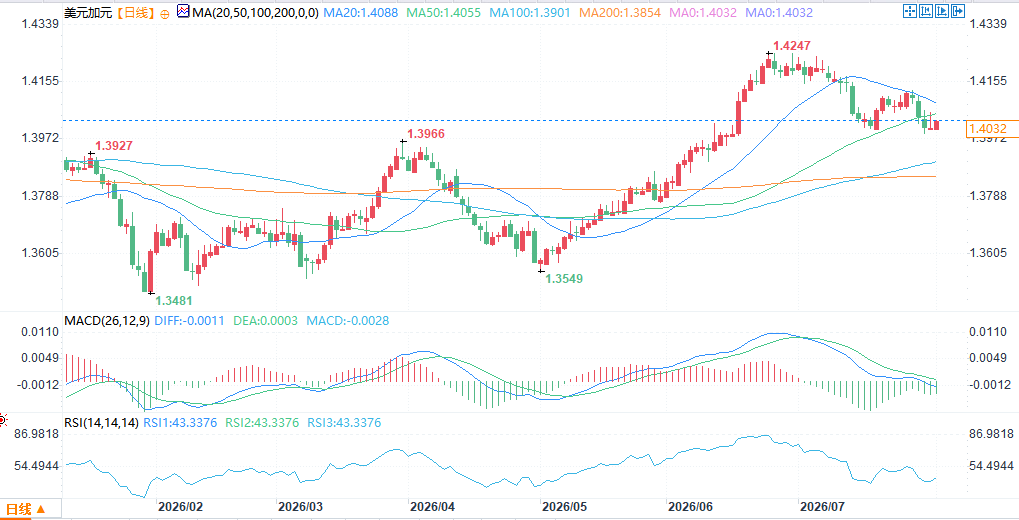 (USD/CAD daily chart, source: EasyForex) At 11:39 Beijing time on August 3, the USD/CAD exchange rate was 1.4032/33.
The plunge in oil prices dragged down the Canadian dollar.
The plunge in oil prices is becoming a major driver of the Canadian dollar's decline. Trump's cancellation of a planned military strike against Iran and his claim that Middle Eastern allies had reached a framework agreement to end the five-month war significantly eased market concerns about geopolitical supply disruptions. Meanwhile, OPEC+ members agreed to increase production by 188,000 barrels per day in September, further pressuring oil prices with expectations of increased supply. The sharp drop in crude oil prices directly weakened the Canadian dollar, which is highly correlated with commodities. As a significant source of Canadian export revenue, the decline in oil prices impacted trade and fiscal prospects, leading to a weaker Canadian dollar. This backdrop provided upward support for the USD/CAD exchange rate, giving it a temporary boost. In the short term, the Canadian dollar's performance will remain highly dependent on oil price fluctuations. If the decline in oil prices continues, downward pressure on the Canadian dollar may increase further; conversely, if geopolitical tensions fluctuate or supply expectations adjust, a rebound in oil prices may limit the Canadian dollar's decline.A weaker dollar limited gains for the dollar against the Canadian dollar.
While the plunge in oil prices provided upward momentum for the USD/CAD pair, a broad-based weakening of the US dollar significantly limited gains. The drop in oil prices effectively eased market concerns about inflation, thereby weakening expectations of an immediate interest rate hike by the Federal Reserve, putting overall pressure on the dollar. Meanwhile, aggressive short covering in the Japanese yen pushed the dollar index to its lowest level since June 17, further dragging down the USD/CAD performance. Against this backdrop, USD/CAD bulls need to remain cautious. Although the exchange rate received some support from the oil price decline, the weakening of the US dollar itself diminished upward momentum. Any meaningful rebound from below 1.4000 (the one-and-a-half-month low reached last Thursday) is likely to face strong resistance. The market is more inclined to wait and see, awaiting clearer policy signals or confirmation from oil price movements before deciding on its next direction.This week's focus
This week, market focus is concentrated on a series of key macroeconomic data and geopolitical developments. Market participants are closely watching important US economic indicators, with the ISM Manufacturing PMI to be released later today. As a leading indicator of manufacturing activity, any surprises or disappointments in this data could trigger short-term volatility in the US dollar and affect market assessments of the resilience of the US economy. However, the real highlight will be the monthly employment reports from the US and Canada, to be released on Friday. Core data such as non-farm payrolls, the unemployment rate, and average hourly earnings will directly influence market pricing in the Federal Reserve's policy path; Canadian employment data will determine the Bank of Canada's policy expectations. If both countries' data are simultaneously strong, it could reinforce the "tightening" narrative and increase volatility in the USD/CAD exchange rate; if they diverge, the exchange rate direction will become clearer. The employment report results are expected to have a significant impact on the USD/CAD exchange rate in the short term, becoming the most crucial trading catalyst this week. Furthermore, further developments in the Middle East situation could continue to cause market volatility. If geopolitical tensions escalate again or show signs of easing, risk appetite and oil price movements will change in tandem, providing new directional guidance for the exchange rate. Overall, the USD/CAD exchange rate this week will be driven by both data and geopolitical factors, with potentially amplified volatility.The downside risk for the Canadian dollar may increase.
The market's focus regarding the Canadian dollar's trajectory is currently concentrated on three key variables. First, oil prices. As a crucial Canadian export, a continued decline in crude oil prices would directly weaken Canada's trade and fiscal prospects, putting significant pressure on the Canadian dollar and potentially pushing it below its recent support level. Second, expectations of a Federal Reserve interest rate hike are equally important. If the market continues to price in a September rate hike, the US dollar will receive strong support, and a widening US-Canada interest rate differential will attract capital flows to dollar assets, thus exerting additional downward pressure on the Canadian dollar. If the US dollar index strengthens in tandem, the Canadian dollar's depreciation could further intensify. Third, US and Canadian employment data cannot be ignored. Stronger data from both countries would reinforce market expectations that the Federal Reserve and the Bank of Canada will maintain tightening or even further raise interest rates, with the repricing of interest rate differentials and growth prospects dominating exchange rate fluctuations. In summary, if these variables converge, the short-term downside risk for the Canadian dollar may increase.Summarize
The USD/CAD pair traded around 1.4030 amid a plunge in oil prices and a weakening US dollar. Trump's cancellation of sanctions and OPEC+ production cuts led to a sharp drop in oil prices, dragging down the Canadian dollar; however, the US dollar weakened due to short covering in the Japanese yen and a cooling of interest rate hike expectations, limiting the upside potential for USD/CAD. In the short term, USD/CAD is likely to consolidate within the 1.3950-1.4100 range. If oil prices continue to fall and expectations of a Fed rate hike rise, USD/CAD may break through the 1.4100 resistance level; if the US dollar continues to weaken and oil prices stabilize, USD/CAD may retest the 1.3950 support level. This week's US and Canadian employment reports will be a key variable in breaking the current deadlock. (USD/CAD daily chart, source: EasyForex) At 11:39 Beijing time on August 3, the USD/CAD exchange rate was 1.4032/33.
- Risk Warning and Disclaimer
- The market involves risk, and trading may not be suitable for all investors. This article is for reference only and does not constitute personal investment advice, nor does it take into account certain users’ specific investment objectives, financial situation, or other needs. Any investment decisions made based on this information are at your own risk.