The yen surged over 5% in three days, from 164 to 155! How powerful was the joint intervention by the US and Japan? Historical data provides the answer.
2026-08-03 11:04:52
On Monday (August 3), Japanese Finance Minister Satsuki Katayama issued a statement saying that Japan had intervened in the foreign exchange market in conjunction with the United States on July 31 (US Eastern Time), and did not rule out further intervention measures depending on market conditions. This is the first time in 15 years that the US and Japan have jointly intervened in the foreign exchange market by buying yen, amounting to nearly $60 billion. US Treasury Secretary Bessenter's handwritten "yen-buying" to-do list was unexpectedly revealed, and President Trump publicly supported it, saying that this move reflects US-Japan friendship and benefits the global economy. The yen surged by more than 5%, the dollar index came under pressure, and the global foreign exchange market suddenly became tense. Can this rare collaboration truly reverse the yen's decline, or is it merely a short-term pain reliever? 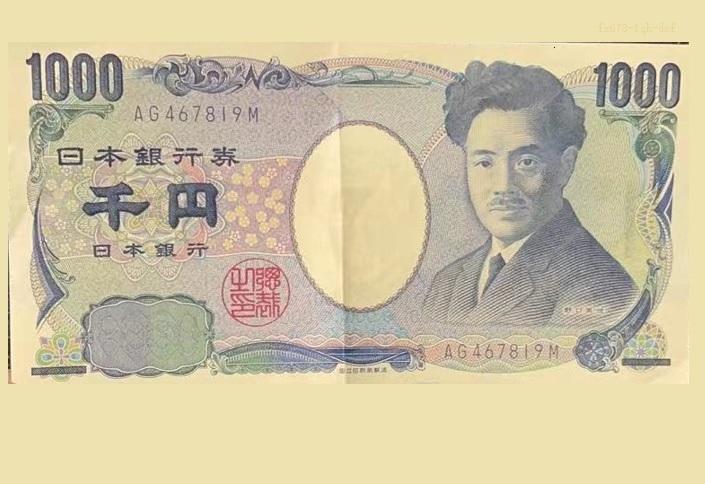
 The strong appreciation of the yen put broad pressure on the dollar. The euro rose to a one-and-a-half-month high of $1.1559, while the pound also touched a two-week high of $1.3484. The dollar index has fallen more than 1.5% last week, briefly hitting a one-and-a-half-month low of 99.42 in early trading on Monday. Furthermore, falling oil prices further weighed on the dollar – news that US President Trump had called a halt to attacks on Iran and planned to begin negotiations with Iran pushed oil prices lower, weakening safe-haven buying of the dollar.
A rare joint operation between Japan and the United States
On August 3, Japan's Ministry of Finance officially announced that Japan and the United States had jointly implemented a coordinated exchange rate intervention last week, buying yen and selling dollars. This marks the first time in 15 years that Japan and the United States have jointly intervened in the foreign exchange market since the G7's joint intervention following the 2011 Great East Japan Earthquake; if only the bilateral joint purchase of yen is considered, it is the first such intervention in 28 years since the 1998 Asian financial crisis. Japanese Finance Minister Satsuki Katayama stated in a press release that this joint intervention was based on the joint statement issued by the Japan and US finance ministers in September 2025 and aimed at addressing the recent sharp fluctuations and chaotic trends in the yen exchange rate. She also emphasized that Japan will continue to maintain close communication with the United States and will "not hesitate to take further coordinated intervention measures" if necessary. US Treasury Secretary Bessenter subsequently posted on social media that the coordinated US-Japan foreign exchange intervention effectively curbed the disorderly fluctuations in the yen exchange rate, and that the Trump administration strongly supports Japan's market and monetary policy measures to correct the significant undervaluation of the yen.Background to the intervention: The yen fell to a 40-year low, putting Japanese authorities under immense pressure.
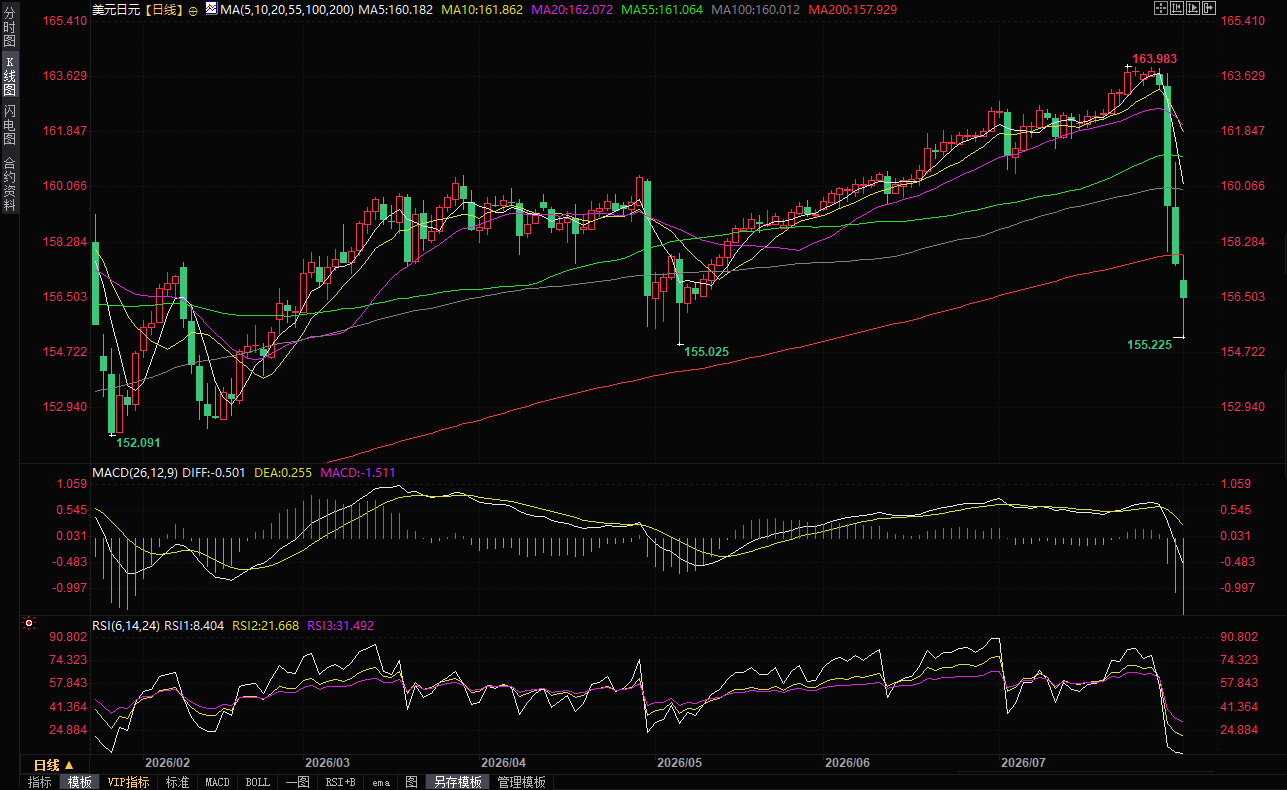
The yen has been weakening since the beginning of this year. In late July, the yen-dollar exchange rate approached 164 yen to the dollar, hitting its lowest level since 1986. The fundamental reason for the yen's long-term weakness lies in the combination of multiple factors: Japanese interest rates have been relatively low for a long time, and the large interest rate differential with the dollar continues to attract funds to dollar assets; at the same time, rising energy prices continue to impact Japan's terms of trade, and rising import costs further exacerbate the pressure on the yen to depreciate. The continued depreciation of the yen has had a profound impact on the Japanese domestic economy. The sharp rise in import prices has pushed up domestic inflation, not only squeezing real household income but also severely dragging down the approval rating of Japanese Prime Minister Sanae Takaichi. According to Japanese media polls, since Takaichi took office last October, the yen has depreciated by more than 9%, and her cabinet's approval rating has continued to decline, falling from 51% to 41%, while the disapproval rating has exceeded the approval rating for the first time. The yen's depreciation has evolved from a simple economic issue into a serious political challenge, which has become an important driving force for the Japanese authorities to take strong intervention measures.Intervention Process: Nearly $60 billion injected into the market, Bessant's "handwritten list" unexpectedly revealed.
According to data released by the Bank of Japan, Japanese authorities conducted a large-scale yen-buying operation during the New York trading session last Thursday (July 30), potentially selling as much as $58.97 billion to support the yen's exchange rate. Subsequently, on Friday, signs reappeared in the market suggesting further intervention by Japan. The most noteworthy aspect of this intervention was the deep involvement of the United States. Multiple sources confirmed that the US Treasury Department informed several banks on Friday of its potential intervention in the yen market and requested them to prepare for future actions. Even more intriguingly, a photo taken at a cabinet meeting at Camp David inadvertently revealed US Treasury Secretary Bessenter's "to-do list," which prominently featured "buying yen worth $5 billion to $10 billion." This photo, taken from behind Bessenter during a public interview at the meeting, inadvertently revealed the specific plans for US intervention. Bessenter had previously stated publicly on multiple occasions that the yen was "significantly undervalued," and this action is highly consistent with his consistent stance. It is worth noting that this intervention was not an isolated action by the US and Japan. As a signal of broader policy coordination, South Korean authorities also intervened last Thursday to buy won, indicating that cooperation on currency stability in the region is strengthening.Market reaction: The yen surged, putting pressure on the dollar index.
The confirmation of the joint intervention immediately triggered a sharp reaction in the foreign exchange market. Following a significant rise in the yen on Thursday and Friday of last week, the yen continued its upward trend against the dollar in early Asian trading on Monday. The dollar/yen pair fell as much as 1.5% during the session, hitting a low of 155.22, its lowest level since May 6th. Previously, the yen closed at around 157.60 on Friday. From its 40-year low of around 164 in late July, the yen has rebounded by more than 5% in just a few days. The strong appreciation of the yen put broad pressure on the dollar. The euro rose to a one-and-a-half-month high of $1.1559, while the pound also touched a two-week high of $1.3484. The dollar index has fallen more than 1.5% last week, briefly hitting a one-and-a-half-month low of 99.42 in early trading on Monday. Furthermore, falling oil prices further weighed on the dollar – news that US President Trump had called a halt to attacks on Iran and planned to begin negotiations with Iran pushed oil prices lower, weakening safe-haven buying of the dollar.V. Interpretations from Various Parties: Market Opinions Diverge on Whether the Intervention's Effects Can Be Sustained
Market analysts hold differing views on the effectiveness and prospects of this joint intervention. BBH's global head of market strategy points out that historical experience shows joint foreign exchange intervention is extremely powerful—the three coordinated interventions involving the US since 1998 have all achieved significant results. Takashi Isida, a strategist at Kansai Mirai Bank in Osaka, believes that the Japanese authorities have demonstrated a tough stance to curb the yen's depreciation, showing a firm determination to support the yen. If the Bank of Japan intends to further raise interest rates, the yen's rise is expected to continue until September or October. However, Nick Twidale, chief market strategist at ATFX GLOBAL in Sydney, expresses a more cautious view. He points out that although the Japanese authorities have invested billions of dollars and acted in conjunction with the US, demonstrating a strong desire to push for yen appreciation, fundamental changes in the economic fundamentals are needed for such measures to remain effective. Once the market believes the intervention has ended, it is likely to challenge the yen again. Sim Moh Siong, a strategist at OCBC Bank in Singapore, analyzes that this intervention sends a clear signal—the US and Japanese authorities will do everything possible to stabilize the yen's exchange rate. If the USD/JPY pair falls below 155, a squeeze on market positions will likely trigger more stop-loss orders, pushing the yen further down. Goldman Sachs analysts warn that if the yen begins to give back its recent gains, authorities are likely to intervene further in the coming days. Unless there is a substantial change in the policy mix or the global economic growth outlook, encouraging capital repatriation will be the most powerful policy tool to support the yen in the long term.VI. Policy Coordination: The Bank of Japan releases hawkish signals, fueling expectations of an interest rate hike.
In conjunction with this currency intervention, the Bank of Japan (BOJ) also released important signals regarding monetary policy. Last Friday, while maintaining the policy rate at 1%, the BOJ passed a resolution with an 8-1 vote, with the sole dissenting vote from board member Takada Venture Capital advocating for an immediate rate hike to 1.25%. This marks the fifth rate hike by the BOJ since ending its negative interest rate policy in March 2024, and the 1% policy rate is the highest level since 1995. More noteworthy is that in its concurrently released quarterly outlook report, the BOJ characterized the current underlying inflation level as "approaching 2%" for the first time, explicitly stating that trend inflation will reach a level roughly consistent with the 2% target in the second half of 2026 and fiscal year 2027. This statement has been widely interpreted by the market as the clearest signal yet of an imminent rate hike, perfectly echoing Bessant's repeated calls for higher interest rates in Japan.VII. Summary and Outlook: Where Will the Yen Go After Historic Intervention?
This joint intervention by Japan and the US in the foreign exchange market is a landmark event in terms of scale, political level, and depth of policy coordination. The nearly $60 billion injection, the US Treasury Secretary's handwritten list of "buying yen" tasks, and President Trump's public statement that "the US is ready to support Japan at any time" all indicate an unprecedented consensus between the two countries on stabilizing the yen's exchange rate. However, historical experience tells us that exchange rate intervention often only brings short-term effects. In April and May of this year, Japanese authorities implemented yen-buying interventions independently, but these only triggered a brief rebound. Whether this joint intervention can break this curse fundamentally depends on three factors: first, whether the Bank of Japan can continue to send sufficiently hawkish monetary policy signals; second, whether the US is willing to continue providing support if necessary; and third, whether the global economic growth outlook and interest rate environment will undergo directional changes favorable to the yen. This week, market focus will shift to the US non-farm payroll data to be released on Friday. Analysts at OCBC Bank pointed out that if the labor market remains resilient or the slowdown in inflation stalls, it may increase pressure on the Federal Reserve to strengthen its anti-inflationary stance, which will have a significant impact on the dollar's performance. The performance of a series of key data points will be crucial before the Fed's September interest rate meeting. For the Japanese yen, this currency market storm triggered by the joint intervention of Japan and the United States may have only just begun.Frequently Asked Questions
Question 1: Why did Japan and the US jointly intervene in the foreign exchange market at this time? The direct reason for the joint intervention by Japan and the US in the foreign exchange market is the continued plunge of the yen to a 40-year low. While the yen's depreciation is beneficial to Japanese exports, excessive depreciation will push up import prices, exacerbate domestic inflation, and squeeze household real income. As a result, Japanese Prime Minister Sanae Takaichi's approval rating has continued to decline, falling from 51% to 41%. From an economic perspective, the yen's depreciation reflects market concerns about Japan's fiscal expansion and the central bank's lagging monetary policy response. From a political perspective, the intervention is both an economic emergency and a political self-rescue. On the US side, Treasury Secretary Bessenter has repeatedly stated that the yen is "severely undervalued," and participating in the intervention is both in line with his value judgment and reflects support for his ally. Question 2: How large is the scale of this intervention? According to data released by the Bank of Japan, Japanese authorities may have sold as much as $58.97 billion to buy yen during the New York market trading session last Thursday. A second round of intervention was then suspected on Friday. Furthermore, US Treasury Secretary Bessenter's "to-do list" shows that the US is considering buying between $5 billion and $10 billion worth of yen. In summary, the total scale of this intervention may exceed $60 billion, making it one of the largest currency interventions in recent years. Question 3: How does this intervention differ from previous ones? The special nature of this intervention lies in three aspects. First, this is the first joint intervention in the foreign exchange market by Japan and the United States in 15 years since 2011. If it involves bilateral purchases of yen by both Japan and the US, it would be the first such intervention in 28 years since the 1998 Asian financial crisis. Second, the timing of the intervention coincides with the announcement of the Bank of Japan's monetary policy decision, forming a policy combination of "currency intervention + monetary tightening." Third, the US not only participated in the intervention, but Treasury Secretary Bessenter also personally listed "buying yen" as a to-do item in his notebook—this "handwritten list" style signaling is extremely rare. Question 4: Can the intervention truly reverse the yen's depreciation trend? The market is divided on this. Historical experience shows that the short-term effects of joint intervention are usually significant—coordinated interventions involving the US since 1998 have all been effective. However, the long-term effect depends on whether the fundamentals change. After Japan's unilateral intervention in April and May of this year, the yen only rebounded briefly. Analysts believe that for the intervention to remain effective, the Bank of Japan needs to further raise interest rates to narrow the Japan-US interest rate differential, while the US also needs to continue providing support if necessary. Goldman Sachs points out that unless the policy mix or the global economic growth outlook changes, encouraging capital inflows is the most powerful tool to support the yen in the long term. Question 5: What are the key variables for the future trend of the yen? In the short term, the market will closely watch whether the Japanese authorities will continue to intervene this week, especially during the illiquid Asian morning session. Meanwhile, the 155 level for USD/JPY is considered a key technical level; a break below this level could trigger a large number of stop-loss orders. In the medium term, the pace of the Bank of Japan's interest rate hikes is crucial—the market widely expects another rate hike in September or October. Furthermore, the US non-farm payroll data released this Friday will affect the Fed's policy expectations, thus influencing the dollar's trend. If the US labor market remains resilient, it may strengthen the Fed's stance of maintaining high interest rates, putting pressure on the yen. At 11:01 Beijing time, USD/JPY is currently trading at 156.63/64.- Risk Warning and Disclaimer
- The market involves risk, and trading may not be suitable for all investors. This article is for reference only and does not constitute personal investment advice, nor does it take into account certain users’ specific investment objectives, financial situation, or other needs. Any investment decisions made based on this information are at your own risk.