Gold is stuck in a key trading range, with the Fed's September interest rate decision being the biggest variable.
2026-08-03 12:12:52
International gold prices have recently entered a period of consolidation, with the battle between bulls and bears intensifying. The key support level of $4,000 has become a watershed between short-term strength and weakness for gold prices. Easing inflation data has provided some support for gold prices, but hawkish statements from the Federal Reserve, volatility in US Treasury yields, and the continued threat of energy inflation continue to put pressure on the market. Currently, institutional opinions are highly divergent, with the market awaiting crucial employment data for direction. The prevailing market prediction is short-term consolidation followed by a medium- to long-term bullish outlook.
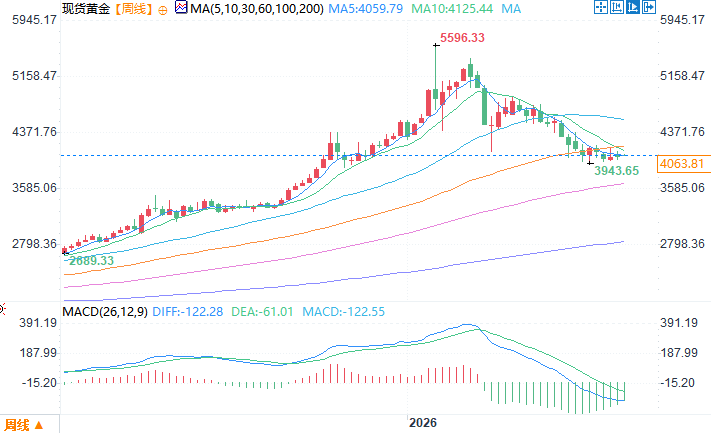 Spot gold weekly chart source: FX678. As of 12:10 PM Beijing time on August 3rd, spot gold was trading at $4065.81 per ounce.
Last week's market recap: The $4,000 mark was repeatedly contested.
Last week, international gold prices experienced a volatile, back-and-forth trading pattern, with intense competition between bulls and bears resulting in a confused and directionless market. Gold prices held firm at the key psychological and technical support level of $4,000 per ounce, supported by declining inflation data and bargain hunting. However, multiple negative factors continued to suppress any upward movement, including the Federal Reserve's hawkish interest rate decision, a continued rebound in US Treasury yields, and renewed concerns about inflation fueled by recovering oil prices. This confluence of pressures prevented gold from breaking out of its trading range and establishing a clear upward trend. Throughout the week, gold prices fluctuated rapidly, with narrowing price swings, ultimately closing slightly lower on the weekly chart, exhibiting a typical high-level consolidation pattern. Overall, current gold price movements are entirely driven by expectations of Federal Reserve monetary policy changes, with its short-term safe-haven and inflation-hedging attributes alternating ineffectiveness, and the market entirely mirroring changes in macroeconomic sentiment.Institutional opinions are widely diverging, leaving the market direction uncertain.
Gold market survey data shows a three-way split among Wall Street analysts: those bullish, bearish, and those remaining neutral are roughly equal, with no clear dominant direction. Meanwhile, the proportion of bullish positions held by retail investors has significantly declined, with previous bullish sentiment cooling rapidly, resulting in extremely conflicted and divergent market sentiment. Most market institutions agree that gold currently lacks a core driver for a one-sided trend, making sustained upward or downward movements difficult. Future price movements will depend on the clarity of two key variables: the direction of the Federal Reserve's monetary policy and the Middle East geopolitical situation. Renowned analyst Adrian Day points out that the subsequent pace of global monetary tightening has not yet materialized, and the ongoing Middle East geopolitical conflict and high uncertainty mean that gold is unlikely to establish a one-sided trend until these two key risks are clearly resolved, and is more likely to continue its pattern of high-level fluctuations. The mainstream market view is that gold prices may experience a technical correction in the short term, but the medium- to long-term upward trend remains intact. Most institutions believe that the probability of a Fed rate hike in September is extremely low, and current market expectations for a rate hike are significantly inaccurate. Even if some officials at the FOMC meeting support a rate hike, multiple practical factors will likely constrain the Federal Reserve to keep rates unchanged. Dai believes this technical pullback in gold prices will pave the way for an autumn rally. If the Fed maintains rates unchanged in September as expected, market expectations for a rate hike will cool rapidly, and the correction of this expectation gap will drive a new round of steady price increases for gold and silver. Meanwhile, Fed Chairman Kevin Warsh's policy approach leans towards creating market expectation discrepancies, and he is adept at guiding market sentiment through public opinion. He is likely to continue the conservative strategy of maintaining unchanged rates and will not rashly initiate rate hikes, providing support for the medium- to long-term trend of gold.Key catalyst for the market outlook: US employment data will dominate short-term direction.
Looking ahead to this week, the core focus of the gold market will be entirely on a series of key US economic data, especially employment data. The results will directly influence expectations for the Federal Reserve's September monetary policy and dominate the short-term fluctuations in gold prices. This week will see a dense data window, with the release of the US ISM Manufacturing and Services PMIs, JOLTS job openings data, ADP private sector employment data, and weekly initial jobless claims, culminating in the July non-farm payroll report. This entire set of data will comprehensively reflect the current state of the US job market. If the overall employment data is strong, it will reinforce expectations of a Fed rate hike, pushing up US Treasury yields and significantly suppressing gold prices. Conversely, if the employment data is weak, it will effectively cool market expectations of tightening, weakening the strength of the dollar and US Treasuries, providing core momentum for a gold price rebound. In summary , gold currently has solid support at the $4,000 level, and its industry fundamentals and long-term investment value continue to stand out. However, in the short term, it is constrained by multiple factors such as Fed policy expectations, energy price volatility, and recurring geopolitical tensions, making it difficult to break out of the current range-bound trading pattern quickly. Most analysts predict that gold prices will likely follow a downward trend in the short term, followed by a rise. After sufficient technical consolidation and a long period of oscillation, the negative sentiment in the market will be fully cleared, and a new round of upward movement in gold prices in the second half of the year is brewing. Spot gold weekly chart source: FX678. As of 12:10 PM Beijing time on August 3rd, spot gold was trading at $4065.81 per ounce.
- Risk Warning and Disclaimer
- The market involves risk, and trading may not be suitable for all investors. This article is for reference only and does not constitute personal investment advice, nor does it take into account certain users’ specific investment objectives, financial situation, or other needs. Any investment decisions made based on this information are at your own risk.