The US dollar index hit a six-week low as US-Iran negotiations aimed to exert pressure, with non-farm payroll data becoming a key variable.
2026-08-03 14:58:53
On Monday (August 3) during Asian trading hours, the US dollar index fell as much as 0.37%, hitting a new low since June 15 at 99.42. However, given the significant declines in the previous trading days and the still high probability of a Fed rate hike in September (65%), the dollar was supported by bargain hunting and has now rebounded to around 99.80, recovering its earlier losses. Previously, the dollar index had recorded four consecutive days of decline. Trump stated last Sunday that he had canceled the attack on Iran, and that negotiations between the two sides would begin on Monday. The reopening of the agreement by Hormuz may be nearing completion, improving risk appetite and putting pressure on the dollar. The market is focused on today's ISM Manufacturing PMI and Friday's non-farm payroll report—stronger data could limit the dollar's decline. 
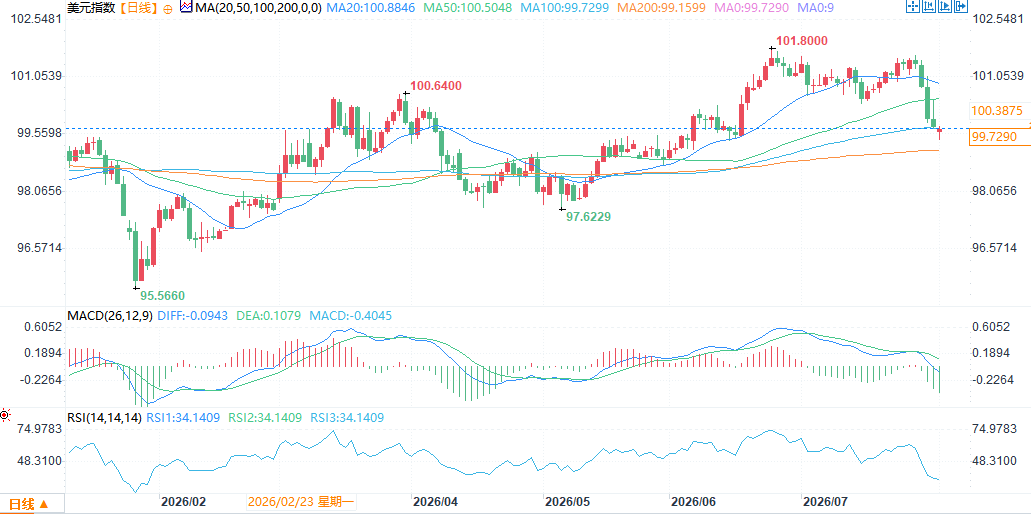 (US Dollar Index Daily Chart, Source: FX678) At 14:56 Beijing time on August 3, the US Dollar Index was at 99.78.
US-Iran negotiations aim to put pressure on the dollar, cooling demand for safe-haven assets.
Easing hopes for US-Iran negotiations are putting pressure on the US dollar, significantly reducing safe-haven demand. The main driver of the dollar's weakness is rising expectations of geopolitical easing. Trump stated he has cancelled attacks on Iran, negotiations will begin on Monday, an agreement to reopen the Strait of Hormuz may be nearing completion, and he will continue to seek a path to end Iran's nuclear program. The market interprets this as a potential substantial easing of tensions. Hopes for a breakthrough between Washington and Tehran may weaken the dollar's safe-haven appeal in the short term, putting downward pressure on the dollar index. As risk appetite recovers, funds tend to flow into risk assets, weakening the dollar's support as a traditional safe-haven currency. However, uncertainties remain in the negotiations. If progress falls short of expectations or Iran's stance changes, geopolitical uncertainty may escalate again, potentially restoring safe-haven buying support for the dollar. In the short term, the dollar's performance will be highly dependent on the progress of negotiations and statements from both sides.Markets focus on non-farm payroll report
Market focus is now fully on Friday's US non-farm payrolls report. As a core indicator of the health of the labor market, this data is crucial for guiding the dollar's trajectory. Economists currently expect non-farm payrolls to increase by 91,000 in July, with the unemployment rate expected to rise to 4.3%. This expectation reflects the market's basic assessment of a moderate slowdown in job growth and a slight increase in the unemployment rate. If the data is stronger than expected, it will significantly strengthen market confidence in the resilience of the US economy and may solidify expectations that the Federal Reserve will maintain a tight monetary policy. The real interest rate and the dollar's interest rate differential are expected to be supported, effectively limiting further declines in the dollar index and potentially triggering a short-term rebound. Conversely, if the data is significantly weak, market concerns about an economic slowdown will intensify, increasing the probability of a dovish turn by the Federal Reserve, and the dollar may face greater downward pressure. In summary, the non-farm payrolls report will be a key catalyst for the dollar's direction this week. The degree of deviation between the data and expectations will directly determine the magnitude of adjustments in market risk appetite and interest rate pricing.Commerzbank warns of downside risks to the US dollar
Analysts at Commerzbank point out that the dollar may face renewed downward pressure once tensions with Iran subside substantially. The firm believes the Federal Reserve is "unlikely to raise interest rates as priced in by the market," and there is significant room for correction in current overly high rate hike expectations. Easing geopolitical risks will remove key safe-haven support for the dollar, making it more vulnerable to disappointment in the US interest rate path. In other words, if a de-escalation in the Middle East coincides with a decline in rate hike expectations, the dollar's short-term downside risk may increase significantly. The market previously priced in a relatively tight policy from the Fed; if the actual path falls short of expectations, the dollar's interest rate advantage will weaken rapidly, thus exacerbating pressure for exchange rate adjustments.The US dollar faces three variables: US-Iran negotiations, ISM data, and the non-farm payroll report.
The market's focus regarding the US dollar's trajectory is currently concentrated on three key variables. First, regarding the progress of US-Iran negotiations, if both sides achieve a substantial breakthrough and geopolitical tensions significantly ease, global risk appetite will rise noticeably, safe-haven demand will decrease, and the dollar, as a traditional safe-haven currency, may weaken further, putting downward pressure on the dollar index. The US ISM Manufacturing PMI is also crucial. As an important leading indicator of manufacturing activity, stronger-than-expected data will strengthen market confidence in the resilience of the US economy, supporting a short-term rebound in the dollar and potentially partially offsetting the downward pressure from easing geopolitical tensions. Furthermore, the non-farm payroll data cannot be ignored. If Friday's employment report is generally strong, it will limit the market's pricing space for a dovish shift by the Federal Reserve, maintaining the advantage of real interest rates and the dollar's interest rate differential, thus effectively limiting the dollar's decline. In summary, if these variables resonate, the dollar's trajectory will seek a balance between rising risk appetite and supportive domestic data, potentially leading to increased volatility.The US dollar awaits direction amid hopes for US-Iran negotiations and jobs data.
The US dollar index fell below the 100 mark to around 99.50 under the dual pressure of hopes for US-Iran negotiations and improved risk appetite. Commerzbank warned that the dollar could face even greater pressure once geopolitical risks subside. In the short term, the dollar index is likely to consolidate within the 99.00-100.50 range. If a breakthrough is achieved in US-Iran negotiations and US data is weak, the dollar may weaken further to below 99.00; if negotiations break down or US data is strong, the dollar may rebound to above 100.50. This Friday's non-farm payroll report will be a key variable that could disrupt the current pattern. (US Dollar Index Daily Chart, Source: FX678) At 14:56 Beijing time on August 3, the US Dollar Index was at 99.78.
- Risk Warning and Disclaimer
- The market involves risk, and trading may not be suitable for all investors. This article is for reference only and does not constitute personal investment advice, nor does it take into account certain users’ specific investment objectives, financial situation, or other needs. Any investment decisions made based on this information are at your own risk.