The Japanese yen rewrote trading logic overnight, and joint intervention released three dangerous signals.
2026-08-03 15:36:51
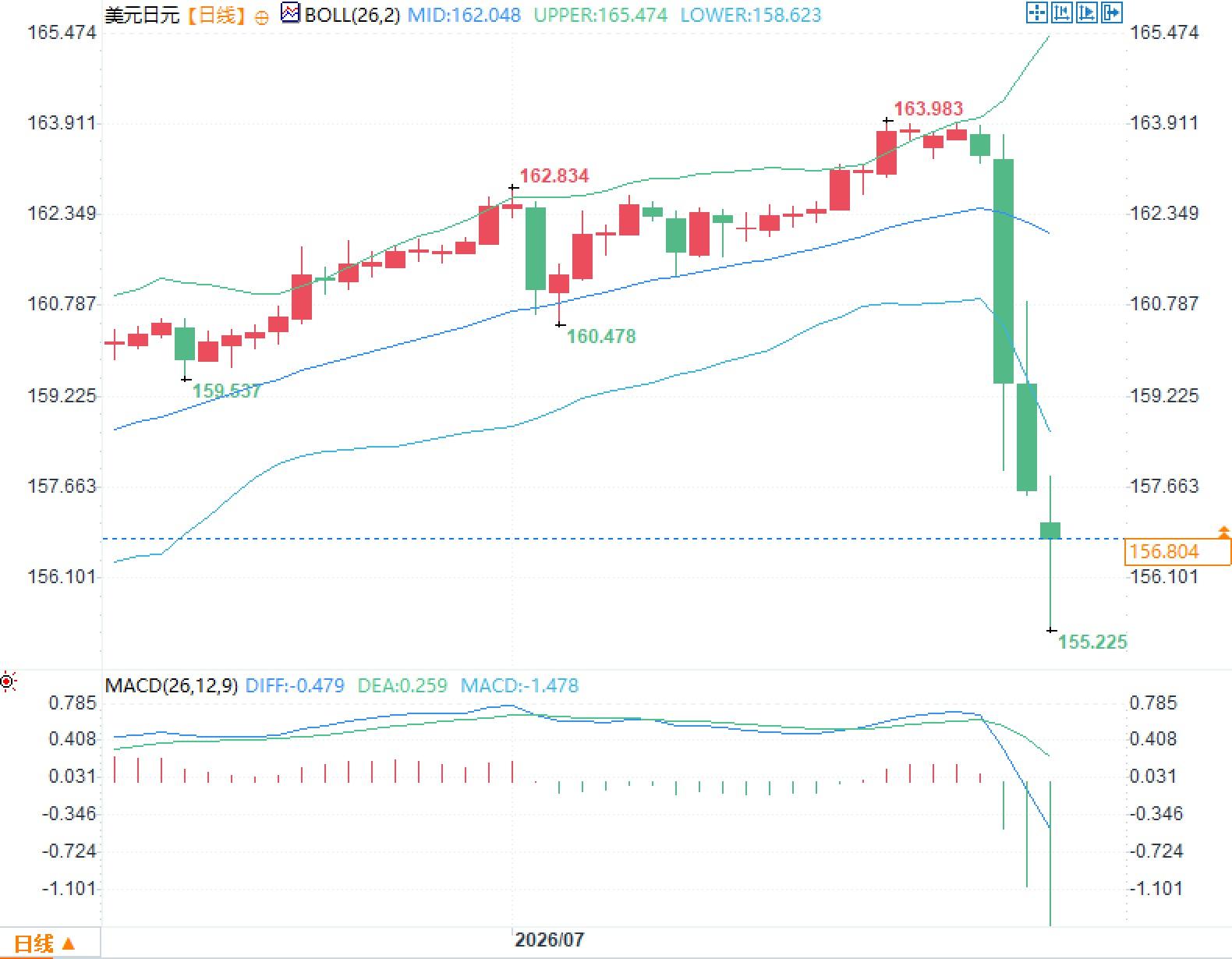
Monday, August 3rd. The USD/JPY pair quickly retreated after breaking through 163, briefly touching around 155.20 before returning to the 156-157 range. The core market variable has shifted from simple carry trades to the combined pricing of official intervention, position clearing, and policy expectations. Public information indicates that this round of price action occurred after a rare joint purchase of yen by the US and Japan, with Japan's operations potentially approaching 8 trillion yen. The market is currently assessing whether further actions will follow. 
 However, from a macroeconomic perspective, the coordinated intervention has not yet eliminated the main foundations supporting the USD/JPY exchange rate. A significant interest rate differential still exists between the US and Japan, and factors such as Japan's fiscal expansion, imported energy costs, and low real yields have not fundamentally changed. Many institutions believe that while intervention can force short covering, it is unlikely to alone create a sustained yen appreciation trend lasting for several months. Some institutions still predict the USD/JPY exchange rate will remain around 156 by the end of the year. The variables that truly determine the medium-term direction include whether the Bank of Japan accelerates policy normalization, whether US Treasury yields continue to decline, whether falling oil prices can improve Japan's terms of trade, and whether the government will upgrade a one-off action to a coordinated, continuous one. If these conditions do not change synchronously, intervention is more likely to compress the upside potential of the exchange rate than to fundamentally reconstruct the long-term equilibrium level.
Joint interventions do not change prices, but rather tail risks.
The most noteworthy aspect of this event is not the drop in USD/JPY from above 163 to around 156, but rather the US Treasury's participation in yen purchases through the Federal Reserve Bank of New York, employing a strategy of selling euros and buying yen. Such cross-currency, cross-departmental coordinated action is extremely rare. The last time the US monetary authorities publicly purchased yen was in 1998, amounting to approximately $833 million. The intervention primarily altered the risk-reward structure of short yen positions. Previously, the market generally believed that unilateral Japanese actions could only create short-term volatility and were unlikely to reverse trends driven by interest rate differentials, energy imports, and fiscal expansion. With the coordinated action, traders had to reassess the scale of official funds, the timing of entry, and potential continuity. As long as the market cannot predict whether the next round of intervention will occur at 160, 158, or other levels, yen short positions will incur higher volatility and stop-loss costs. This also explains why the exchange rate decline was significantly greater than the single-day changes in fundamental variables. The price not only reflects official buying but also the unwinding of crowded positions, hedging adjustments by option market makers, and the reversal of short-term trend models.The euro becomes an intervention tool, constraining dollar assets.
Traditional yen support actions typically involve selling dollar reserves and buying yen. This time, however, the use of euros as a partial funding source sends a more complex balance sheet signal. One plausible explanation is that relevant departments hope to reduce the additional impact of concentrated dollar asset sales on US Treasury yields. Japan holds a massive amount of foreign exchange reserves. When the market anticipates continued sales of dollar assets, the term premium of US Treasury bonds may face upward pressure, and financing costs and global risk asset valuations will also be affected. Using euro cross-currency pairs can, to some extent, reduce the direct pressure on the dollar and dollar bond markets. This does not necessarily mean the European Central Bank (ECB) was involved; currently, publicly available information only confirms that the US communicated with ECB officials, which is insufficient to prove the formation of a multilateral intervention mechanism. Therefore, this action may serve two objectives simultaneously: first, to curb imported inflation caused by rapid yen depreciation; and second, to prevent Japan from achieving the same goal through large-scale sales of dollar assets. The latter may have a greater impact on the global interest rate market than the exchange rate itself.A technical reversal has occurred, but a trend reversal remains to be confirmed.
From a chart perspective, the USD/JPY pair fell sharply from around 163.983, breaking below the Bollinger Band middle line at 162.048 and the lower line at 158.623, reaching a low of 155.225, with a significantly wider intraday range. The MACD DIFF line dropped to -0.479, and the histogram fell to -1.478, indicating that short-term downward momentum remains strong. Since the price has clearly deviated from the middle line, any subsequent rebound cannot be directly equated with a resumption of the original upward trend. However, from a macroeconomic perspective, the coordinated intervention has not yet eliminated the main foundations supporting the USD/JPY exchange rate. A significant interest rate differential still exists between the US and Japan, and factors such as Japan's fiscal expansion, imported energy costs, and low real yields have not fundamentally changed. Many institutions believe that while intervention can force short covering, it is unlikely to alone create a sustained yen appreciation trend lasting for several months. Some institutions still predict the USD/JPY exchange rate will remain around 156 by the end of the year. The variables that truly determine the medium-term direction include whether the Bank of Japan accelerates policy normalization, whether US Treasury yields continue to decline, whether falling oil prices can improve Japan's terms of trade, and whether the government will upgrade a one-off action to a coordinated, continuous one. If these conditions do not change synchronously, intervention is more likely to compress the upside potential of the exchange rate than to fundamentally reconstruct the long-term equilibrium level.Market pricing enters a policy game phase
The USD/JPY exchange rate is no longer simply an expression of interest rate differentials. The policy-sensitive zone above 163, the rapid rebound near 155, and the sharp expansion of the Bollinger Bands all indicate that the market has entered a state of high volatility. On August 3rd, the exchange rate reached a strong yen level near 155.20 before returning to around 156.80, showing that there is still demand for the dollar at lower levels, while expectations of intervention continue to limit the rebound. Going forward, we need to distinguish three forces. The first is official funds, characterized by their large scale and opaque timing, but whose sustainability is constrained by policy coordination. The second is the liquidation of leveraged funds, which has a rapid impact but may diminish after the positions are released. The third is the reallocation of macro funds; only when interest rate differentials, inflation, and energy prices change together can a more sustainable exchange rate trend form.- Risk Warning and Disclaimer
- The market involves risk, and trading may not be suitable for all investors. This article is for reference only and does not constitute personal investment advice, nor does it take into account certain users’ specific investment objectives, financial situation, or other needs. Any investment decisions made based on this information are at your own risk.