Oil prices rebounded briefly due to uncertainty surrounding a US-Iran ceasefire, but then fell nearly 6% again! However, risks remain.
2026-08-03 16:00:52
On Monday (August 3), during the Asian and European trading sessions, Trump's announcement of a ceasefire over the weekend led to increased volatility in international oil prices. WTI crude oil opened 6.9% lower on Monday and is currently trading around 76.63, down 5.96%. The Strait of Hormuz handles nearly 20% of global oil and natural gas maritime trade, and the navigation status of this energy chokepoint has consistently been a core variable in recent international crude oil pricing. The five-month-long US-Iran conflict has seen another turning point, with Trump announcing a temporary halt to a new round of military strikes against Iran. The US and Iran are expected to restart diplomatic negotiations, but fundamental differences remain on the core issue of navigation through the Strait. The market is unable to quickly clear the geopolitical risk premium in the oil market, and oil prices are expected to maintain a high-level volatile pattern. 
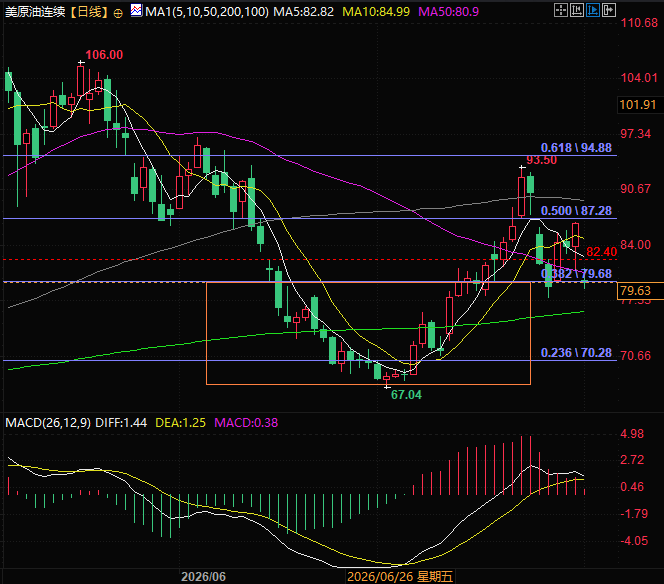 (WTI crude oil futures daily chart, source: EasyTrade) At 15:51 Beijing time, WTI crude oil futures were trading at $79.53 per barrel.
The US urgently called off a large-scale military strike, with the dissuasion of its Gulf allies being the core reason.
US President Trump disclosed on Sunday that the collective persuasion of Gulf allies, including Qatar, Saudi Arabia, and the UAE, was the key reason for his emergency halt to a new round of US military strikes against Iran. Previously, the US had developed a comprehensive operational plan and originally intended to launch what would be "the largest offensive against Iran since World War II" on Sunday, with military action imminent. Ultimately, after mediation by Saudi Crown Prince Mohammed bin Salman and other key Gulf leaders, and receiving a ceasefire appeal from anonymous Iranian officials, the US formally shelved the military strike plan, allowing a window of opportunity for bilateral diplomatic negotiations. Trump revealed that he directly consulted with Saudi Arabia, asking whether they preferred US military action or diplomatic reconciliation. The Gulf states unanimously chose to facilitate an agreement, clearly expressing concern that an unlimited escalation of the conflict would trigger unpredictable chain reactions. Saudi Arabia highlighted the risks: if the US launched airstrikes against Iran, Iran would likely retaliate against Gulf oil-producing countries, directly impacting the global energy supply chain and macroeconomic stability. Furthermore, the Gulf states have varying internal defense capabilities; Saudi Arabia, the UAE, and Qatar possess resilience, but Kuwait's defenses are weak, making it highly vulnerable to attacks by pro-Iranian militias within Iraq. It is worth noting that this easing of tensions marks the second short-term reversal of Trump's stance. The day before, he had publicly stated that he was losing confidence in negotiations with Iran and warned that he would launch a strong attack on Iran.US-Iran negotiation framework finalized: lifting blockade in exchange for access to the Straits and a comprehensive ceasefire.
As military tensions escalate, the US has officially released the core draft of the latest round of US-Iran negotiations, focusing on three main dimensions: energy routes, the nuclear issue, and regional security, and outlining reciprocal exchange conditions. The two core issues of this round of negotiations are the resumption of normal navigation in the Strait of Hormuz and addressing US security concerns regarding Iran's nuclear program, which are also key factors influencing short-term crude oil price movements. According to the details of the mediation plan, Iran must cease its indiscriminate attacks on merchant ships passing through the Strait, fully restore normal navigation, and halt all military attacks by Iranian-backed militias in Iraq, Jordan, and the Gulf region. In exchange, the US will lift its maritime blockade of Iran, restore normal Iranian crude oil export routes, and implement the previously reached temporary ceasefire framework. Trump confirmed that US-Iran negotiations will officially resume on Monday afternoon, and Israel will cooperate in implementing the June ceasefire agreement and participating in stability maintenance efforts, but Israeli officials have not yet publicly responded to this matter. Several anonymous officials involved in the mediation confirmed that the two sides have only reached a framework for negotiations, and no formal agreement has been finalized. Multi-party mediation efforts are ongoing, and the negotiations remain highly uncertain.The core differences are irreconcilable: Iran explicitly refuses to restore pre-war air traffic control.
The market should not overinterpret the short-term easing of tensions. The fundamental reason for the persistent geopolitical risks in the oil market lies in the insurmountable chasm between the US and Iran over the core interest of free navigation in the Strait of Hormuz. Since the US-Israel joint attack on Iran on February 28th, which ignited a full-blown conflict, Iran has long intercepted merchant ships passing through the strait without its permission, completely altering the existing navigation pattern. On Sunday, the Iranian Foreign Ministry made a clear and strong statement that the Strait of Hormuz will absolutely not be restored to the free navigation status it enjoyed before the outbreak of the war on February 28th. Currently, Iran is only communicating with Oman on partial shipping matters and has no intention of resuming negotiations for full free navigation in the strait, directly rejecting the core demands of the US draft negotiation proposal. Furthermore, internal political divisions within Iran are further amplifying the uncertainties in the negotiations. The Iranian military has stated that it is on full alert for any US actions and will not passively respond to any military threats, maintaining a unified stance of strong resistance against the US. However, significant internal divisions have emerged. Conservatives are resolutely opposing all negotiations with the US, while pragmatists hope to leverage the current military standoff to secure core interests such as the economy and sanctions waivers at the negotiating table. This internal power struggle may lead to repeated shifts in Iran's negotiating position.The core logic of crude oil trading: the easing is merely a sentiment correction; geopolitical risks have not been cleared up.
The recent de-escalation of tensions between the US and Iran can only temporarily alleviate market panic and slightly reduce geopolitical premiums for crude oil, but it cannot drive a deep drop in oil prices. Multiple core supporting factors remain in effect. First, the US has only temporarily suspended military action, not permanently canceled its operational plans. Trump retains the right to restart military operations at any time, and the risk of a black swan event in the Middle East persists. Second, Iran's firm refusal to restore pre-war navigation in the Strait of Hormuz makes it difficult to improve the current situation of restricted access to key global energy routes. High costs for oil transportation and shipping insurance premiums continue to strongly support spot crude oil prices. Finally, Gulf allies can only push for the resumption of negotiations and cannot interfere with Iran's core interests. The probability of a breakdown in negotiations and a renewed escalation of conflict remains.Key clues to watch in the crude oil market going forward
Short-term oil price fluctuations will be entirely linked to the progress of US-Iran negotiations and Middle East geopolitical dynamics. Three key signals to watch are: first, whether the first round of US-Iran talks on Monday achieved a substantial breakthrough, and whether Iran signaled concessions on the issue of navigation in the Strait of Hormuz; second, whether new armed attacks occur in the Middle East, breaking the current temporary ceasefire and easing tensions; and third, whether the US restarts its military strike plan against Iran, further escalating geopolitical tensions. Overall, before the geopolitical game is completely resolved, international oil prices will maintain a high volatility and high premium trend, with prices fluctuating repeatedly depending on whether the negotiations are positive or negative news is negative. Technically, WTI oil prices remain in a range-bound pattern. After retracing to the 0.382 Fibonacci retracement level, WTI oil prices found support. Last week, oil prices quickly rose to around 87.28 (the 0.500 level) in the early morning. Currently, oil prices are holding at the 0.382 level, which is also the breakout point of the lower range. This level is important for the bulls and is a crucial watershed between bulls and bears in the near term. (WTI crude oil futures daily chart, source: EasyTrade) At 15:51 Beijing time, WTI crude oil futures were trading at $79.53 per barrel.
- Risk Warning and Disclaimer
- The market involves risk, and trading may not be suitable for all investors. This article is for reference only and does not constitute personal investment advice, nor does it take into account certain users’ specific investment objectives, financial situation, or other needs. Any investment decisions made based on this information are at your own risk.