WTI crude oil plunges below $80. What will happen to oil prices under the hope of peace?
2026-08-03 16:32:56
On Monday (August 3), WTI crude oil futures continued their early-morning decline during the European session, currently trading below $80 per barrel. Trump posted on Truth Social that Iran had fully reopened the Strait of Hormuz and that the US had suspended its planned attack. This news significantly increased expectations of a resumption of peace talks between the US and Iran, alleviating market concerns about a prolonged disruption to energy supplies. WTI oil prices surged over 22.5% in July due to the escalation of the US-Iran military conflict, but the market remains concerned about the sustainability of the ceasefire. 
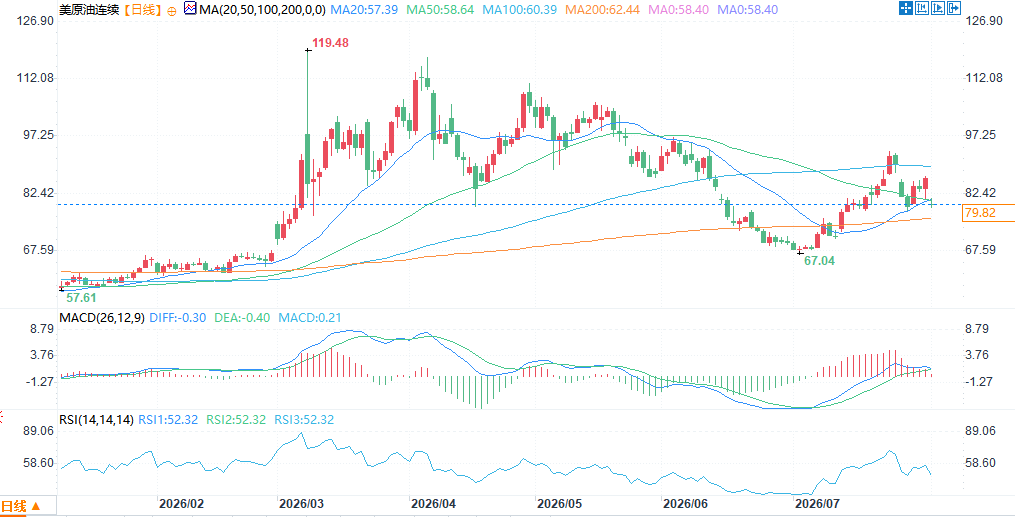 (US crude oil futures daily chart, source: FX678) At 16:10 Beijing time on August 3, US crude oil futures were trading at $79.87 per barrel.
Trump announces Iran agrees to reopen the Strait of Hormuz, oil prices plummet.
The immediate trigger for the oil price plunge was Trump's post on Truth Social: "A framework agreement has been reached. This will include the immediate, complete, and total reopening of the Strait of Hormuz." This statement significantly increased expectations of a resumption of peace talks between the US and Iran, substantially reduced market concerns about a long-term disruption to energy supplies, and accelerated the erosion of previously accumulated geopolitical risk premiums.After oil prices surged by more than 22% in July, the market is concerned about the sustainability of the ceasefire.
WTI crude oil prices surged over 22.5% in July due to the escalating military conflict between the US and Iran, marking a significant increase. However, concerns about the sustainability of the ceasefire have not subsided but have instead become the core focus of the current oil market. Oil prices initially surged during the conflict, but retreated as news of negotiations emerged, with investor sentiment fluctuating between optimism and caution. Analysts from well-known institutions point out that the market's greater focus is on whether peace can be maintained in the Strait of Hormuz this week. Analysts warn that the potential risk of reigniting geopolitical tensions means that the current easing is only a temporary suppression, not a fundamental resolution. Against this backdrop, oil market pricing remains highly sensitive to any subtle changes in the Middle East situation. If the ceasefire agreement can be substantially advanced and effectively implemented, concerns about supply disruptions will be further alleviated, and oil prices may continue to be under pressure; conversely, if new attacks or signs of a breakdown in negotiations occur, geopolitical premiums may quickly reignite, driving oil prices to fluctuate significantly again. In the short term, the market will closely monitor the statements and actions of both sides to determine the true direction of risk premiums.Institutional Views
Goldman Sachs believes that under the baseline scenario, shipping through the Strait of Hormuz will gradually recover, and the return of Middle Eastern supply will drive the market towards surplus. However, Goldman Sachs also raised its risk warning: if the strait disruption continues until 2027, Brent crude may break through $120 in the fourth quarter, with an average price of $100 in 2027; if the Bab el-Mandeb Strait and the Suez Canal are simultaneously blocked, oil prices may rise another $25. Overall, Goldman Sachs believes that short-term risks are skewed to the upside, but the medium to long term still points to ample supply and falling prices. Citigroup believes that the US-Iran memorandum of understanding is likely to continue, and traffic in the Strait of Hormuz will basically return to normal by mid-to-late July. The rapid return of supply coupled with weak demand will drive the market towards surplus. Citigroup emphasizes that current oil prices have not yet fully reflected the reality of ample supply in the medium term, and there is still considerable downside potential.Summarize
WTI crude oil prices plummeted below $80 per barrel amid expectations that Iran would agree to reopen the Strait of Hormuz, rapidly erasing its more than 22% gain in July. Trump announced a framework agreement had been reached, but market doubts remain about the sustainability of the ceasefire—if negotiations break down or new geopolitical conflicts erupt, oil prices could rebound quickly. Short-term direction depends on the actual progress of US-Iran negotiations and a reassessment of the ceasefire's sustainability by the market. (US crude oil futures daily chart, source: FX678) At 16:10 Beijing time on August 3, US crude oil futures were trading at $79.87 per barrel.
- Risk Warning and Disclaimer
- The market involves risk, and trading may not be suitable for all investors. This article is for reference only and does not constitute personal investment advice, nor does it take into account certain users’ specific investment objectives, financial situation, or other needs. Any investment decisions made based on this information are at your own risk.