Gold prices failed to rise despite bullish news; how can it break out of its weak, volatile trading pattern?
2026-08-03 17:42:52
On Monday (August 3), international gold prices opened slightly higher but then declined. Stimulated by multiple positive factors, including the easing of tensions between the US and Iran over the weekend, a sharp drop in oil prices, and a weakening dollar, gold opened higher and surged in the morning. However, profit-taking by bulls led to a gradual pullback, narrowing the gains. Overall, the price action reflected a fading of positive news and a cooling of market sentiment. Easing geopolitical risks in the Middle East lowered inflation and interest rate hike expectations, while intervention in the US and Japanese foreign exchange markets weakened the dollar, providing support for gold. However, cautious expectations regarding future fundamentals and Fed policies limited further price increases. Currently, gold is trading around 4059, up 0.33%, with an intraday high near the opening price of 4076 (+0.8%). Looking back at the monthly performance, gold recorded its first monthly gain in nearly five months in July, with a monthly increase of approximately 1%. Overall, it is in a consolidation phase, facing a directional choice after this consolidation. 
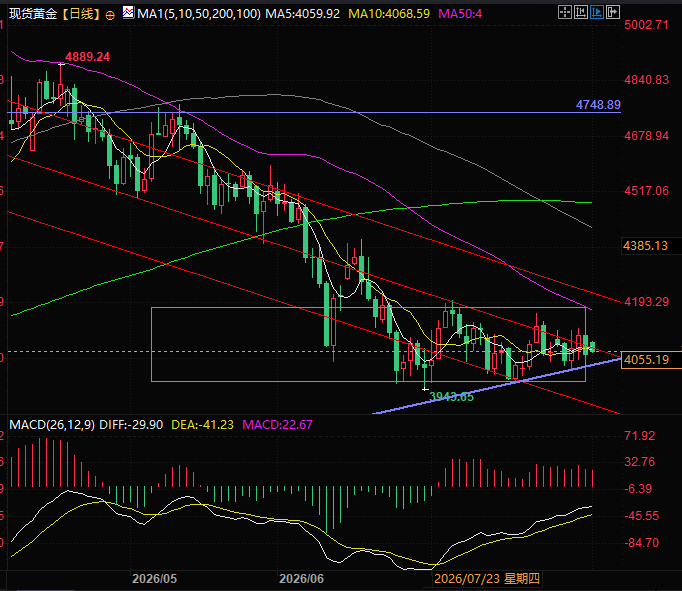 (Spot gold daily chart, source: EasyTrade) At 17:37 Beijing time, spot gold is currently trading at $4050 per ounce.
Core market logic restructured: Oil price plunge reverses inflation expectations, gold finds support for recovery.
US President Trump officially confirmed that the US and Iran will resume negotiations on Monday, and the US has chosen to postpone a new round of military strikes against Iran, without setting a specific deadline for the implementation of the agreement. The rapid easing of tensions in the Middle East directly triggered selling pressure in the energy market, with Brent crude oil falling nearly 6% in a single day to a three-week low. This significant pullback in oil prices has reshaped the pricing logic of major asset classes. During this five-month-long US-Iran standoff, the market has long maintained a bearish chain for gold: "geopolitical conflict → higher oil prices → increased inflation → Fed rate hikes." As a non-interest-bearing asset, gold faces increasing holding costs and continuous pressure in an environment of high inflation and high expectations of interest rate hikes. However, the easing of the conflict and the sharp drop in oil prices have effectively alleviated market inflation anxiety, slightly reducing expectations of a Fed rate hike this year. The core bearish factors that previously suppressed gold have marginally subsided, becoming the core driving force supporting the recovery of gold prices. UBS analyst Giovanni Stanovo stated that the market has returned to the classic correlation pattern, re-entering a negative correlation mode where oil prices fall and gold prices rise, and vice versa. Today's sharp correction in oil prices effectively lowered market bets on an interest rate hike this year, providing clear valuation support for gold. However, this support is limited, as no one knows whether negotiations will proceed as scheduled tonight. The high opening and subsequent decline in gold prices reflects the market's ultimate belief that negotiations are not optimistic.A weaker dollar and declining yields provided some support for gold prices, but this couldn't withstand the pressure from profit-taking.
Besides the positive impact of oil prices, the exchange rate and bond market moved in tandem, providing support for gold. The joint intervention of the US and Japan in the foreign exchange market to support the yen led to a continued weakening of the US dollar index, which fell to its lowest level since mid-June. The depreciation of the dollar reduced the cost of gold for global overseas buyers, boosting demand for gold as an asset. Simultaneously, the yield on the benchmark 10-year US Treasury bond declined, further reducing the opportunity cost of holding non-interest-bearing gold. These multiple positive factors combined to support gold prices, preventing a deep correction in this round of price action. However, the initial positive news quickly turned into negative news. After a concentrated surge in the morning session, market participants chose to take profits, directly causing gold prices to open high and then fall. Tim Waterler, chief market analyst at KCM Trade, pointed out that while gold sentiment was relatively positive at the start of the week, the overall trend was very cautious. The volatile oil market and the continued uncertainty in the Middle East situation prevented the market from sustaining long positions, leading to a rapid contraction in gains.Multiple negative factors continue to suppress the upper limit, limiting the rebound potential of gold prices.
The current gold market is not in a one-sided bullish trend. Multiple risk factors continue to suppress the rebound potential, which is also the key reason why the price failed to continue rising after the initial gap up. First, the US-Iran negotiations only restarted dialogue and did not reach any substantial ceasefire or navigation agreement. Iran has previously explicitly refused to restore the pre-war navigation status of the Strait of Hormuz. The tail risks of Middle East geopolitics have not been completely cleared, and could trigger market risk aversion at any time, pushing up oil prices and interest rate hike expectations, thus suppressing gold prices. Meanwhile, according to Iranian media reports on the 3rd, regarding the resumption of negotiations between Iran and the US, Iranian Foreign Ministry spokesman Bagaei stated that there are no plans to receive or send an Iranian delegation "these days." US President Trump stated last Sunday that the US would hold negotiations with Iran the following day. Second, hawkish voices from the Federal Reserve continue to disturb the market. The three Fed officials who voted against raising interest rates at last week's meeting reiterated their hawkish stance on Friday, emphasizing that if short-term interest rates are not raised immediately, US inflation will remain anchored above the 2% target for a long time. Persistent inflation concerns prevent the market from fully clearing out interest rate hike expectations, continuously limiting the upside potential of gold. Finally, the key US employment data releases this week will be crucial in determining the medium-term trend of gold. The market will see a series of releases, including US job openings data, the ADP employment report, initial jobless claims data, and the highly anticipated non-farm payrolls data. Strong employment data will further reinforce expectations of a Fed rate hike in September, directly putting downward pressure on gold prices; while weak employment data will cool rate hike expectations, opening up upside potential for gold.Summary and Technical Analysis:
In the short term, gold prices opened high and then fell, showing a pattern of being supported by positive factors but lacking upward momentum. Three core positive factors—easing geopolitical tensions, a weaker dollar, and cooling inflation—have solidified the bottom range for gold prices, preventing a deep decline. However, profit-taking by bulls, uncertainty in the Middle East, hawkish expectations from the Federal Reserve, and concerns about the upcoming release of key employment data continue to suppress the rebound. The core theme for the market going forward is clear: in the short term, prices will fluctuate repeatedly following news from US-Iran negotiations; in the medium term, the market will depend entirely on this week's US employment data. Before further escalation of geopolitical tensions and the release of employment data, gold prices will maintain a high-level consolidation pattern with a narrowing upward trend, intensifying the battle between bulls and bears. Technically, despite a slight positive impact from the dollar index's pullback, gold prices have failed to rise, and there is still a risk of further declines to find a bottom. Support lies at the 4000-point psychological level and the recently formed short-term upward trend line. (Spot gold daily chart, source: EasyTrade) At 17:37 Beijing time, spot gold is currently trading at $4050 per ounce.
- Risk Warning and Disclaimer
- The market involves risk, and trading may not be suitable for all investors. This article is for reference only and does not constitute personal investment advice, nor does it take into account certain users’ specific investment objectives, financial situation, or other needs. Any investment decisions made based on this information are at your own risk.