Foreign Exchange Futures Position Report: Short positions in the Japanese Yen and Euro are facing a short squeeze
2026-08-03 18:20:52
The weekly COT report shows the positions of large speculators and asset management firms in the Chicago Mercantile Exchange (CME) futures market, serving as a sentiment indicator for market analysis. Below is the COT positioning data released by the Commodity Exchange Commission (CEPC) as of Tuesday, July 28th. There is a three-day lag between the report's release date and the actual positions recorded by traders. The report is released on Friday, but only contains data up to Tuesday. In terms of timing, it is more suitable for long-term traders. This week's COT positioning report clearly shows that before the sharp market fluctuations last Thursday and Friday, futures traders continuously increased their short positions in the Euro and Yen, resulting in extremely crowded short positions. The US and Japan have now confirmed a joint intervention to support the Yen, marking their first coordinated currency intervention since 2011. This joint intervention announcement adds stronger fundamental support to the current Yen rebound, presenting traders betting on a Yen depreciation with a higher trading threshold.  This round of intervention by the Japanese Ministry of Finance was quite dramatic—most traders had almost assumed Japan wouldn't intervene. The key to the greater impact of this action lies in the explicit support Japan received from the United States. US Treasury Secretary Scott Bessant stated that the US might expand the Federal Reserve's repurchase facility to provide additional dollar liquidity, thus creating conditions for subsequent Japanese intervention. Objectively speaking, this statement carried even more weight than the intervention itself. Previous rounds of unilateral Japanese intervention this year had completely wiped out the yen's gains, but the US's willingness to cooperate with Japan reinforced the judgment that the yen has likely bottomed out. While not a second Plaza Accord, this is the strongest policy coordination signal released by the US and Japan regarding the yen in decades. Large Speculator Positions Large speculator COT position data: Dollar long positions are extremely crowded, yen and Canadian dollar short positions are heavy, and euro positions are roughly balanced. Dollar Index: Ahead of the Fed's interest rate meeting, net long positions in the dollar rose to $48.5 billion, a new 11-year high, less than $3 billion away from the historical record. Euro/Dollar: Large speculators' net short positions in the euro increased to 72,500 contracts, a 20-month high. GBP/Dollar: Asset management firms' net short positions in the pound expanded to 141,000 contracts, just 5,000 contracts away from the historical extreme. USD/JPY: On the eve of intervention by the Japanese Ministry of Finance, large speculators and asset management firms' naked short positions in the yen approached historical highs. USD/CHF: Large speculators' net short positions in the Swiss franc fell to an 8-week low. USD/CAD: Overall positions remained largely unchanged this week, but the net short position in the Canadian dollar remained in the extremely pessimistic range, with both the 3-month and 1-year historical percentiles at 0%. AUD/USD: Price movements and positions continued to diverge; the AUD/USD exchange rate rose for the fourth consecutive week, but large speculators' net short positions in the Australian dollar hit a new high for the year. US Dollar Index Futures Positions Futures traders continued to pour into long positions in the US dollar, with net long positions climbing to $48.5 billion, an 11-year high, less than $3 billion away from the historical record. For the past few weeks, I have consistently warned that market sentiment has reached an extreme, and last week's daily chart showed a bearish engulfing pattern, suggesting that a top may have formed for the US dollar. That said, the US dollar index is currently finding support near the 200-day exponential moving average and the January uptrend line. While there are signs of a shift in the medium- to long-term bullish bias, this support area may trigger a short-term rebound in the dollar before a resumption of the downtrend. COT data for the US dollar index shows that speculative net long positions have reached an 11-year high, and the dollar index is testing a key technical support level. (EUR/USD futures open interest...)
 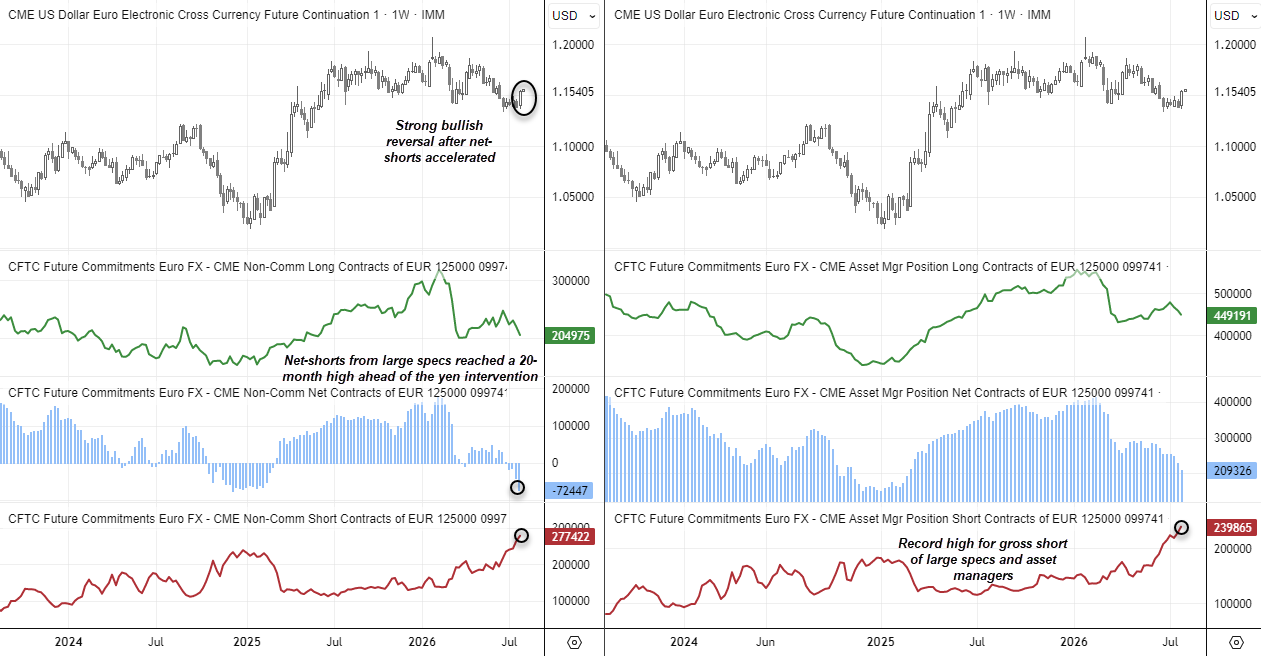 (Whether large speculators (left column) or asset managers (right column), short positions are extremely high, even reaching all-time highs. Given the overcrowding of short positions in the euro, the market has likely bottomed out or is experiencing a strong bullish reversal.) Last week, large speculators and asset managers continued to increase their euro short positions, with short bets reaching a new high. However, these short positions did not yield profits: the Fed's policy decision was more dovish than market expectations, and intervention triggered a dollar sell-off, causing the euro to rise sharply against the dollar that week. Net short positions in the euro reached 72,500 contracts, a 20-month high. Asset managers still hold 209,000 net long euro contracts, but their long positions have fallen to their lowest level since February 2025. The extent of the euro's rebound against the dollar largely depends on whether traders continue to trade two key factors: a dovish shift in Fed policy and Japanese intervention to support the yen. Buying the yen means selling the dollar; if the market continues to sell dollars on a large scale, the euro will indirectly benefit. COT data for the euro against the US dollar shows that speculative short positions hit a new high as asset managers reduced their euro long positions amid a price rebound. USD/JPY futures open interest...
 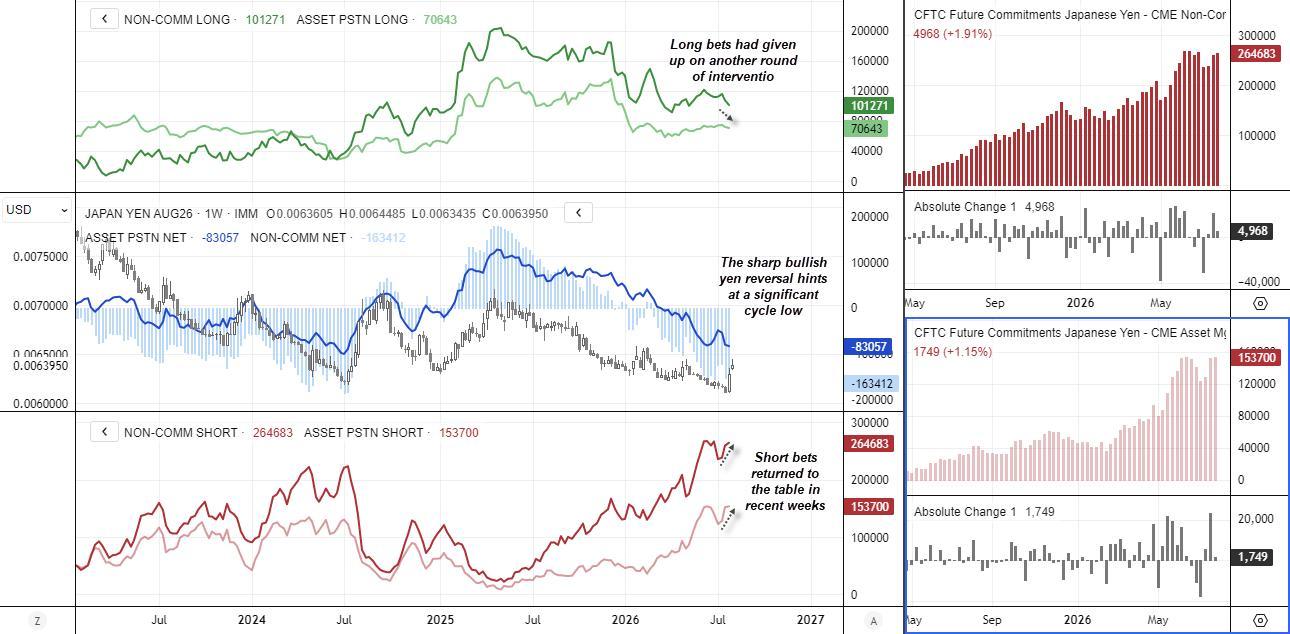 (The market is frantically shorting the yen. The red line in the lower left corner shows a surge in short positions. Non-commercial net positions are -163,412, a huge negative value, indicating that speculators are extremely bearish. In financial analysis, when everyone is bearish, it often means that the market is overcrowded and a short squeeze or trend reversal is imminent, meaning the yen may appreciate significantly.) Last week, large speculators and asset management institutions' naked short positions in the yen approached historical peaks. This clearly shows that futures traders were generally confident that Japan would not intervene in the market again. The Fed's interest rate meeting became the trigger, with the Japanese Ministry of Finance intervening on Thursday to push up the yen, and the US Treasury's statement on Friday further reinforcing this trend. Predictably, yen shorts suffered severe losses from a short squeeze. The yen closed with a strong bullish candle on the weekly chart and gapped up again today. After the US expressed support for Japanese intervention, I am more inclined to believe that the yen has likely found its cyclical low for this year. Yen COT data shows that before the joint US-Japan intervention triggered the yen's surge, speculative short positions were near historical highs.
This round of intervention by the Japanese Ministry of Finance was quite dramatic—most traders had almost assumed Japan wouldn't intervene. The key to the greater impact of this action lies in the explicit support Japan received from the United States. US Treasury Secretary Scott Bessant stated that the US might expand the Federal Reserve's repurchase facility to provide additional dollar liquidity, thus creating conditions for subsequent Japanese intervention. Objectively speaking, this statement carried even more weight than the intervention itself. Previous rounds of unilateral Japanese intervention this year had completely wiped out the yen's gains, but the US's willingness to cooperate with Japan reinforced the judgment that the yen has likely bottomed out. While not a second Plaza Accord, this is the strongest policy coordination signal released by the US and Japan regarding the yen in decades. Large Speculator Positions Large speculator COT position data: Dollar long positions are extremely crowded, yen and Canadian dollar short positions are heavy, and euro positions are roughly balanced. Dollar Index: Ahead of the Fed's interest rate meeting, net long positions in the dollar rose to $48.5 billion, a new 11-year high, less than $3 billion away from the historical record. Euro/Dollar: Large speculators' net short positions in the euro increased to 72,500 contracts, a 20-month high. GBP/Dollar: Asset management firms' net short positions in the pound expanded to 141,000 contracts, just 5,000 contracts away from the historical extreme. USD/JPY: On the eve of intervention by the Japanese Ministry of Finance, large speculators and asset management firms' naked short positions in the yen approached historical highs. USD/CHF: Large speculators' net short positions in the Swiss franc fell to an 8-week low. USD/CAD: Overall positions remained largely unchanged this week, but the net short position in the Canadian dollar remained in the extremely pessimistic range, with both the 3-month and 1-year historical percentiles at 0%. AUD/USD: Price movements and positions continued to diverge; the AUD/USD exchange rate rose for the fourth consecutive week, but large speculators' net short positions in the Australian dollar hit a new high for the year. US Dollar Index Futures Positions Futures traders continued to pour into long positions in the US dollar, with net long positions climbing to $48.5 billion, an 11-year high, less than $3 billion away from the historical record. For the past few weeks, I have consistently warned that market sentiment has reached an extreme, and last week's daily chart showed a bearish engulfing pattern, suggesting that a top may have formed for the US dollar. That said, the US dollar index is currently finding support near the 200-day exponential moving average and the January uptrend line. While there are signs of a shift in the medium- to long-term bullish bias, this support area may trigger a short-term rebound in the dollar before a resumption of the downtrend. COT data for the US dollar index shows that speculative net long positions have reached an 11-year high, and the dollar index is testing a key technical support level. (EUR/USD futures open interest...) (Whether large speculators (left column) or asset managers (right column), short positions are extremely high, even reaching all-time highs. Given the overcrowding of short positions in the euro, the market has likely bottomed out or is experiencing a strong bullish reversal.) Last week, large speculators and asset managers continued to increase their euro short positions, with short bets reaching a new high. However, these short positions did not yield profits: the Fed's policy decision was more dovish than market expectations, and intervention triggered a dollar sell-off, causing the euro to rise sharply against the dollar that week. Net short positions in the euro reached 72,500 contracts, a 20-month high. Asset managers still hold 209,000 net long euro contracts, but their long positions have fallen to their lowest level since February 2025. The extent of the euro's rebound against the dollar largely depends on whether traders continue to trade two key factors: a dovish shift in Fed policy and Japanese intervention to support the yen. Buying the yen means selling the dollar; if the market continues to sell dollars on a large scale, the euro will indirectly benefit. COT data for the euro against the US dollar shows that speculative short positions hit a new high as asset managers reduced their euro long positions amid a price rebound. USD/JPY futures open interest... (The market is frantically shorting the yen. The red line in the lower left corner shows a surge in short positions. Non-commercial net positions are -163,412, a huge negative value, indicating that speculators are extremely bearish. In financial analysis, when everyone is bearish, it often means that the market is overcrowded and a short squeeze or trend reversal is imminent, meaning the yen may appreciate significantly.) Last week, large speculators and asset management institutions' naked short positions in the yen approached historical peaks. This clearly shows that futures traders were generally confident that Japan would not intervene in the market again. The Fed's interest rate meeting became the trigger, with the Japanese Ministry of Finance intervening on Thursday to push up the yen, and the US Treasury's statement on Friday further reinforcing this trend. Predictably, yen shorts suffered severe losses from a short squeeze. The yen closed with a strong bullish candle on the weekly chart and gapped up again today. After the US expressed support for Japanese intervention, I am more inclined to believe that the yen has likely found its cyclical low for this year. Yen COT data shows that before the joint US-Japan intervention triggered the yen's surge, speculative short positions were near historical highs.
- Risk Warning and Disclaimer
- The market involves risk, and trading may not be suitable for all investors. This article is for reference only and does not constitute personal investment advice, nor does it take into account certain users’ specific investment objectives, financial situation, or other needs. Any investment decisions made based on this information are at your own risk.