Why are traders still cutting dollar premiums despite the Fed keeping rate hikes a possibility?
2026-08-03 19:28:51
On Monday, August 3, the US dollar index was trading around 99.80, with an intraday low of approximately 99.42, and had fallen by about 1% over the past month. New York Fed President John Williams recently stated that current interest rate policy remains "in a favorable position" and can push inflation back to 2%, but the Fed will take action if prices deviate from the target. This statement briefly boosted the dollar, but failed to reverse the index's weakness after falling below 100. The market's real focus was not on the repeated phrase "policy is in a favorable position," but rather on Williams' explicit reservation of the possibility of further tightening. On July 29, the Fed, with a vote of 9 to 3, maintained the target range for the federal funds rate at 3.50% to 3.75%, with three members advocating for a 25 basis point rate hike, reflecting a clear divergence within the policymakers regarding the sustainability of inflation. 
 The divergence between fundamentals and technicals is also noteworthy. The Fed's stance was tighter than expected, but the dollar index remains around 99.80, indicating that interest rate expectations are not the sole driver of current exchange rates. Easing tensions in the Middle East reduced safe-haven demand, while falling oil prices lowered inflation premiums and long-term Treasury yields. On August 3, the 10-year Treasury yield briefly fell to around 4.69%, preventing the dollar from gaining sustained support from Williams' speech. Future pricing will shift from official rhetoric to data validation. The July jobs report is scheduled for release on August 7, and the July consumer price index is scheduled for release on August 12. Employment resilience, core service prices, and the energy component will collectively determine the interest rate distribution before the September meeting.
Williams' message was not simply hawkish.
Williams' policy framework comprises two parallel logics. The first is the baseline scenario, where energy prices and previous cost shocks gradually cool, leading to a slow decline in inflation over the next few quarters. The second is risk management, meaning that as long as the downward path of inflation stalls, the Fed cannot rule out further interest rate adjustments. This expression cannot be simply categorized as an escalation of hawkishness. Williams supports keeping interest rates unchanged in July, while arguing that current policy is already restrictive, indicating that his preferred approach remains observation rather than an immediate rate hike. The truly tightening aspect lies in the fact that he did not provide the market with any expectations of rate cuts, nor did he endorse the fixed-rate path implied by the futures market. He emphasized that market pricing can provide information, but the Fed has no obligation to confirm market prices. This statement directly addresses the core contradiction in current interest rate trading. Policy expectations can influence financial conditions, but policymakers will not mechanically implement policies simply because the market has already priced in a certain outcome. The so-called 63% probability of a rate hike in September is essentially just a futures price mapping at a specific point in time, not a policy commitment. The implied probability has fluctuated significantly across different trading sessions recently, indicating that expectations remain highly dependent on energy, employment, and inflation data.A decline in inflation does not mean the pressure has been relieved.
The U.S. Consumer Price Index (CPI) fell 0.4% month-over-month in June, but still rose 3.5% year-over-year. The core CPI rose 2.6% year-over-year, a slowdown from the previous reading; meanwhile, energy prices rose 15.7% year-over-year, and gasoline prices rose 26.7% year-over-year. This means that overall inflation fluctuations are mainly driven by energy, while service prices and housing costs remain somewhat sticky. The personal consumption expenditure (PCE) price index, which the Fed focuses on more closely, rose 3.7% year-over-year in June, while the core index rose 3.3% year-over-year, both significantly above the 2% target. PCE grew 0.3% month-over-month in June, while personal income grew only 0.2%, indicating a weak but not strong pace of consumption expansion, though not weak enough to quickly suppress service inflation. Therefore, Williams' optimism is based on the premise that the energy shock will not recur and that cost transmission will gradually weaken. If the Middle East conflict continues to ease, falling oil prices will improve overall inflation readings, and market expectations for interest rate hikes may cool; if energy prices rise again, even if core inflation does not accelerate simultaneously, the Fed will need to guard against a resurgence of inflation expectations. The current policy function has shifted from simply observing core indicators to simultaneously assessing the duration of the energy shock and its secondary transmission.The US dollar index has entered a tug-of-war between policy interest rate differentials and safe-haven demand.
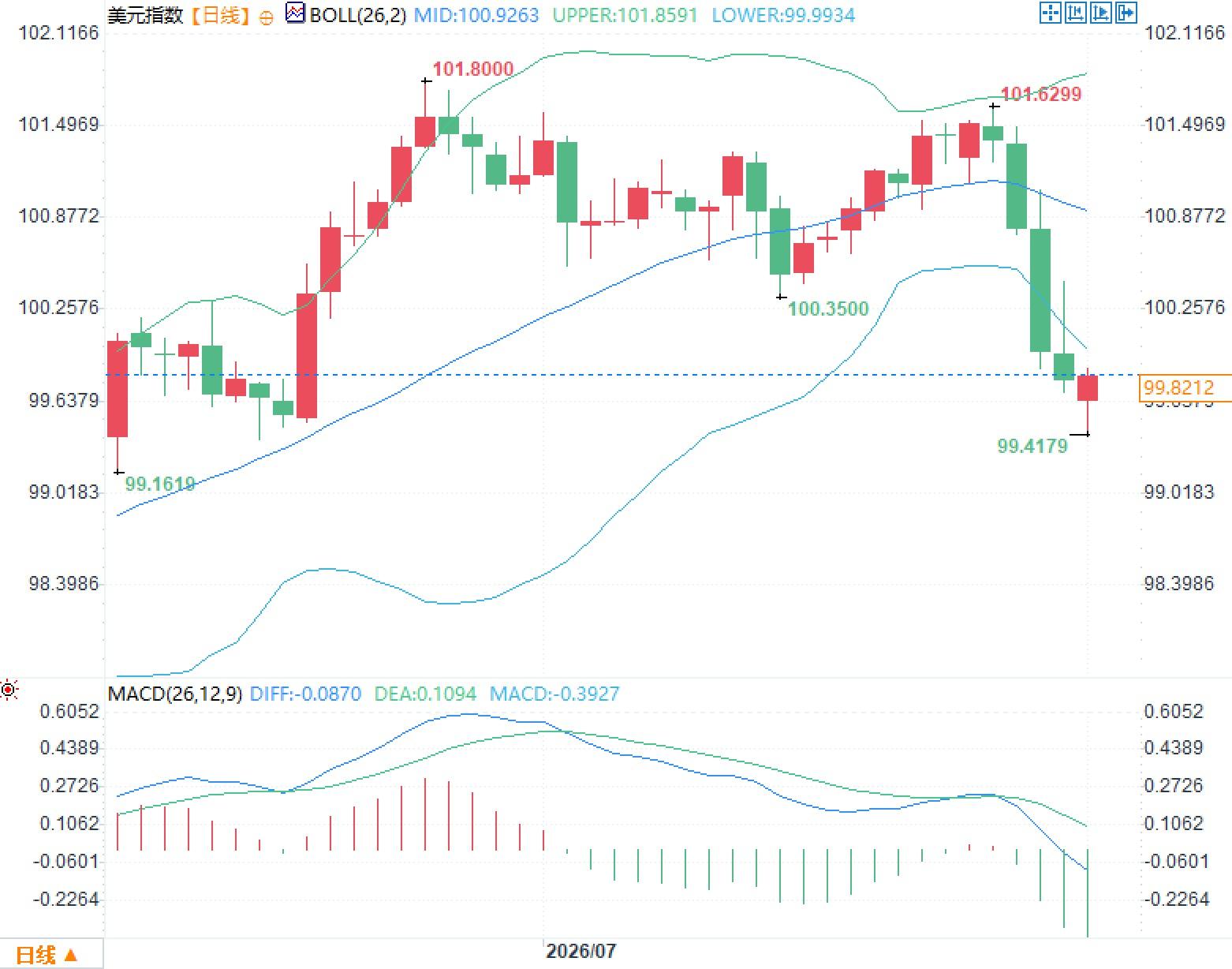
From the daily chart, the US dollar index is currently trading around 99.80, having broken below the lower Bollinger Band at 99.9934. The middle Bollinger Band is at 100.9263, and the upper Bollinger Band is at 101.8591. The index previously fell rapidly from 101.6299, reaching a low of 99.4179, indicating heavy selling pressure around 101.50. The psychological level of 100 has also transformed from short-term support into technical resistance. The divergence between fundamentals and technicals is also noteworthy. The Fed's stance was tighter than expected, but the dollar index remains around 99.80, indicating that interest rate expectations are not the sole driver of current exchange rates. Easing tensions in the Middle East reduced safe-haven demand, while falling oil prices lowered inflation premiums and long-term Treasury yields. On August 3, the 10-year Treasury yield briefly fell to around 4.69%, preventing the dollar from gaining sustained support from Williams' speech. Future pricing will shift from official rhetoric to data validation. The July jobs report is scheduled for release on August 7, and the July consumer price index is scheduled for release on August 12. Employment resilience, core service prices, and the energy component will collectively determine the interest rate distribution before the September meeting.
- Risk Warning and Disclaimer
- The market involves risk, and trading may not be suitable for all investors. This article is for reference only and does not constitute personal investment advice, nor does it take into account certain users’ specific investment objectives, financial situation, or other needs. Any investment decisions made based on this information are at your own risk.